
Where Global Capital Still Incorporates with Confidence
Despite endless headlines about “crackdowns,” offshore corporations are not disappearing. They are consolidating into fewer, stronger jurisdictions—places with legal certainty, respected courts, treaty access, and regulators that understand international business.
In 2026, offshore incorporation is no longer about secrecy. It is about jurisdictional arbitrage: choosing the right legal domicile for capital efficiency, asset protection, banking access, and global credibility.
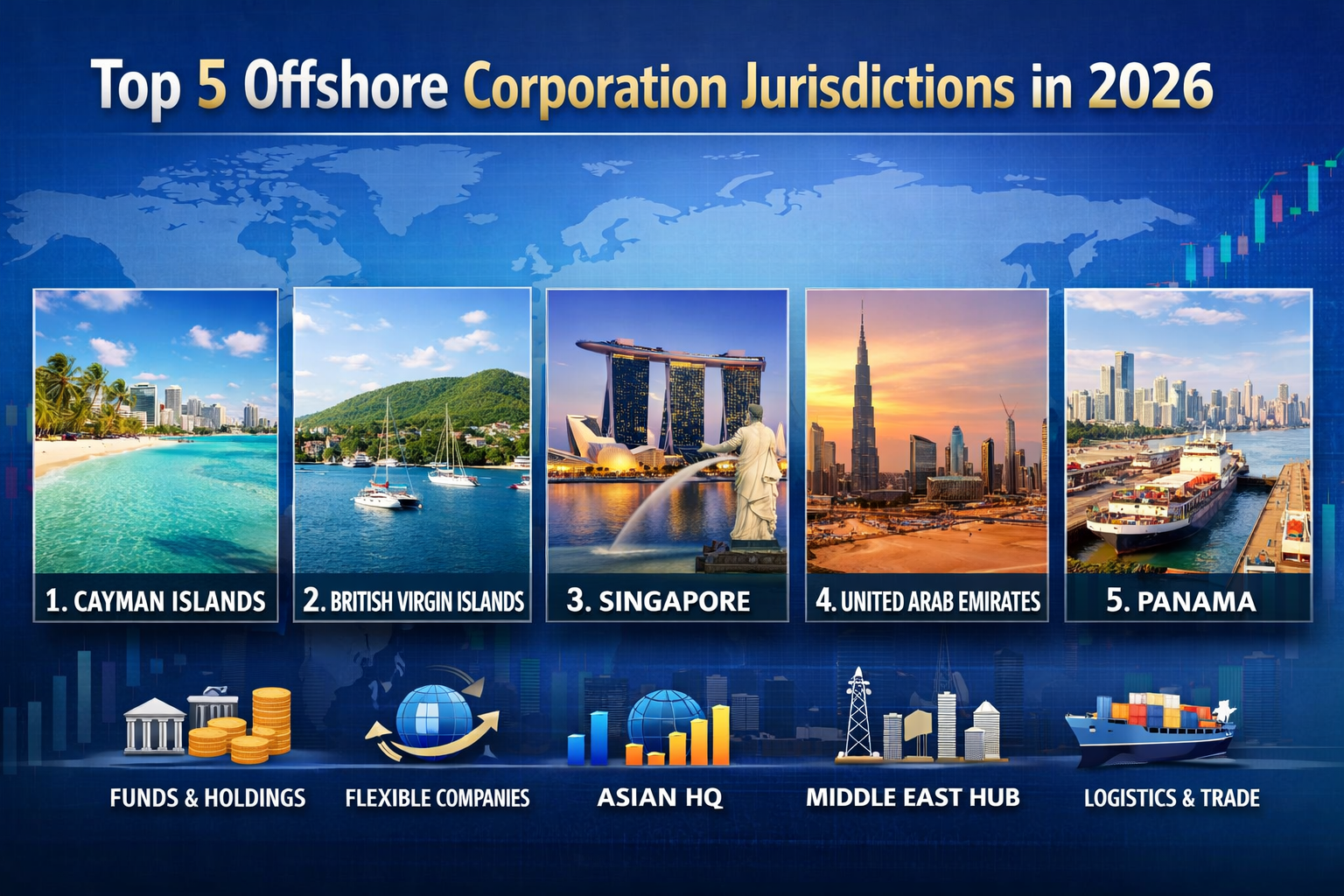
Here are the top five offshore corporation jurisdictions serious international investors continue to use.
1. Cayman Islands — The Gold Standard for Funds & Holding Companies
The Cayman Islands remain the undisputed heavyweight of offshore corporate structuring.
Why Cayman still dominates:
- Zero corporate, capital gains, or withholding taxes
- English common law with Privy Council final appeal
- Gold-standard jurisdiction for hedge funds, PE funds, SPVs, and structured finance
- Accepted by every major global bank and institutional counterparty
- Home to thousands of investment funds and securitization vehicles
Cayman is not “cheap,” but it is bulletproof. For funds, family offices, and institutional capital, Cayman is still the first choice.
Best for:
Investment funds, SPVs, structured finance, holding companies, institutional deals.
2. British Virgin Islands (BVI) — The World’s Most Flexible Offshore Company
If Cayman is the boardroom, BVI is the engine room of offshore business.
Why BVI remains essential:
- Fast, inexpensive incorporations
- Extremely flexible corporate law
- No corporate tax on offshore income
- Globally recognized legal framework
- Ideal for operating companies, IP holding, and joint ventures
BVI companies appear in everything from Asian trade deals to African infrastructure projects to crypto custody structures.
Best for:
Trading companies, joint ventures, IP holding, private operating entities.
3. Singapore — The “Onshore-Offshore” Powerhouse
Singapore is not a tax haven in the old sense—but it is one of the most strategically powerful corporate domiciles in the world.
Why Singapore dominates Asia:
- Low effective corporate tax with exemptions
- Extensive double-tax treaty network
- AAA-rated jurisdiction with world-class banks
- Strong rule of law and regulatory clarity
- Preferred by global banks and institutional investors
Singapore is where offshore meets credibility. It is often used as the top holding company above classic offshore subsidiaries.
Best for:
Holding companies, Asian operations, fintech, family offices, global headquarters.
4. United Arab Emirates (UAE) — The New Capital Magnet
The UAE has become one of the fastest-growing offshore incorporation hubs on Earth.
Why capital is flooding into the UAE:
- Zero personal tax and low corporate tax (with exemptions)
- World-class free zones (DIFC, ADGM, DMCC)
- Strong banking access for international clients
- Crypto-friendly and trade-friendly regulations
- Strategic gateway between Europe, Africa, and Asia
For cash-intensive businesses, commodities, crypto, and international trade, the UAE has become non-optional.
Best for:
Commodity trading, crypto, fintech, logistics, Middle East & Africa operations.
5. Panama — The Quiet Comeback Jurisdiction
Panama never disappeared—it simply went quiet.
Why Panama still matters:
- Territorial tax system (foreign income untaxed)
- Mature corporate law with bearer-share reforms completed
- Strategic control of the Panama Canal
- Strong logistics and trade infrastructure
- Increasingly compliant but still flexible
Panama works best when paired with proper compliance and banking discipline. When structured correctly, it remains a powerful jurisdiction for international business.
Best for:
Trading companies, logistics, shipping, Latin American operations.
Choosing the Right Offshore Jurisdiction Is Strategic, Not Cosmetic
The biggest mistake investors make is asking:
“Which jurisdiction has the lowest tax?”
The right question is:
“Which jurisdiction matches my capital flow, banking needs, counterparties, and long-term strategy?”
Modern offshore structuring is about:
- Banking survivability
- Regulatory durability
- Asset protection
- Jurisdictional reputation
- Exit and succession planning
Final Thoughts
Offshore corporations are not about hiding.
They are about positioning.
The jurisdictions above remain dominant because they offer legal certainty, global acceptance, and financial infrastructure—not loopholes.
At Invest Offshore, we advise clients on jurisdiction-first structuring, ensuring that corporations, banks, and counterparties all align before capital moves.
In a world of rising regulation and monetary instability, where you incorporate matters more than ever.
Leave a Reply