
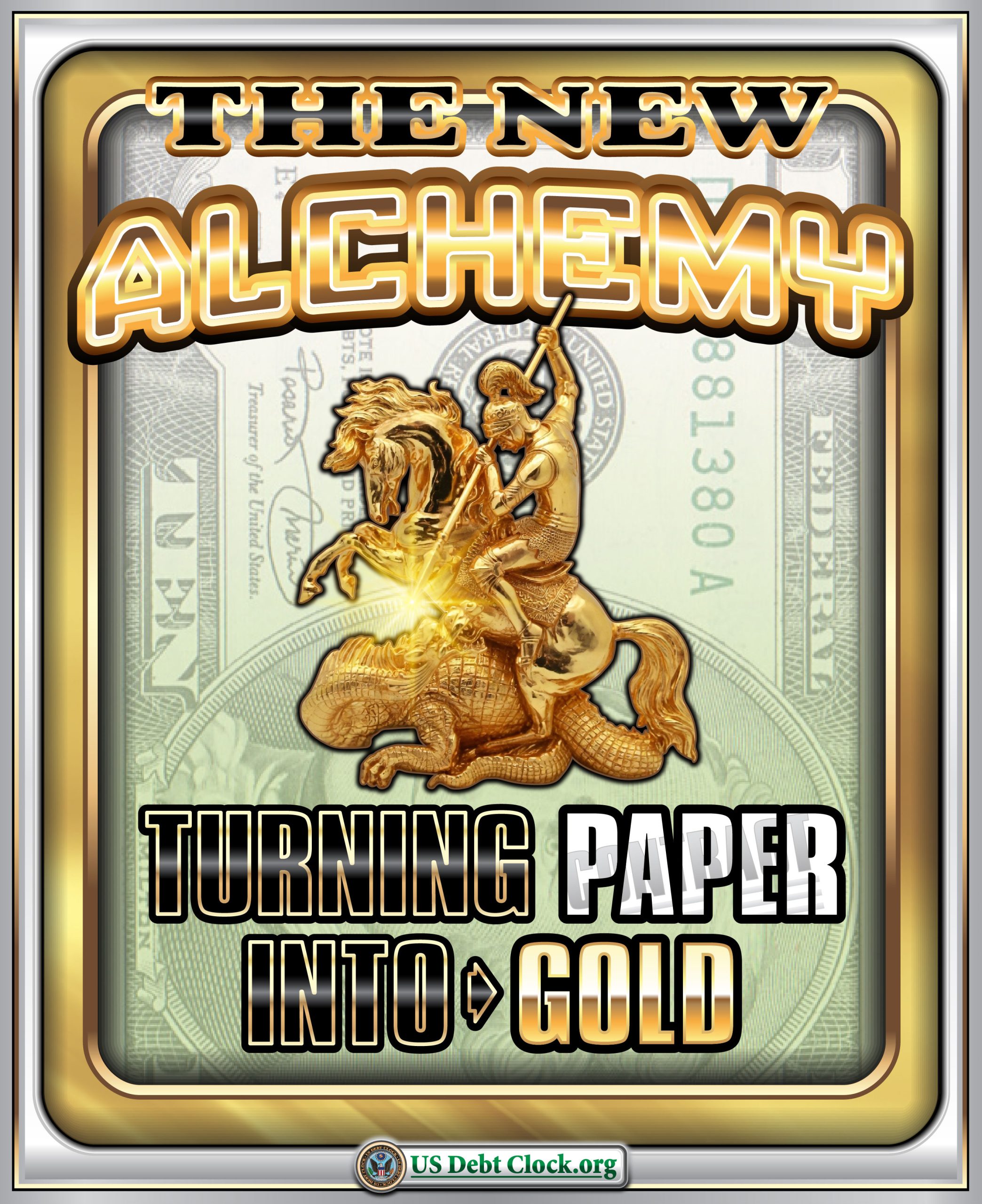
The March 22, 2026 US Debt Clock poster is one of the most direct metaphors in the entire series. In giant letters it declares “THE NEW ALCHEMY” and then spells out the punchline across the bottom:
“TURNING PAPER INTO GOLD.”
At the center is a golden knight on horseback driving a spear into a dragon—classic imagery of conquest, purification, and victory over something monstrous. Behind it all sits the faint texture of U.S. currency, as if the dollar itself is the battlefield.
This isn’t a subtle design. It’s a thesis statement: the old system turns value into paper, and the new system turns paper back into value. That’s the New Money Revolution in one sentence.
What the poster is really saying
Historically, “alchemy” was the dream of turning base metals into gold. In modern finance, the “alchemy” has been the ability to turn debt into money—through credit creation, leverage, and financial engineering. In that sense, today’s world already runs on a kind of monetary alchemy:
- a loan becomes a deposit,
- deposits circulate as money,
- debt expands,
- and the system grows.
The poster argues we’re reaching the end of that road—and that the next era flips the process:
not “make more paper claims,” but “reconnect claims to real assets.”
That’s why the background is a banknote and the foreground is a gold conquest scene: it’s depicting the victory of hard value over paper illusion.
The knight and the dragon: a symbol of what gets defeated
In this poster’s vocabulary, the “dragon” represents the forces that keep paper dominant:
- runaway debt expansion
- currency dilution
- opaque intermediaries
- “too big to fail” leverage
- and the quiet transfer of purchasing power from savers to issuers
The golden knight represents the opposite:
- constraint
- discipline
- redemption
- auditability
- and a return to measurable value
It’s basically saying: the monster is not a country or a person—it’s the mechanism.
How “paper becomes gold” without literal magic
The New Money Revolution doesn’t require physically redeeming every note for bullion. “Turning paper into gold” can happen through several real-world pathways:
1) Repricing scarce assets upward
If confidence in fiat weakens—or if money supply grows faster than real output—scarce assets often reprice to reflect that dilution. Gold becomes the scoreboard.
In this view, the “alchemy” is not manufacturing gold, but revealing the true price of gold when paper claims are questioned.
2) Treasury or sovereign re-anchoring
The poster series repeatedly hints at Treasury-led instruments, “reserve” language, and “redeemable assets.” If a sovereign system begins using gold or commodities as a reserve anchor—directly or indirectly—then paper starts behaving more like a receipt.
That’s the psychological flip the poster is selling: money that is backed, not merely believed.
3) Tokenization and auditability
A modern “paper-to-gold” bridge can also be digital: tokenized gold, vaulted gold units, and settlement rails that allow real-time verification of reserves.
Even for skeptical readers, this is one place the story becomes technically plausible: transparency tools can reduce the gap between “claims” and “assets.”
Why this poster resonates right now
Because people feel the difference between:
- owning a promise
and - owning an asset
They also feel how fast the world is changing:
- AI is compressing time
- geopolitics is fragmenting trade
- debt loads are historic
- and trust is the scarce resource
In that environment, gold isn’t just a metal—it’s a language. It communicates permanence, neutrality, and independence from policy mood swings.
So when the poster says “The New Alchemy,” it’s really saying:
The next era is about restoring trust through tangible value.
The New Money Revolution, summed up
Across the US Debt Clock poster series, the New Money Revolution has three recurring ideas:
- The old system is extraction through debt
- The new system is participation through assets
- The transition is a narrative shift first, then a mechanism shift
This March 22 poster is the “mythic” version of the argument: the hero defeats the monster and restores the gold.
Whether you see that as prophecy, metaphor, or marketing, it reflects a growing mainstream intuition:
paper alone is no longer enough.
What investors can take from it
If you believe the world is heading toward more asset-linkage—even partially—then the strategy is timeless:
- own scarce, essential assets
- favor jurisdictions and structures built for transparency
- and assume monetary rules can change faster than most people expect
Because in every era of monetary transition, the winners are rarely the loudest.
They are the ones already holding what the next system will value.
Invest Offshore continues to track real-asset opportunities globally, including investment opportunities in West Africa seeking investors for the Copperbelt Region, plus verified gold for sale through our network and partners worldwide, and select mining concessions with documented title, geology, and clear pathways to production.
Leave a Reply