
Every market has a moment when urgency replaces patience.
In the world of USD cash pallets, that moment may be arriving now.
Over the past several weeks, Invest Offshore has received a noticeable increase in communications from private placement program operators, intermediaries, and platform-connected advisors. One recent message stood out—not because it was louder than the rest, but because it captured the full intensity of what is quickly becoming a “now or never” narrative.
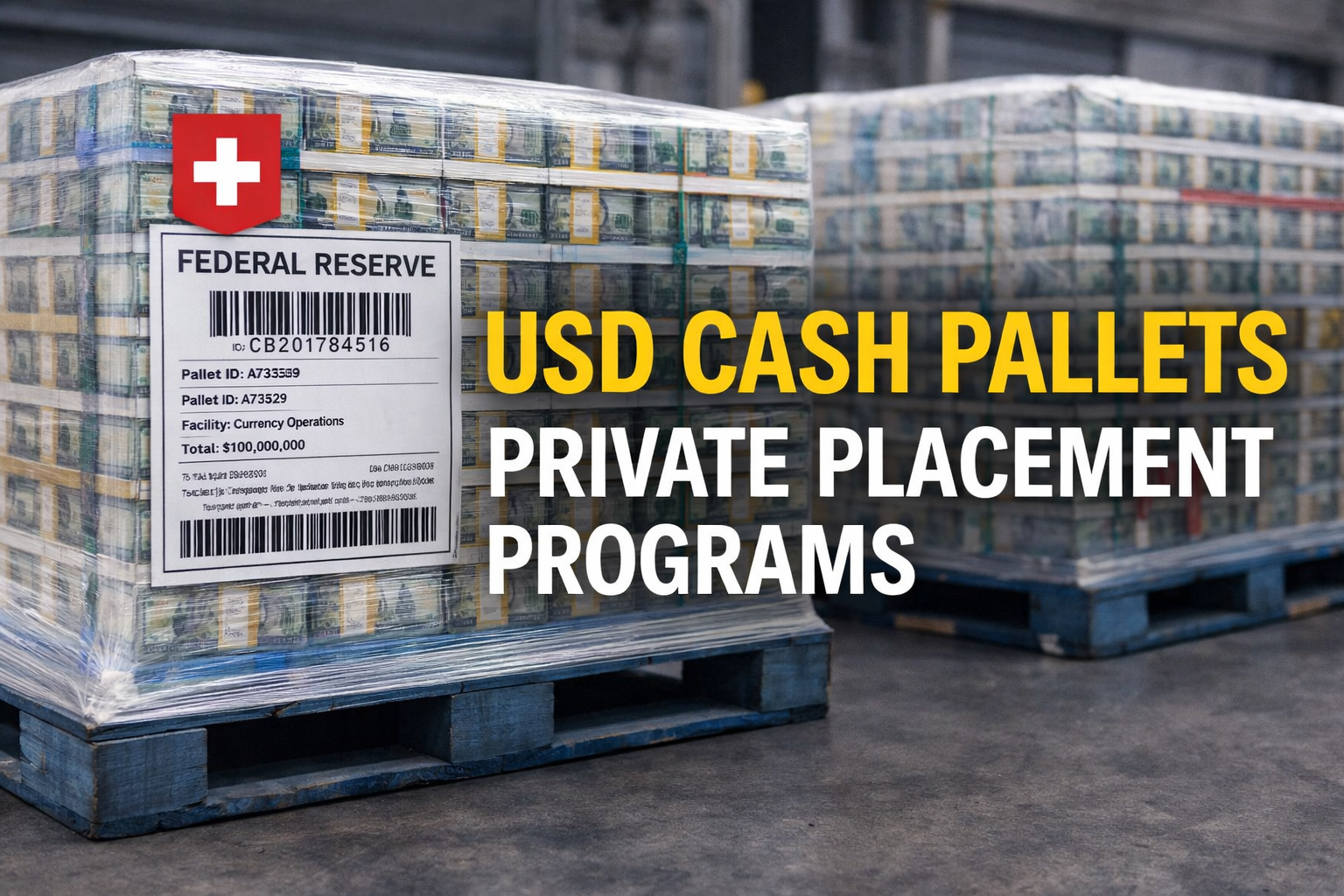
The message came from an agent claiming direct access to a private placement platform—one capable of putting USD cash pallets “into trade.” According to the advisor, a client already holding pallets is proceeding through the platform, with each pallet being reconstituted to a $100 million denomination, complete with FED chip insertion.
That alone tells you everything about where this market is heading: standardization, digitization, and platform integration.
But the real story lies beneath the surface.
From Storage to “Tradeable Instrument”
Traditionally, cash pallets—whether real, rumored, or misunderstood—have existed in a gray zone between physical custody and financial mythology.
This new wave of messaging reframes them entirely.
Not as stored cash.
But as tradeable financial instruments.
The structure described is familiar to anyone who has spent time around private placement programs:
- Pallets are held in a bank vault
- A Safe Keeping Receipt (SKR) is issued
- The platform requires the holding bank to assume full responsibility
- Confirmation is transmitted via SWIFT MT760
- Platform reviews documentation: CIS, QR codes, SKR, Trade Agreement
- If accepted, funding is claimed to be near-immediate
The key distinction here is critical: an SKR alone is not enough.
The message explicitly states that the SKR must be validated by the bank itself through SWIFT. This aligns, at least structurally, with how real institutional instruments are handled—where bank-to-bank confirmation carries more weight than any standalone document.
In other words, paper is meaningless without the bank standing behind it.
The Promise: Extraordinary Returns
The numbers presented are, as always, attention-grabbing:
- 25% per trade cycle
- Up to 100% per month
- 40-week trade duration
- Cash-based structure (no LTV)
These figures fall squarely into the territory often associated with high-yield trading programs (HYIPs) or so-called private placement platforms.
And this is where experienced investors pause.
Because in legitimate institutional finance, returns are typically constrained by risk, liquidity, and regulatory oversight. When returns accelerate beyond those boundaries, the burden of proof rises exponentially.
That does not automatically invalidate the opportunity—but it does demand a higher level of scrutiny.
Switzerland, SKRs, and the “One Shot” Narrative
The message reinforces a theme we are seeing repeatedly: Switzerland as the preferred jurisdiction.
That makes sense. Swiss banking still carries a reputation for discretion, stability, and vault-grade custody infrastructure. For anyone attempting to legitimize a high-value asset process, Switzerland provides a credible backdrop.
But the more interesting element is psychological.
“The client has one shot and this is it.”
This is classic pressure framing.
It creates urgency. It compresses timelines. It discourages due diligence.
And yet, in parallel, the same message emphasizes:
- Bank verification
- Platform intake procedures
- Direct treasury connections
- Face-to-face engagement
This contradiction is worth noting.
Real institutional processes move deliberately. They require layers of compliance, verification, and legal structuring. They do not rely on urgency alone.
The Most Explosive Claim: “Off-System Cash Will Be Worthless”
Perhaps the most striking statement in the message is this:
“In a few months ALL pallet cash, not in the system (FED), will be worthless.”
No official policy from the Federal Reserve, U.S. Treasury, or major central banks currently supports such a claim.
But as a narrative device, it is powerful.
It taps into broader themes already circulating in global finance:
- Increasing digitization of money
- Central bank oversight expansion
- Anti-money laundering tightening
- The gradual disappearance of unverified liquidity
Whether or not the claim is accurate, it reflects a growing belief among certain market participants: that undocumented or “off-ledger” assets may face increasing friction—or outright exclusion—from the financial system.
And that belief alone is enough to drive behavior.
What This Really Signals
Strip away the claims, the returns, and the urgency, and what remains is a clear trend:
The market—real or perceived—is attempting to move from chaos to structure.
From:
- Intermediary chains
- Unverified claims
- Informal introductions
To:
- Bank-backed verification
- Platform-based processing
- Direct principal engagement
That transition, if real, would be significant.
Because markets do not mature through promises.
They mature through process.
Final Thought: Opportunity or Illusion?
There is no shortage of bold claims in the cash pallet world.
There never has been.
But what is different now is the convergence of narrative:
- Switzerland as a hub
- Bank-backed SKRs
- SWIFT confirmations
- Platform intake structures
- Urgency tied to systemic change
When multiple independent messages begin to sound the same, it is worth paying attention—not necessarily to believe, but to observe.
Because even if only a fraction of it proves real, the implications would be substantial.
And if it proves otherwise, then the lesson is just as valuable:
In high finance, the difference between access and illusion is always measured in one thing—Verification.
Leave a Reply