
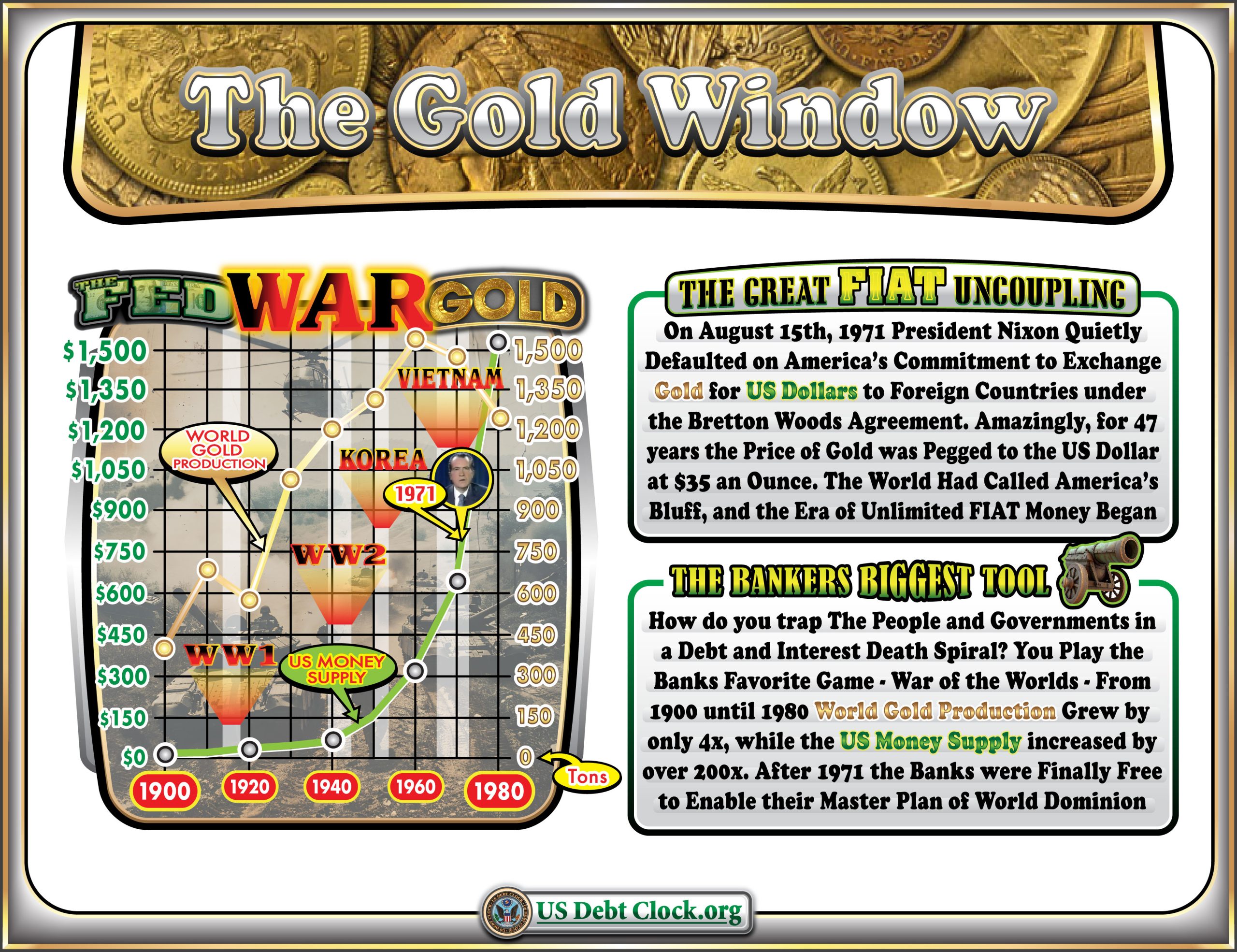
The new March 20, 2026 US Debt Clock poster is titled “The Gold Window.” It’s a direct callback to the pivotal moment modern money was unchained: August 15, 1971, when the United States suspended gold convertibility for foreign governments under Bretton Woods—what most people shorthand as “closing the gold window.”
The poster’s thesis is blunt: once the dollar was no longer redeemable for gold, fiat could expand without the old constraint, and the world entered an era where money supply could grow far faster than real production of scarce assets like gold.
That single shift is presented here as the origin story of the New Money Revolution—the idea that the next monetary era will be defined by re-linking money to something real, verifiable, and scarce.
What the image is showing at a glance
The left side is a stylized chart labeled with big words and bigger emotions: “The Fed,” “War,” “Gold,” and a timeline from 1900 to 1980 with war markers (WWI, WWII, Korea, Vietnam). Two curves are the heart of the image:
- World gold production (shown growing steadily but slowly)
- U.S. money supply (shown growing modestly early, then accelerating sharply—especially after 1971)
The right side contains two bold text blocks:
- “The Great Fiat Uncoupling” — stating that Nixon’s 1971 decision ended the dollar’s gold redemption and began the era of unlimited fiat.
- “The Bankers Biggest Tool” — arguing that debt, interest, and war were used to trap nations in a spiral once money could be expanded without a hard anchor.
The graphic is making a moral argument as much as an economic one: remove discipline from money, and power concentrates.
Why 1971 is the hinge point (even outside the poster’s rhetoric)
Even without the dramatic framing, 1971 is widely understood as a major regime change in global monetary history:
- Bretton Woods linked the dollar to gold at a fixed rate for official foreign convertibility.
- Once that link was severed, the world drifted toward floating exchange rates and a fully fiat era.
- In fiat systems, money supply and credit can expand far more flexibly—good for crisis management, but also prone to debt build-up and asset inflation.
This is why the “Gold Window” is so symbolic: it represents the moment money stopped being a receipt and became a policy instrument.
The poster’s deeper claim: wars + money printing became a feedback loop
Notice how the war labels (WWI, WWII, Korea, Vietnam) are placed like “boost points” on the chart. The message is:
- War spending rises
- Financing pressure increases
- Debt and money issuance expand
- The currency’s anchor weakens
- The system becomes more dependent on credit growth
That’s not a conspiracy requirement—it’s a structural temptation in any system where governments can finance large commitments through debt issuance supported by monetary expansion.
The poster is saying the old gold constraint wasn’t just about gold.
It was about stopping the feedback loop from running forever.
So what is the “New Money Revolution” in this context?
In the US Debt Clock poster universe, the New Money Revolution is the reversal of the 1971 logic:
- From: money backed by confidence alone
- To: money tied to assets and transparent limits
- From: debt expansion as the engine
- To: reserves, redemption language, and “dividend” narratives
- From: centralized control via credit
- To: broader participation in productive wealth
That’s why so many recent posters have used phrases like:
- “asset-backed dollar”
- “100% reserve”
- “dividend dollar”
- “redeemable assets”
- “banking transformed”
They’re all variations on one theme:
the next system must restore trust by restoring constraint.
Why gold keeps returning to center stage
Gold is the perfect symbol for this story because it is:
- scarce
- globally recognized
- politically neutral (no single nation can print it)
- a long-term measure of monetary discipline
Whether or not a future system is literally gold-convertible, gold remains the benchmark that exposes excess. When fiat expands faster than real output, gold tends to re-price as the measuring stick.
That’s why the poster calls it “The Gold Window.” It’s not only about the past.
It’s saying:
the window is opening again—this time for re-anchoring.
The takeaway for investors: history is a compass, not a script
This poster is persuasive because it points to a real pattern: when money expands faster than scarce assets, scarce assets eventually matter more.
But the “New Money Revolution” doesn’t require a single dramatic flip. It can arrive through:
- commodity-backed settlement in trade corridors
- asset-linked sovereign instruments
- gold and critical minerals repricing in reserves
- parallel rails (tokenized assets, stablecoins, alternative payment networks)
- and gradual public demand for limits, transparency, and fairness
However it arrives, the “Gold Window” idea is a reminder that monetary regimes change, and when they do, the people positioned in real assets tend to sleep better.
Invest Offshore continues to track real-asset opportunities globally, including investment opportunities in West Africa seeking investors for the Copperbelt Region, plus verified gold for sale through our network and partners worldwide, and select mining concessions with documented title, geology, and clear pathways to production.
Leave a Reply