
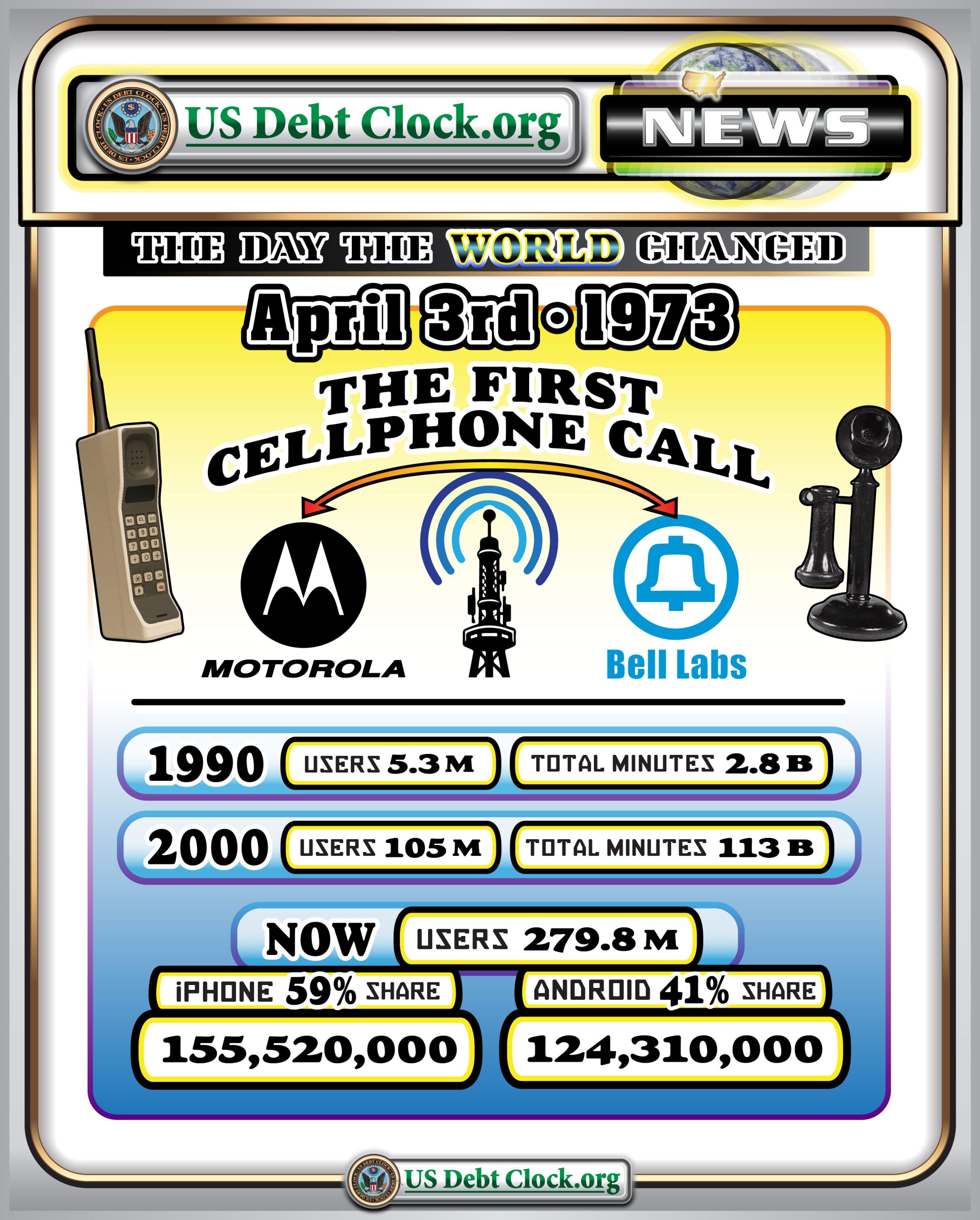
The March 16, 2026 US Debt Clock “NEWS” poster is a reminder that the biggest wealth waves often begin with a single, almost ordinary moment.
Across the top it declares: “THE DAY THE WORLD CHANGED.”
Then it pins the spark to a precise milestone:
April 3rd, 1973 — The First Cellphone Call
The graphic places a brick-style early handset on one side and an old-school desk telephone on the other—then connects the moment to the logos of Motorola and Bell Labs, like bookends on a new era. Beneath that, it tracks adoption: early user counts, exploding call minutes, and today’s smartphone ecosystem split between iPhone and Android.
Whether the exact “now” numbers on the poster are perfect or not, the bigger story is undeniable:
The cellphone didn’t just change communication. It manufactured wealth.
One invention, a hundred industries
The mobile phone is one of those rare inventions that didn’t create just a product category—it created an entire economic layer on top of daily life.
Think of everything the cellphone enabled:
- mobile networks and towers
- semiconductor demand at unimaginable scale
- miniaturized computing and sensors
- app stores and subscription economics
- mobile advertising and social platforms
- GPS navigation, ride-sharing, food delivery
- mobile banking, QR payments, crypto wallets
- creator economies and influencer-led commerce
The phone became the remote control for modern civilization—and the toll roads to that civilization became some of the most profitable businesses in history.
The wealth engine: compounding platforms, not one-time sales
The real wealth created by mobile wasn’t just in selling handsets. It came from platform compounding:
- Hardware cycle (new models, upgrades, accessory ecosystems)
- Network cycle (carrier contracts, spectrum value, infrastructure buildout)
- Software cycle (apps, recurring revenue, data, payments)
- Advertising cycle (attention converted into cash at planetary scale)
That’s why the poster’s framing—“the day the world changed”—hits so hard. It’s pointing to the moment when communication became a scalable platform business, and once you have platforms, you have compounding wealth.
How Motorola and Bell Labs led the first wave
The poster highlights Motorola and Bell Labs because they symbolize the two essential ingredients:
- Motorola: the commercialization drive—turning breakthrough engineering into products people can hold.
- Bell Labs: the deep R&D engine—generating foundational telecom innovations that ripple for decades.
And then, as always in America, the first wave didn’t stay the first wave.
The wealth creation expanded outward into entire markets: chipmakers, handset manufacturers, carriers, network equipment, software platforms, and the companies that learned to monetize mobile attention.
Millions of millionaires—by design, not by accident
When a technology becomes infrastructure, it doesn’t just make a few founders rich. It creates layers of opportunity:
- early employees with equity
- engineers and specialists riding the demand curve
- investors who held the winners for years
- entrepreneurs building apps, services, accessories, logistics, media
- real estate and supply chain businesses that followed the growth
Mobile created fortunes not because people “got lucky,” but because the economic pattern was clear:
Mass adoption + network effects + recurring revenue = long-duration wealth.
And it’s still growing—because the next phase isn’t “more phones.” It’s phones becoming the wallet, the ID, the medical device, the work terminal, the AI assistant, and the key to every service.
The next wealth wave: mobile + AI
If the first era was “everyone gets a phone,” the next is “every phone gets an AI.”
That will create new winners in:
- AI chips and edge computing
- privacy-preserving identity and credentials
- on-device assistants and agent-based commerce
- payments, settlement, and tokenized assets
- cybersecurity and anti-fraud infrastructure
Mobile already made millions of millionaires. AI-on-mobile will do it again—because it increases productivity, reduces friction, and creates new marketplaces at the speed of software.
The point of the poster
This isn’t nostalgia. It’s a lesson:
One invention can rearrange the entire wealth map.
The day the first cellphone call was made, nobody saw the full blast radius—smartphones, app empires, trillion-dollar companies, global mobile banking, and a culture that lives in its pocket.
But the wealth came anyway, because the technology became indispensable.
That’s what “The Day the World Changed” is really saying:
When a tool becomes infrastructure, the people who build it—and the people who own pieces of what’s built—get very, very wealthy.
Invest Offshore continues to track real-asset opportunities globally, including investment opportunities in West Africa seeking investors for the Copperbelt Region, plus verified gold for sale through our network and partners worldwide, and select mining concessions with documented title, geology, and clear pathways to production.
Leave a Reply