
April 5 is not just another date on the Bitcoin calendar. For many in the crypto world, it is the symbolic birthday of Satoshi Nakamoto, whose old P2P Foundation profile listed a birthdate of April 5, 1975. There is no proof that this was Satoshi’s real birthday, but few serious Bitcoin observers believe it was chosen at random. The date points straight at one of the most important monetary events in modern American history. (BitMarkets)
On April 5, 1933, President Franklin D. Roosevelt signed Executive Order 6102, which prohibited the hoarding of gold coin, gold bullion, and gold certificates in the continental United States. Americans were required to deliver much of their gold to the banking system by May 1, 1933, in exchange for paper currency. In plain English, Washington centralized monetary power by forcing citizens out of hard money and deeper into a state-managed system. (The American Presidency Project)
That is why the date April 5 carries such weight. If Satoshi deliberately chose April 5, 1975, the gesture appears almost too elegant to ignore: April 5 marks the day private gold ownership was attacked, and 1975 points to the year Americans regained the legal right to own gold again after the 1974 repeal took effect. Whether literal or symbolic, the message is powerful. Bitcoin was designed as a form of money that cannot be confiscated by decree in the same way physical gold once was. (U.S. Mint)
That is the deeper reason April 5 matters to Bitcoin. It is a date that ties together gold confiscation, monetary sovereignty, and the birth of a digital bearer asset built to live outside the reach of central planners. Gold had to be stored, moved, verified, and physically surrendered. Bitcoin, by contrast, can be self-custodied globally, transferred without a central bank, and secured by math rather than by permission. In that sense, Bitcoin is not merely a speculative instrument. It is a direct challenge to the old monopoly model of money. (The American Presidency Project)

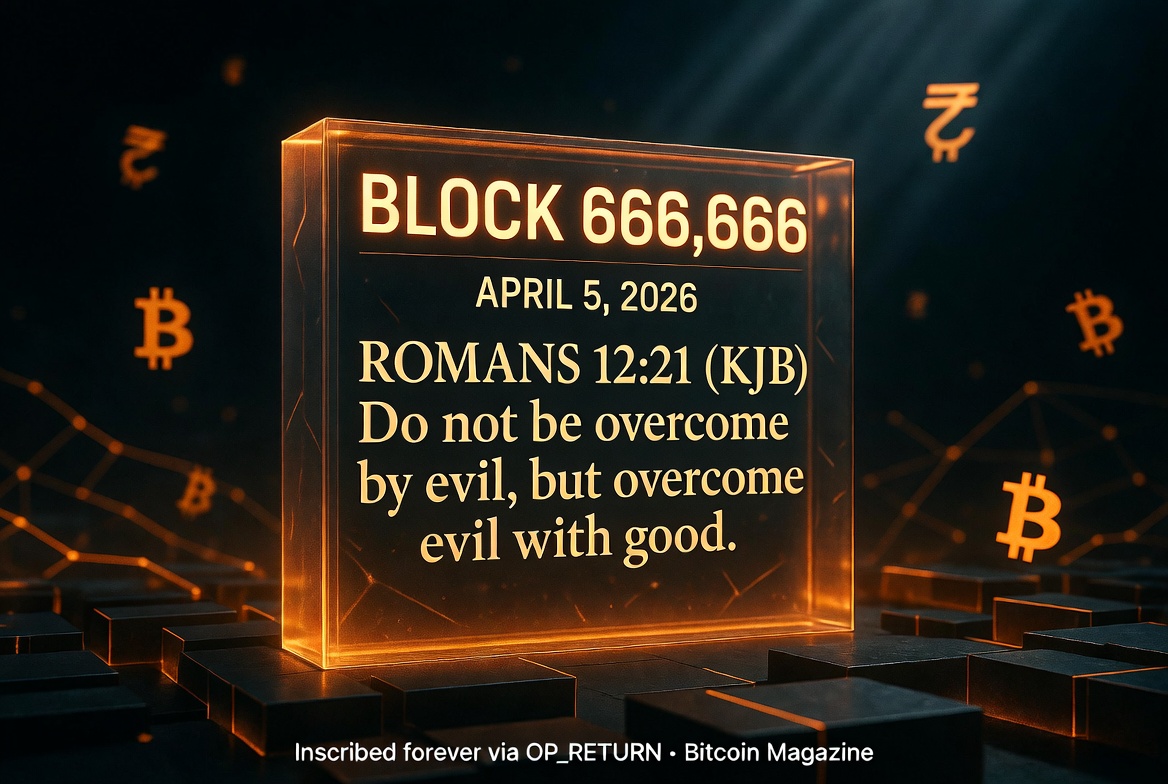
That symbolism became even more interesting again today, April 5, 2026, as the crypto community revisited one of Bitcoin’s most talked-about blocks: block 666,666. One detail is worth getting right. The block itself was not mined today. It was mined on January 18, 2021 by BTC.com. What resurfaced today was renewed attention to what was permanently embedded inside it. (Blockchain)
According to Blockchain.com’s block explorer, block 666,666 contains OP_RETURN data referencing Romans 12:21 and the line, “Do not be overcome by evil, but overcome evil with good.” OP_RETURN is the part of Bitcoin script used to embed small amounts of arbitrary data into a transaction, making that data part of the permanent historical record of the chain. The result is a strange and unforgettable juxtaposition: the most infamous number in biblical symbolism paired with a verse about resisting evil through goodness. (Blockchain)
That matters because Bitcoin is often described only in terms of price, volatility, ETFs, or regulation. But Bitcoin has always also been a narrative machine. From the Genesis Block headline about bank bailouts to inscriptions like the one in block 666,666, the network preserves not just value, but memory. It records moments, symbols, warnings, and statements in a way that no central archive can quietly revise later. (Blockchain)
Seen through that lens, April 5 feels almost perfect for Bitcoin. It ties the memory of gold confiscation to the creation myth of digital hard money. It reminds the market that Satoshi’s project was not simply about faster payments or clever code. It was about building an exit from centralized monetary coercion. And now, on this same symbolic date, the community is again staring at a message immutably lodged inside Bitcoin’s ledger: do not be overcome by evil, but overcome evil with good. (The American Presidency Project)
For Invest Offshore readers, that is the real takeaway. Bitcoin’s story was never only about technology. It is about sovereignty, memory, and the long global search for money beyond the arbitrary reach of the state. In a world still wrestling with inflation, debt, confiscation risk, and monetary experimentation, April 5 is a reminder that the battle over who controls money is far from over. And as always, Invest Offshore continues to track the rise of hard assets, offshore strategies, and investment opportunities in West Africa, including the Copperbelt Region, for readers seeking real-world exposure beyond the paper system.
Leave a Reply