
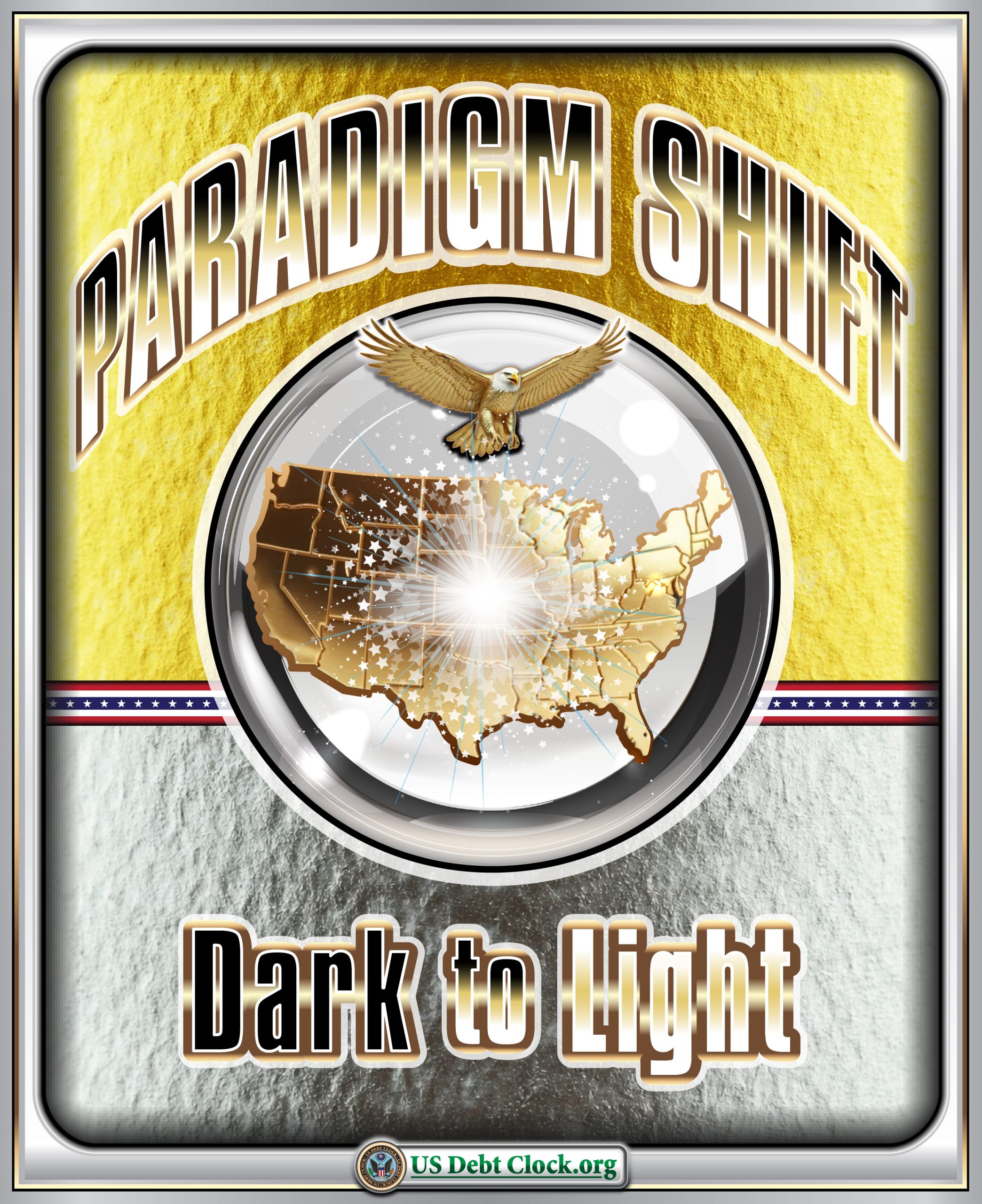
The March 15, 2026 US Debt Clock poster is blunt in its message and clean in its symbolism. Across the top: “PARADIGM SHIFT.” Across the bottom: “Dark to Light.” In the center, a glowing sphere frames a gold-toned map of the United States—lit from within like a switch has been flipped—while an eagle hovers above, wings spread, as if guarding the moment.
This isn’t a poster about markets moving ten basis points. It’s a poster about consciousness moving—about the public narrative shifting from sleepwalking through systems to questioning who built them, who benefits, and why the rules feel rigged.
In short: it’s a visual for mass awakening.
“Dark to Light” as an awakening theme
“Dark to Light” is not primarily financial language—it’s spiritual and civic language. It suggests a collective realization that the structures people assumed were neutral—money, banking, debt, taxation, war financing—may be designed to centralize power.
The glowing U.S. map inside the glass sphere is the key: it implies that the light isn’t coming from outside. The light is coming from inside the country, inside the public mind—an internal ignition. A re-education.
The book behind the poster’s worldview: The Creature from Jekyll Island

If you’ve spent time in alternative monetary circles, this poster’s tone strongly echoes one book more than any other: The Creature from Jekyll Island (1994) by G. Edward Griffin.
The book’s thesis—presented as a critique—is that the creation of the Federal Reserve in 1913 served the interests of a private banking class and established a system capable of expanding credit, monetizing government debt, and insulating monetary power from direct democratic control. Whether one agrees with the author’s framing or not, the cultural impact of the book is undeniable: it turned “How money works” into a political and moral question for millions of readers.
That’s exactly what “Paradigm Shift” suggests: the public learning the plumbing.
Central banking as the root of sovereignty loss (in the poster’s frame)
This poster is not asking people to debate small reforms. It’s implying that central banking is the root architecture behind America’s loss of sovereignty—because whoever controls money controls:
- the cost of living (via inflation/credit cycles)
- the political budget (via debt issuance and monetization)
- the war machine (via off-balance-sheet financing through bonds and credit)
- the boom-bust cycle (which consolidates assets in downturns)
That’s why the image features:
- a fortified, sealed sphere (systems and control),
- an eagle (national authority and protection),
- and a U.S. map lighting up (awakening to the real mechanism).
The message is: once the public understands the monetary mechanism, everything else comes into focus—from taxes to foreign policy.
“City of London moneychangers” and the long arc of control

The poster’s worldview also implies a deeper historical narrative: that modern central banking traces back to older financial power centers—often symbolized as the “City of London moneychangers” dating to the 1600s—where governments increasingly relied on financiers to fund wars and state expansion.
In this framing, the cause-and-effect chain is:
centralized money → centralized debt → centralized policy → perpetual conflict → domestic division
It’s not a claim about one group controlling everything with a joystick. It’s an argument about incentives: debt finance makes the state behave differently than it would under hard constraints, and that difference can ripple into wars, surveillance, polarization, and social stress.
That’s why these posters keep linking money to “everything wrong.” They’re arguing the foundation is cracked.
The Second Amendment, state nullification, and the “local sovereignty” response
The poster also points toward a political response that’s been gaining energy: local and state resistance to federal overreach, often described as state nullification.
In that worldview:
- the Second Amendment symbolizes the final backstop against tyranny, and
- state-level sovereignty represents the practical method of resisting centralized control—legal, legislative, and cultural.
It’s the same “decentralize power” instinct—applied not to banks, but to governance itself.
The “Dark to Light” awakening, then, isn’t just reading books. It’s a shift in posture:
from passive subjects → to active citizens
from centralized permission → to local authority
Whether one agrees or not, that is the emotional center of the poster.
What this means for the “New Money Revolution” theme
Across the US Debt Clock series, the posters have been building one consistent storyline:
- The public learns the monetary system is debt-centric and bank-mediated
- The public sees how that system shapes politics, war, and inequality
- The public demands an alternative: more transparent, more asset-linked, more accountable
- A new framework emerges (often framed as Treasury-led, reserve-based, and citizen-benefiting)
“Paradigm Shift — Dark to Light” is essentially the awakening chapter of that story.
Not the policy chapter. The psychology chapter.
Bottom line
This March 15 poster is a declaration that the real revolution is not merely new instruments or new rails—it is new awareness.
A shift from:
- trusting institutions blindly
to - understanding how money, power, and sovereignty are connected.
That is the “Dark to Light” moment: when the public begins to believe that central banking is not just a technical feature of modern life—
but the mechanism that quietly rewired the nation’s independence.
And when enough people believe that, the financial system doesn’t change first.
The narrative changes first.

33 Q posts found containing “Dark to Light”.
Leave a Reply