
I love silver.
I’ve loved silver since 2009—when nobody cared, when it was cheap, hated, and misunderstood.
But loving silver and trusting the silver market are two very different things.
On February 25, 2026, @zerohedge dropped a little grenade on X:
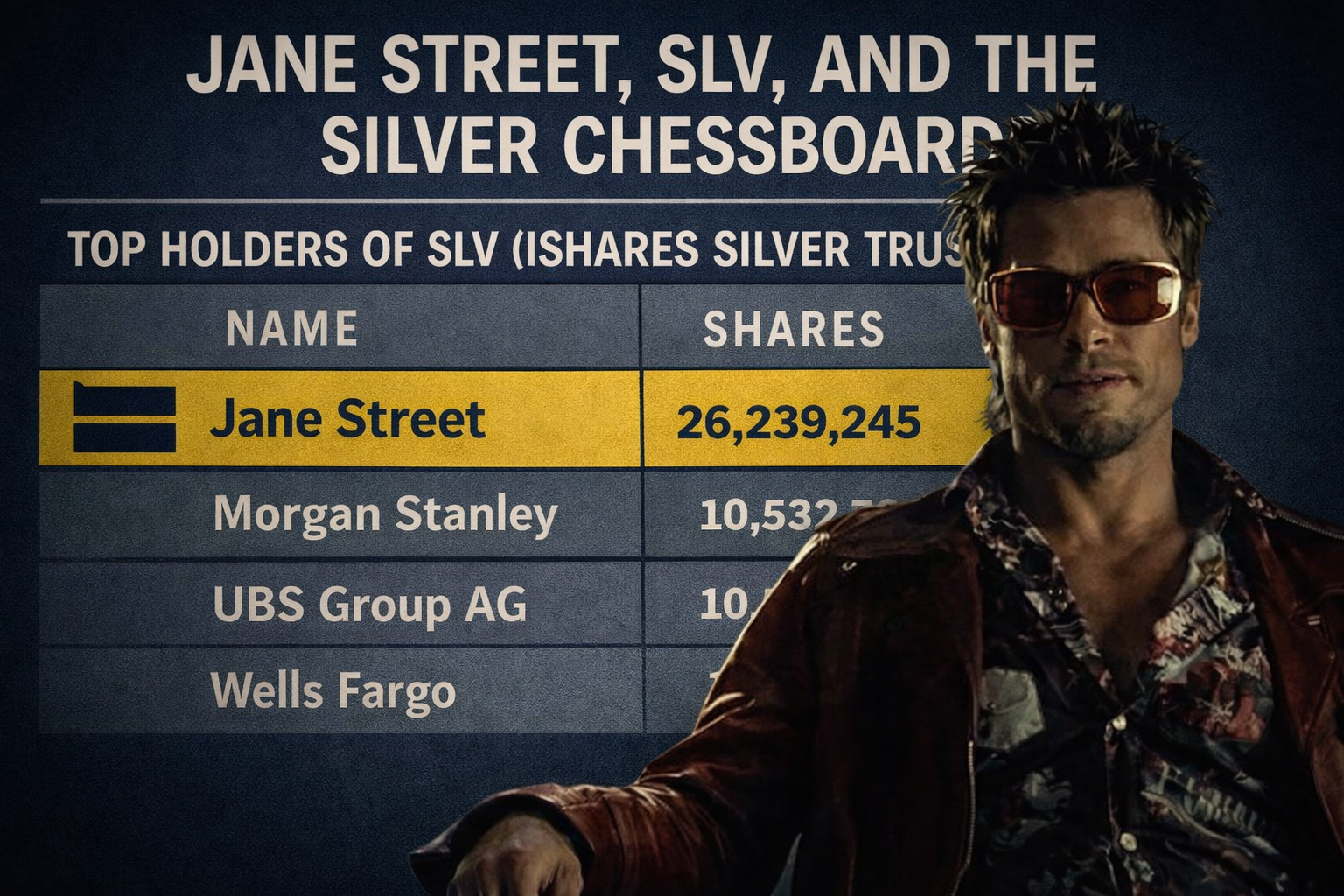
“We have been huge silver bulls since 2009, but be very careful here: lots of financial engineering going on. Jane Street not only added a record 20.6MM shares of SLV in Q4, it is now also the biggest holder of SLV.”
Translation?
The biggest quantitative trading firm in the world just became the largest holder of the iShares Silver Trust (SLV).
And if you think that’s a coincidence, you haven’t been paying attention to how modern markets work.
What Is SLV Really?
The iShares Silver Trust (SLV) is designed to track the price of silver. It’s the institutional gateway drug for exposure to the metal.
But here’s the uncomfortable truth:
You don’t own silver.
You own shares in a trust that owns silver.
Assuming the structure works exactly as advertised.
That’s where the internet lights up.
Critics call it:
- “Synthetic silver”
- “Paper silver”
- A derivative wrapper
And now, with Jane Street sitting at the top of the holder list after adding 20.6 million shares in a single quarter, the conspiracy engines are humming.
Financial Engineering: The Two-Edged Sword
ZeroHedge’s warning about “financial engineering” isn’t random paranoia.
It’s code for:
- Derivatives stacked on derivatives
- High-frequency arbitrage
- Delta hedging against futures
- Creation/redemption cycles inside ETF plumbing
- Synthetic exposure that can exceed physical constraints
Jane Street isn’t your uncle buying silver coins for doomsday.
They’re one of the most sophisticated liquidity providers on Earth.
They don’t “bet.”
They structure.
When a firm like that becomes the largest holder of SLV, there are only three possibilities:
- They’re hedging something much bigger.
- They’re positioning for volatility.
- They’re providing liquidity ahead of massive flows.
None of those are retail narratives.
Bullish… Or Setting the Trap?
Here’s where it gets interesting.
Some see this as ultra-bullish.
“Smart money loading up before the squeeze.”
Others see something darker.
“If they own the ETF, they control the liquidity. If they control liquidity, they control the price action.”
The silver market has a long history of manipulation accusations—futures concentration, spoofing cases, big-bank dominance. So when the biggest quant shop becomes the largest ETF holder, suspicion is inevitable.
But let’s remove emotion.
Jane Street makes money on spreads, structure, and volatility.
Silver is one of the most volatile metals on Earth.
Do the math.
The Physical vs Paper Divide

This post reignited the oldest argument in metals:
Physical vs ETF.
The physical crowd says:
“If you don’t hold it, you don’t own it.”
The ETF crowd says:
“Liquidity beats storage.”
Both are right.
Physical silver removes counterparty risk.
ETFs offer liquidity, scale, and leverage.
But here’s the part nobody says out loud:
If a silver squeeze happens, it won’t begin in coin shops.
It will begin in derivatives plumbing.
And that’s exactly where Jane Street operates.
Could This Precede a Shock?
The engagement numbers—900,000+ views, thousands of likes and reposts—tell you something else:
The silver narrative is heating up again.
Whenever silver starts trending, volatility follows.
And volatility is oxygen for firms like Jane Street.
So the real question isn’t:
“Is SLV fake?”
The real question is:
“What happens if ETF flows accelerate faster than physical supply can adjust?”
That’s when arbitrage breaks.
That’s when spreads widen.
That’s when paper and physical diverge.
And that’s when markets get interesting.
What Smart Offshore Capital Should Do
This isn’t a panic signal.
It’s a reminder.
If you’re exposed to silver, ask yourself:
- Do you understand your counterparty risk?
- Are you diversified between physical and paper?
- Are you positioned for volatility—or just price appreciation?
Silver doesn’t move politely.
It spikes.
It squeezes.
It collapses.
Then it repeats.
Jane Street isn’t emotional about that cycle.
You shouldn’t be either.
The Bottom Line
I’m still a silver bull.
But bulls who ignore structure get slaughtered.
When the largest quantitative trading firm becomes the largest holder of the biggest silver ETF, that’s not a headline.
That’s a signal.
Not necessarily of doom.
But of complexity.
And in modern markets, complexity is where fortunes are made—or vaporized.
Remember:
Gold is about trust.
Silver is about volatility.
And Wall Street?
Wall Street is about engineering.
If you’re going to play silver in 2026, don’t just buy the metal.
Understand the machine around it.
Because the machine just got bigger.
Leave a Reply