
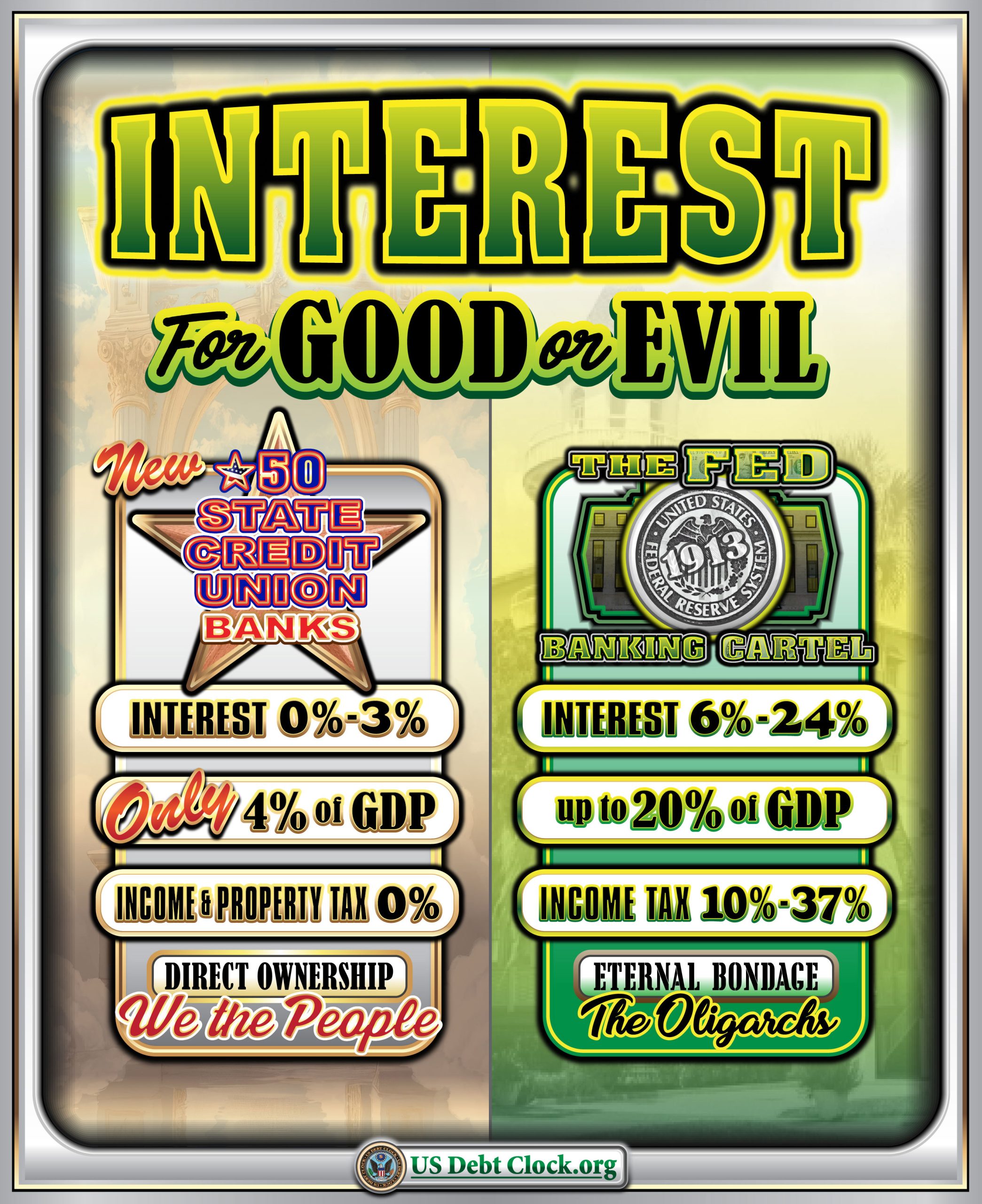
The April 7, 2026 US Debt Clock poster is titled “INTEREST — For GOOD or EVIL.” It’s a split-screen morality play about money, built around one simple claim:
Interest can either empower society… or enslave it.
On the left, the poster introduces a “new” model: ⭐ 50 State Credit Union Banks. On the right, it attacks the existing model: The Fed / Banking Cartel. The contrast is framed like a choice between two futures—one where the cost of money is low, civic-owned, and productive… and one where the cost of money is high, extractive, and politically corrosive.
Let’s unpack what the image is saying and why it matters to the New Money Revolution narrative.
What the poster shows (in plain language)
Left side: “New ⭐ 50 State Credit Union Banks”
The left panel claims:
- Interest: 0%–3%
- Only 4% of GDP (implying a smaller interest burden on the economy)
- Income & property tax: 0% (suggesting banking revenue could replace major taxes)
- Direct ownership: “We the People”
The visual design reinforces the message: star badge, “new” label, and language of citizen ownership.
Right side: “The Fed / Banking Cartel”
The right panel claims:
- Interest: 6%–24%
- Up to 20% of GDP (implying a much larger interest drag)
- Income tax: 10%–37%
- “Eternal Bondage — The Oligarchs”
This side is meant to feel heavier, darker, and more punitive—suggesting a system where interest is a perpetual siphon from households and governments.
Even if you don’t accept the precise numbers, the poster’s argument is unmistakable:
High interest is a tool of extraction. Low interest is a tool of liberation.
What “50 State Credit Union Banks” means in this worldview
The poster is essentially proposing a public-benefit banking layer—not necessarily “nationalized banking,” but a network of state-level, citizen-owned credit institutions that operate like credit unions at scale.
The imagined characteristics are:
- Public or citizen ownership
Instead of private shareholders capturing the spread, the spread flows back to residents—either as dividends, rebates, or reduced taxes. - Low, capped interest rates (0%–3%)
The poster suggests interest becomes a service fee—not a profit engine—designed to cover operating costs, risk reserves, and infrastructure. - A smaller “interest burden” on the economy
The claim “only 4% of GDP” implies that when credit is cheaper and the spread is not extracted as rent, the economy keeps more of what it produces. - Banking as a public utility
The idea is that money and credit should be treated like infrastructure—similar to roads, power lines, or water systems—critical to society, not optimized for extraction.
Why the New Money Revolution keeps focusing on interest
Because interest is where money becomes political.
When interest costs rise, three things happen:
- Households feel it first: mortgages, credit cards, car loans
- Businesses feel it next: cost of capital, expansion slows, layoffs rise
- Governments feel it last: debt service crowds out services, taxes rise, deficits deepen
So in the New Money Revolution narrative, interest is not a neutral price. It’s the lever that decides whether a society compounds wealth—or compounds debt.
That’s why the poster frames it as “good or evil.” It’s less about morality in a church sense and more about consequence:
- Does interest recycle benefits back to citizens?
- Or does it concentrate benefits upward and outward?
The bold claim: “Income & property tax 0%”
This is the poster’s attention-grabber—and also the part that requires the most realism.
In practice, states fund services through a mix of taxes, federal transfers, and fees. Eliminating income and property taxes would require massive, reliable alternative revenue, plus major policy coordination.
But the poster’s point isn’t an implementation plan—it’s an aspiration:
If the banking spread became a public revenue stream, it could reduce the tax burden.
That’s the underlying logic: redirect the cost of money from private extraction to public benefit.
What would it take for something like this to work?
Even conceptually, a “50 state” public-benefit banking system would require:
- strong governance and transparency
- strict credit standards and anti-corruption controls
- capital reserves for defaults and downturns
- clear separation from political lending
- coordination with national settlement rails and regulations
Without disciplined operations, “cheap money” becomes misallocated money. So the real debate isn’t whether low interest is good—it’s whether the system can keep low interest without creating a new kind of risk spiral.
The takeaway
The April 7 poster is not just about rates. It’s about who owns the financial engine.
In the US Debt Clock worldview, the New Money Revolution is a shift from:
- interest as extraction
to - interest as service and shared benefit
Whether or not the “50 State Credit Union Banks” model ever materializes exactly as shown, the poster captures a real turning point in public sentiment:
People are no longer asking only “What is the rate?”
They’re asking “Who is the rate for?”
And once that question becomes mainstream, the architecture of banking inevitably comes under pressure to evolve.
Invest Offshore continues to track real-asset opportunities globally, including investment opportunities in West Africa seeking investors for the Copperbelt Region, plus verified gold for sale through our network and partners worldwide, and select mining concessions with documented title, geology, and clear pathways to production.
Leave a Reply