
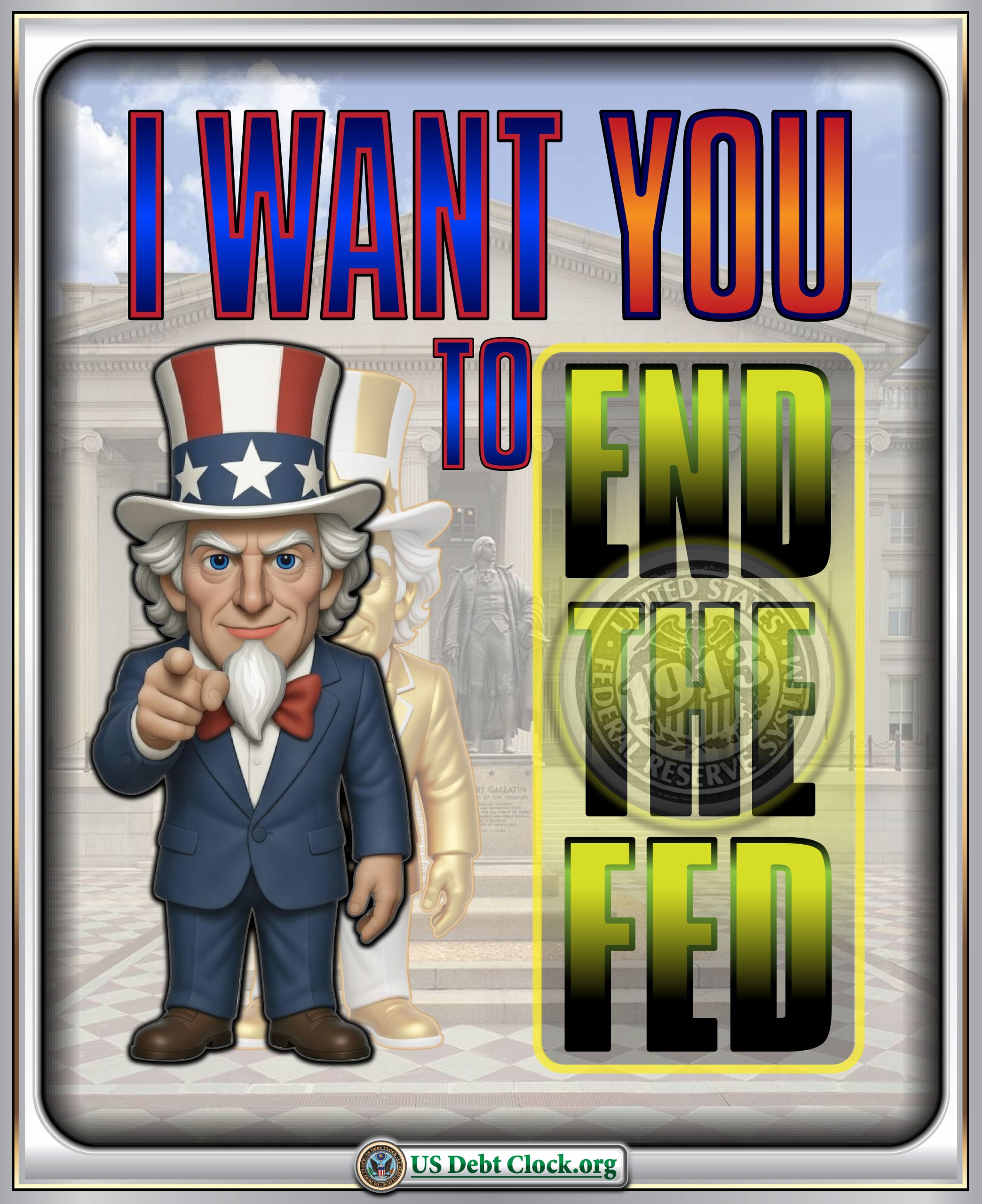
The March 31, 2026 US Debt Clock poster doesn’t whisper. It points straight at the viewer and says: “I WANT YOU TO END THE FED.” The image borrows the classic Uncle Sam recruitment pose—finger extended, eyes locked—then stacks the words END / THE / FED in a neon-highlighted block, with a faint Federal Reserve seal sitting behind the letters like a target.
It’s propaganda in the old-school sense: bold, emotional, personal. Not “someone should do something,” but you should.
And that’s exactly why this poster matters in the New Money Revolution storyline: the movement is shifting from theory to participation. From “look what they did” to “what are you going to do about it?”
What the poster is really saying
At surface level, “End the Fed” is a slogan. Underneath, it’s shorthand for a broader demand:
- end money creation dominated by debt and intermediaries
- end the hidden tax of currency dilution
- end a system where the cost of money is set by centralized policy rather than transparent rules
- end a financial architecture that feels designed to extract more than it produces
You can agree, disagree, or land somewhere in the middle—but the emotional engine is real: people feel the system is rigged, and “End the Fed” becomes a simple label for restoring control.
The New Money Revolution connection
Across the US Debt Clock poster series, the New Money Revolution has repeated the same promises in different outfits:
- “asset-backed”
- “100% reserve”
- “dividend dollar”
- “redeemable assets”
- “state credit union banks”
- “payable to the bearer on demand”
Those are all attempts to answer one question:
How do you rebuild trust in money?
The “End the Fed” poster is the political expression of that question. It’s the demand for a reset of the money architecture—whether that means reform, replacement, decentralization, or a completely different issuance model.
So what can “YOU” do? (Practical steps, not slogans)
You don’t need a megaphone to matter. You need a plan. Here are high-leverage actions that fit the spirit of the poster without requiring you to join a cult, burn bridges, or pretend complexity doesn’t exist.
1) Learn the plumbing (and teach it)
Most people argue about money using vibes. The fastest way to level up is to learn:
- how money is created (credit, reserves, Treasury issuance)
- how interest flows through the system
- how inflation actually shows up (asset inflation vs. consumer inflation)
- what a “reserve-based” or “asset-linked” system would require to function
Then share it. The revolution is informational before it’s institutional.
2) Vote with your balance sheet
If you want less exposure to “paper fragility,” your assets should reflect that:
- hold a portion in real assets (metals, productive land, energy, essential commodities)
- avoid being overconcentrated in any single currency or jurisdiction
- prioritize liquidity + custody clarity (know where things are held and under what law)
This isn’t about fear. It’s about optionality.
3) Choose better banks — and demand transparency
You can’t “end” anything if you keep feeding the worst version of it.
Support institutions that offer:
- clean documentation
- strong capitalization
- sane fee structures
- real customer service
- and robust compliance (yes, that matters—because the future system will be more transparent, not less)
If your bank treats you like a number, move.
4) Support local and state-level monetary experimentation (legally)
If you believe decentralization is healthier, pay attention to:
- state-level sound money initiatives
- bullion depository programs
- tax policy changes around gold/silver
- fintech charters and alternative settlement networks
- credit union expansion and community banking
You don’t need to agree with every proposal. You just need to encourage competition and experimentation.
5) Build income that isn’t hostage to policy
One reason “End the Fed” resonates is because people feel trapped by the cost of living and the cost of money.
The most powerful personal hedge is:
- skills that remain valuable in any cycle
- businesses with pricing power
- international clients or revenue streams
- and assets that produce cash flow
A free person is harder to control.
6) Keep your activism grounded
If the New Money Revolution is real, it will require:
- law
- institutions
- audits
- settlement mechanics
- and disciplined implementation
So avoid the trap of “date-setting” and rumor addiction. Real transitions are staged, boring, and operational. The loudest people are usually last to understand the plumbing.
What “End the Fed” could realistically mean
Even among critics of the Federal Reserve, “end” can mean different things:
- reform the Fed’s mandate
- constrain money creation with rules
- move toward Treasury-led issuance models
- introduce parallel asset-linked instruments
- decentralize credit through state or community institutions
- increase transparency and reduce intermediary tolls
The poster chooses the sharpest phrase possible. Your job is to translate that energy into coherent action.
Bottom line
The March 31 image is a call to personal agency. It’s saying:
Stop treating money like weather. Treat it like architecture.
And the moment enough people do that—by learning, reallocating, demanding transparency, and supporting alternatives—the system changes whether or not a slogan “wins.”
Because in the end, the most powerful way to “End the Fed” isn’t a tweet.
It’s millions of people building a life that no longer depends on the old system’s permission.
Invest Offshore continues to track real-asset opportunities globally, including investment opportunities in West Africa seeking investors for the Copperbelt Region, plus verified gold for sale through our network and partners worldwide, and select mining concessions with documented title, geology, and clear pathways to production.
Leave a Reply