
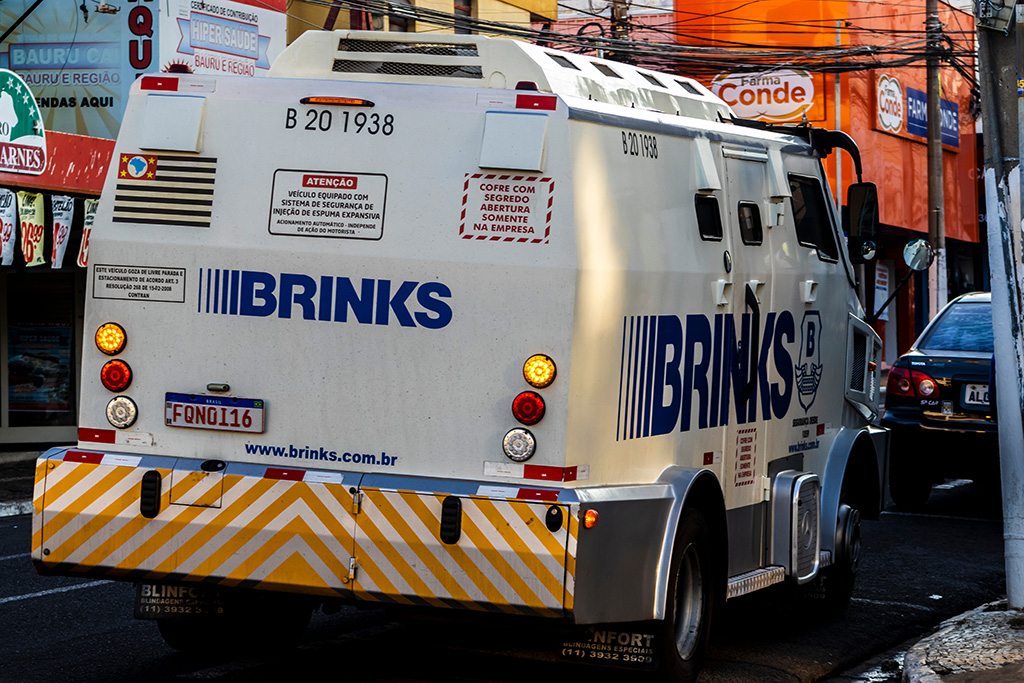
When investors think about “financial institutions,” they usually picture banks, credit unions, and brokerages.
But behind nearly every major bank sits a different kind of giant — one that rarely makes headlines, yet quietly powers the physical money system.
That giant is Brink’s.
Brink’s is not an offshore bank. It does not take deposits or make loans.
Yet in practical terms, it may be one of the largest financial infrastructure providers in the world, delivering the cash-handling backbone that banks, central banks, and cash-intensive institutions depend on every day.
For sophisticated investors — especially those exploring large cash placements, SKR cash pallet transactions, and high-value liquidity logistics — understanding Brink’s role is essential.
Brink’s: A Financial Institution Without a Banking License
Brink’s operates as a banking-facing infrastructure company rather than a bank. Its business model centers on securing, moving, storing, processing, and digitally reconciling physical currency on behalf of:
- Commercial banks
- Central banks
- Credit unions
- ATM networks
- Retail chains and casinos
- Cash-intensive enterprises
In other words, Brink’s runs the physical side of money so banks can focus on balance-sheet activities.
This positioning places Brink’s in a unique category:
a systemically important financial utility.
Core Banking-Facing Services
1. Cash Vault Services
Brink’s operates secure vault facilities that:
- Store bank currency inventories
- Count and verify cash
- Fitness-sort banknotes
- Reduce the amount of cash held inside bank branches
For many banks, Brink’s vaults effectively function as externalized branch vaults.
2. Cash Processing
Multi-currency:
- Counting
- Validation
- Wrapping
- Counterfeit detection
- Inventory management
In many regions, Brink’s acts as an outsourced cash back office for commercial banks and even central banks.
3. ATM Managed Services
End-to-end ATM operations including:
- Installation and ownership
- Cash loading
- Network monitoring
- Forecasting
- Maintenance
- Reporting
Banks increasingly offload ATM infrastructure to Brink’s to lower operating costs and improve uptime.
4. Teller Automation (Brink’s Complete Teller)
Commercial deposits and change orders are routed through Brink’s smart devices and systems, dramatically reducing in-branch teller workload.
Services for Businesses (Often Bank-Integrated)
- Total Cash Management platforms
- Smart safes with provisional crediting
- Armored pickup and delivery
- Track-and-trace logistics
- Real-time reporting dashboards
For many enterprises, Brink’s is the front door to the banking system for physical cash.
Payment & Card Products (Brink’s Money)
While not a bank, Brink’s also brands consumer payment solutions:
- Prepaid cards
- Payroll cards
- Paycards
- Armored Account (via partner bank in the U.S.)
These products further reinforce Brink’s role as a banking services wrapper rather than a deposit-taking institution.
Why Banks Depend on Brink’s
From a strategic perspective, Brink’s allows banks to:
- Lower CAPEX on vault construction
- Reduce branch cash risk
- Shrink ATM maintenance budgets
- Improve security and insurance coverage
- Reallocate staff toward revenue-generating functions
Brink’s is therefore not a competitor — it is an operational extension of the banking system.
The SKR Cash Pallet Angle
In large institutional cash movements, particularly:
- High-denomination physical currency
- Structured cash repositories
- Sovereign or quasi-sovereign liquidity operations
- Private placement liquidity staging
Brink’s facilities often become the physical settlement layer.
This is where SKR (Safe Keeping Receipt) structures frequently intersect with Brink’s infrastructure:
- Palletized cash stored in Brink’s vaults
- Independent verification and inventory control
- Chain-of-custody documentation
- Vault-to-vault or vault-to-bank movement capability
While Brink’s does not issue SKRs itself as a bank would, its vault network is commonly used in transactions where SKRs reference the physical location of stored cash.
Put simply:
If large volumes of physical money exist in institutional form, Brink’s is very often the custodian.
Brink’s as the “Hidden Giant” Financial Institution
Measured by:
- Volume of currency handled
- Global footprint
- Number of banks served
- Amount of physical liquidity under management
Brink’s quietly ranks among the most important financial infrastructure providers on Earth.
It is not an offshore bank.
But in practical terms, many offshore and onshore banks could not operate physical cash businesses at scale without Brink’s.
Strategic Takeaway for Invest Offshore Readers
Brink’s represents a critical bridge between:
- Traditional banking
- Institutional cash logistics
- Structured liquidity transactions
- Physical-to-digital financial convergence
For investors and institutions exploring large cash placements, structured custody, or SKR-referenced transactions, understanding Brink’s ecosystem is often more important than choosing a particular bank.
Final Thought
Banks create credit.
Brink’s moves money.
In the modern financial system, both are indispensable.
Invest Offshore works with partners and intermediaries active in structured liquidity, institutional custody, and commodity-backed transactions. We also have investment opportunities in West Africa seeking investors for projects connected to the Copperbelt region.
Leave a Reply