
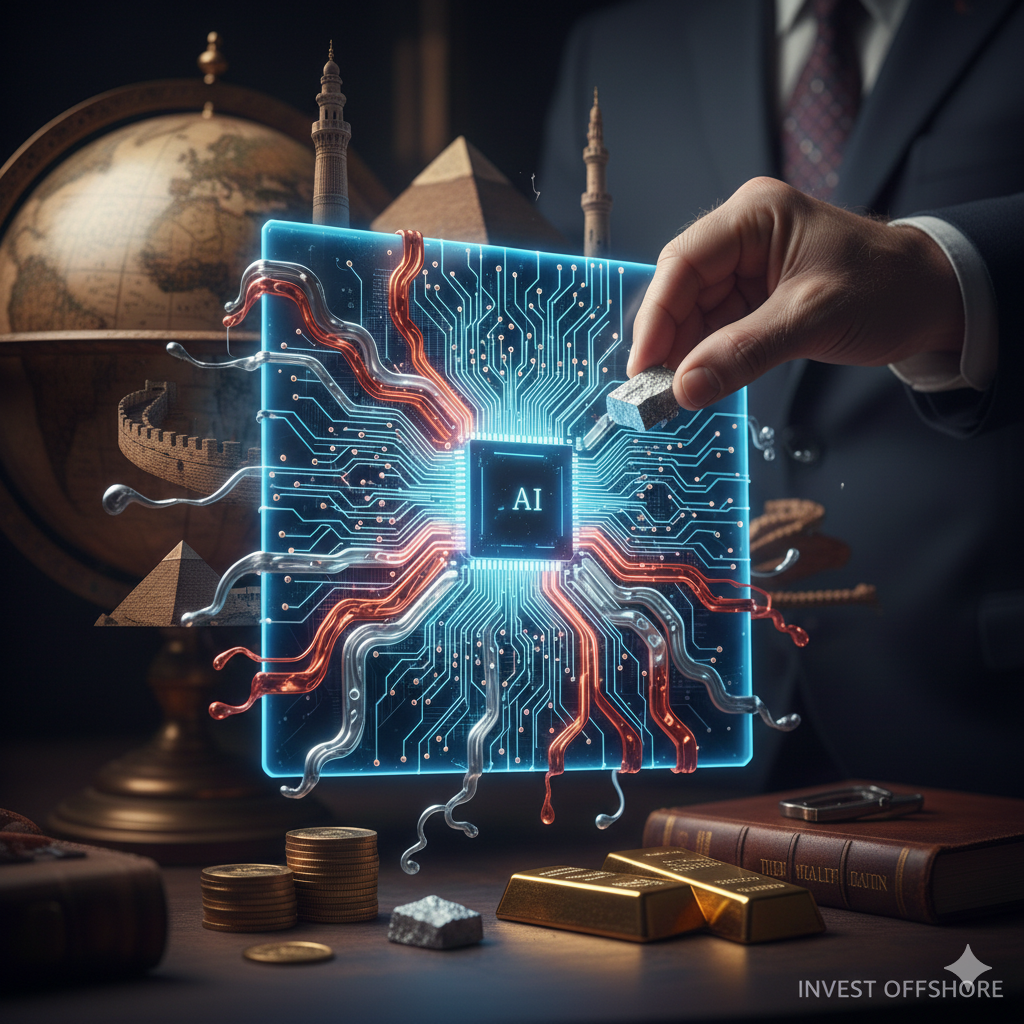
For decades, the “Offshore” playbook for wealth preservation was simple: move into hard assets, primarily gold and silver, and store them in jurisdictions with high rule-of-law and low fiscal desperation.
But as we move deeper into 2026, the definition of a “safe haven” is evolving. While gold remains the ultimate insurance policy against currency debasement, it doesn’t power the technology that is currently re-ordering the global economy.
If you want to hedge against geopolitical friction while positioning for the AI-driven “Compute Supercycle,” you have to look at the metals that the West needs, but doesn’t control: Gallium, Germanium, and Antimony.
The “Control Point” Investment
The investment thesis for these strategic metals is different from precious metals. Gold is valuable because of its scarcity and neutrality. Strategic metals are valuable because of their chokepoint potential. Currently, China produces roughly 98% of the world’s Gallium and 60-70% of its Germanium. In an era of “de-risking” and trade fragmentation, these metals have become more than just commodities—they are diplomatic leverage.
1. Gallium: The Backbone of High-Speed AI
Silicon has reached its physical limits. As AI models demand faster data processing and more efficient power conversion, the industry is shifting toward Gallium Nitride (GaN).
- The Play: Gallium is essential for the high-performance semiconductors used in AI data centers and 5G infrastructure.
- The Geopolitical Reality: In late 2023, China implemented export controls on Gallium. For the offshore investor, this creates a classic supply-demand imbalance. When the “just-in-time” supply chain breaks, the price of “just-in-case” inventory skyrockets.
2. Germanium: The Lens of the Future
If Gallium is the brain of the AI revolution, Germanium is the eye. It is indispensable for fiber-optic communications and infrared night-vision technology.
- The Opportunity: As global tensions rise, defense spending on sophisticated thermal imaging and secure fiber networks is decoupled from standard economic cycles.
- Offshore Angle: Much like offshore banking, Germanium is about discretion and security. It is a critical component in the hardware that keeps the world’s data encrypted and its borders monitored.
3. Antimony: The Great Stabilizer
Antimony is the “quiet” strategic metal that is suddenly making a lot of noise. Primarily used as a flame retardant and a lead-acid battery hardener, its new frontier is large-scale liquid metal batteries for renewable energy storage and military-grade munitions.
- The Scarcity Factor: With Russia and China controlling the lion’s share of production, Western “Strategic Stockpiles” are precariously low.
- The Investor Upside: Unlike gold, which sits in a vault, Antimony is consumed. As supply chains tighten, the “in-ground” value of junior miners operating in friendly jurisdictions (or neutral offshore hubs) becomes an asymmetric bet on global stability.
Moving Beyond the “Gold Standard”
Investing in strategic metals requires a shift in mindset. You aren’t just buying a store of value; you are buying a piece of the global supply chain that cannot be easily replicated or “printed” by a central bank.
For the Invest Offshore reader, these metals represent a unique convergence:
- Asset Protection: Physical ownership or “streaming” contracts in these metals are difficult for Western tax authorities to value and seize compared to traditional equities.
- Geopolitical Arbitrage: You are betting on the reality that the “Great Wealth Migration” isn’t just about people—it’s about the resources that power the future.
While the world watches the gold price, the real power moves are happening in the elements you can’t see, but the AI cannot live without.
Leave a Reply