
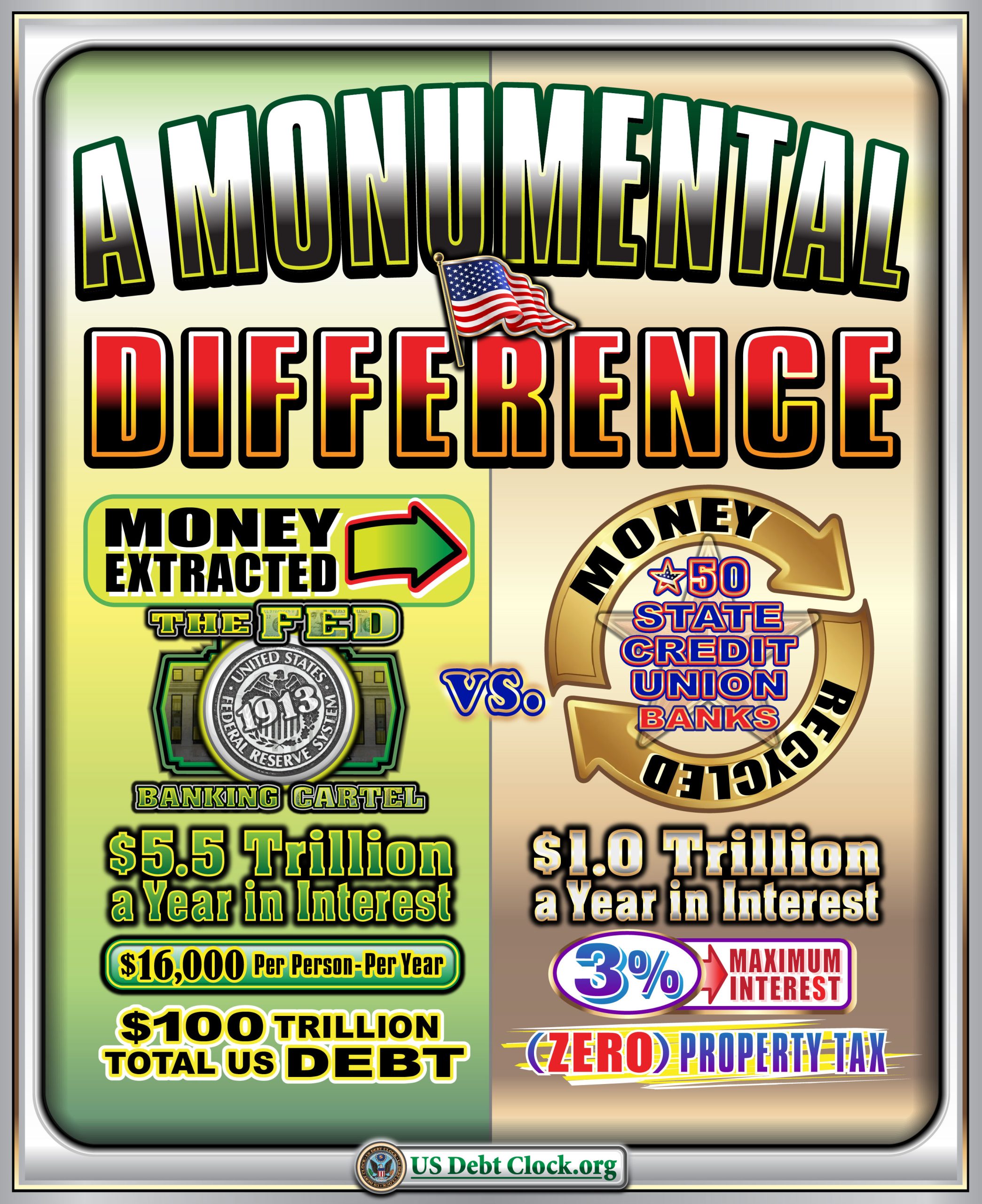
The March 18, 2026 US Debt Clock poster is built like a billboard you’d see on a highway right before a fork in the road. The headline says it all: “A MONUMENTAL DIFFERENCE.” And beneath it, the image divides the world into two competing monetary stories—money extracted versus money recycled—framed as the clearest “before/after” depiction yet of what many readers call the New Money Revolution.
On the left: a green panel labeled “Money Extracted” with “The Fed / Banking Cartel,” claiming $5.5 trillion a year in interest, a $16,000 per person per year burden, and a stark “$100 trillion total US debt” line.
On the right: a gold panel proposing “50 State Credit Union Banks,” claiming $1.0 trillion a year in interest, a 3% maximum interest cap, and the most provocative promise of all: “ZERO PROPERTY TAX.”
Whether you take every number literally or view it as symbolism, the poster’s message is blunt:
The difference between the old money system and the new one is not small. It’s monumental.
What the poster means by “monumental”
This isn’t just a poster about interest rates. It’s a poster about who owns the banking spread—and where the “profit” of money creation flows.
The old system (left side): money extracted
The left panel frames today’s regime as a siphon:
- Money is created through debt.
- Interest becomes an unavoidable toll.
- The toll concentrates upward—into the “banking class.”
- Households and governments run faster just to stay in place.
In the New Money Revolution storyline, this is why people feel trapped:
you can pay your whole life and still never get ahead—because the system is designed to extract.
The proposed system (right side): money recycled
The right panel reframes banking as a public utility:
- Credit institutions are state-level and “citizen-owned.”
- Interest is capped (the “3% maximum” cue).
- Banking revenue becomes public benefit (or direct relief through taxes).
In other words: if banking must generate interest income, the poster argues that income should return to citizens rather than being permanently skimmed as private rent.
That’s why the right side uses a circular arrow motif around “Money Recycled.” It’s depicting a closed-loop system instead of an extraction funnel.
Why this fits the “New Money Revolution”
If you’ve been watching this US Debt Clock poster series, the New Money Revolution has consistent themes:
- Debt-based money is reaching its limits (too much interest, too much leverage, too much fragility).
- People are waking up to the plumbing (how money is created, who benefits, why inflation feels structural).
- A new model is being proposed (Treasury-led currency, reserve-based money, dividend logic, citizen benefit).
- Decentralization of power becomes the political instinct (state-first banking, local sovereignty, limits on centralized control).
This March 18 poster is basically that entire storyline in one image—an argument that the next system will be judged on a single metric:
Does money serve the citizen—or does the citizen serve the money?
The most controversial claim: “Zero property tax”
The “ZERO property tax” line is the poster’s emotional hook, because property tax is one of the most visible symbols of modern financial frustration: you can “own” your home, but you still pay forever.
The poster’s logic is:
- If state banking revenue replaces certain forms of taxation,
- then taxes like property taxes could be reduced or eliminated.
That’s an aggressive claim, and it would require enormous structural changes in public finance. But as messaging, it’s powerful because it translates the New Money Revolution into kitchen-table language:
“What would my life look like if the cost of money wasn’t siphoning my future?”
The real takeaway
You don’t have to agree with every claim to understand what this poster is doing. It’s building momentum for a simple worldview:
- The current system creates money through debt and extracts interest.
- A redesigned system would create money with tighter rules and recycle returns back to the people.
- The difference between those two outcomes is not incremental.
It’s monumental.
That’s why this series keeps returning to the same visual language: green vs gold, extracted vs recycled, cartel vs citizen, debt vs dividend.
What Invest Offshore readers should watch
If the New Money Revolution is even partially real—whether through policy, market evolution, or a new settlement layer—these are the signals that matter more than posters:
- rules that change how banks hold reserves and extend credit
- Treasury-led instruments that behave more like “receipts” than IOUs
- new rails for settlement that reduce reliance on legacy intermediaries
- a push for transparency, auditability, and asset linkage
- public pressure to convert “finance profits” into public benefits
Posters don’t flip switches. But they do reveal what large numbers of people are primed to believe—and what political coalitions might rally around next.
Invest Offshore continues to track real-asset opportunities globally, including investment opportunities in West Africa seeking investors for the Copperbelt Region, plus verified gold for sale through our network and partners worldwide, and select mining concessions with documented title, geology, and clear pathways to production.
Leave a Reply