
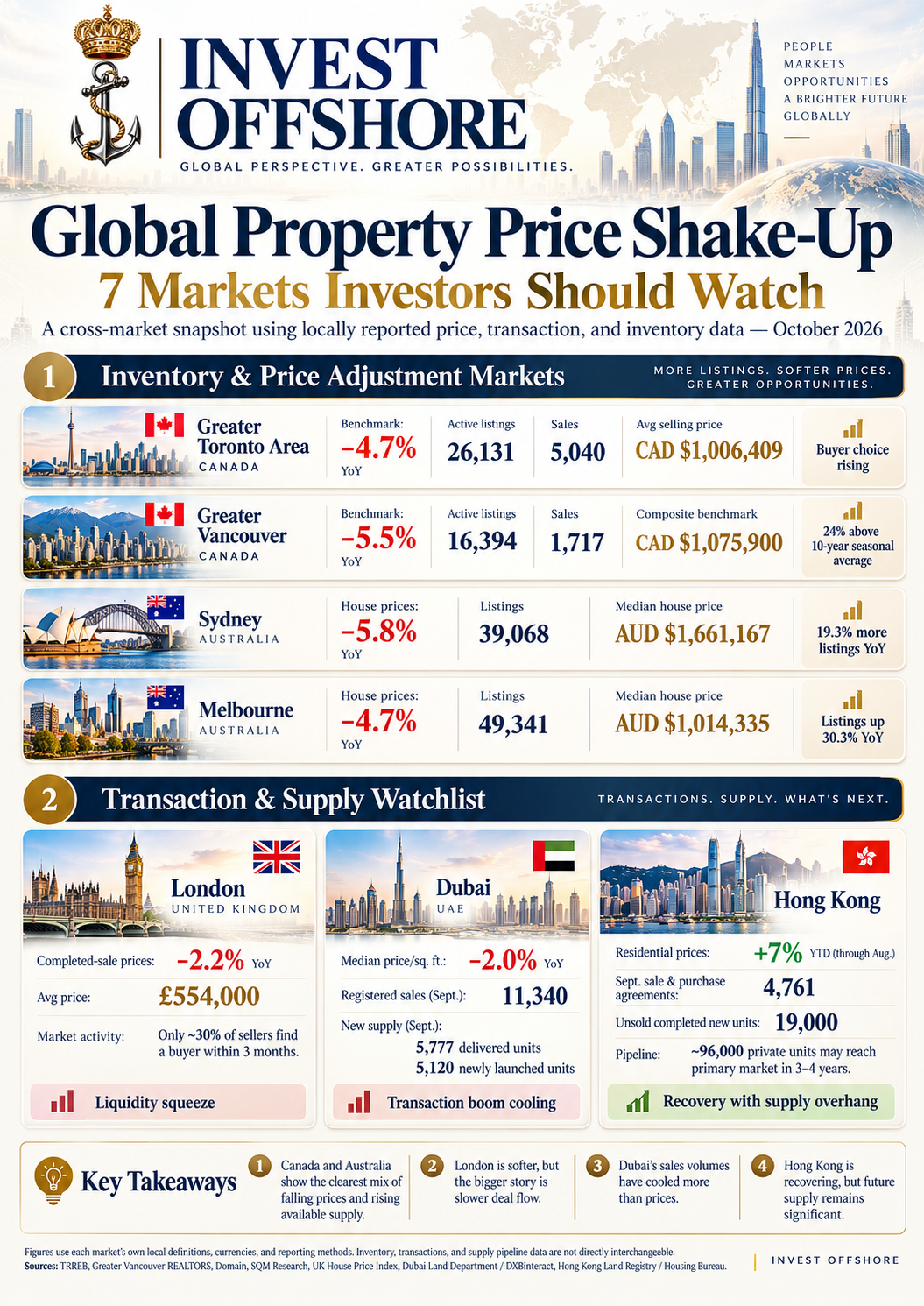
The latest figures reveal significant housing price adjustments in Canada, Australia, and London, a sharp contraction in Dubai’s transaction volumes, and a very different recovery story in Hong Kong. The key distinction is between markets where inventories are accumulating and markets where property demand is beginning to recover.
Global Property Price Shake-Up: 7 Markets Investors Should Watch
From Toronto and Vancouver to Hong Kong, Dubai, London, and Australia, shifting property prices and substantial housing inventories are reshaping international real estate investment.
The global real estate market is entering an extraordinary period of adjustment.
Across several of the world’s most important property markets, the speculative momentum that once propelled housing prices to record heights is losing strength. Higher financing costs, cautious buyers, and greater competition among sellers are transforming the investment landscape.
But the correction is far from universal.
While Toronto, Vancouver, Sydney, and Melbourne are experiencing measurable price declines, Hong Kong is recovering from a prolonged downturn. Meanwhile, Dubai’s property market is recording substantially fewer transactions even as prices per square foot have proved more resilient.
The opportunity for international investors lies in understanding where property prices are correcting, where inventories are accumulating, and where actual transactions confirm changing valuations.
Invest Offshore examines seven major markets using locally reported property prices, transactions, and available housing supply.
Global Real Estate Market Snapshot — 2026
| Market | Latest price indicator | Property supply or sales activity |
|---|---|---|
| Greater Toronto Area | Benchmark -4.7% annually | 26,131 active listings |
| Greater Vancouver | Benchmark -5.5% annually | 16,394 active listings |
| Sydney | House prices -5.8% annually | 39,068 properties listed |
| Melbourne | House prices -4.7% annually | 49,341 properties listed |
| London | Completed-sale prices -2.2% annually | Slow transaction conditions |
| Dubai | Median price/sq. ft. -2.0% annually | 11,340 September registered sales |
| Hong Kong | Prices up approximately 7% year-to-date through August | 19,000 unsold completed new units at June-end |
Important: Figures use each market’s own definitions, reporting periods, and local currencies. Listing inventories, completed but unsold units, and monthly transactions are different measurements and should not be added together or directly ranked. Annual price indicators also differ in methodology.
1. Greater Toronto Area, Canada — A Major Housing Market Searches for Its Bottom
Toronto spent much of the previous decade establishing itself as one of North America’s most expensive and internationally connected residential property markets.
Now, a different picture is emerging.
According to the Toronto Regional Real Estate Board, September 2026 recorded:
- 26,131 active residential listings
- 5,040 completed sales
- CAD $1,006,409 average selling price
- 5.1% annual decline in the average selling price
- 4.7% annual decline in the benchmark home price index
These figures indicate a market where buyers have substantial choice and sellers must increasingly justify their valuations.
Perhaps the most interesting segment is Toronto’s condominium market, where competition between resale properties and newer units can create opportunities for selective purchasers.
For investors, the essential question is whether lower acquisition prices will translate into sustainable rental yields after condominium fees, taxes, financing, and maintenance expenses.
Toronto’s affordability challenge has not disappeared. But the shift away from intense bidding competition is significant.
Investment outlook: Attractive for long-term research, particularly among condominium owners under financial pressure and sellers prepared to negotiate.
2. Greater Vancouver, Canada — Housing Prices Retreat on the Pacific Coast
Vancouver remains one of the world’s most geographically constrained and internationally recognizable residential property markets.
Its proximity to Asia, limited developable land, and natural setting have historically supported premium valuations.
Yet September 2026 data from Greater Vancouver REALTORS indicate a market facing persistent downward pressure.
The composite residential benchmark price reached CAD $1,075,900, representing an annual decline of 5.5%.
There were 16,394 active properties listed for sale, approximately 24% above the ten-year seasonal average.
Only 1,717 residential properties sold during September.
The sales-to-active-listings ratio stood at 10.9%, a level associated with downward price pressure when sustained.
Apartment benchmark prices declined 6.2% annually, while detached property prices declined 7.3%.
Investment outlook: Vancouver deserves close monitoring for resale condominium acquisitions, motivated sellers, and properties in established rental-demand locations.
However, prospective purchasers must distinguish the metropolitan benchmark from the valuations of individual neighbourhoods and property types.
3. Sydney, Australia — A Major Correction in a Global Gateway City
Sydney has emerged as one of the clearest examples of a major international housing market undergoing repricing.
Domain’s September-quarter research reported a median house price of AUD $1,661,167, down 5.8% from a year earlier.
That represents an approximately AUD $101,000 annual reduction in the median house price.
House prices were also 7.9% below their December 2025 peak.
Meanwhile, SQM Research data showed 39,068 residential properties listed for sale in September 2026, approximately 19.3% more than a year earlier.
A growing stock of unsold properties, together with declining sale prices, can create a powerful negotiating environment.
The situation is especially relevant for investors who previously regarded Sydney as a market where housing scarcity would continually overwhelm affordability concerns.
Investment outlook: Potential opportunities may exist in established suburban markets, family housing, and carefully selected apartments. However, foreign investors face substantial restrictions on purchases of existing residential property.
4. Melbourne, Australia — Almost 50,000 Properties on the Market
Melbourne arguably presents one of the most compelling combinations of housing availability and falling prices in this international comparison.
SQM Research recorded 49,341 properties for sale during September 2026.
That represented an extraordinary 30.3% increase compared with September 2025.
Domain reported a median Melbourne house price of AUD $1,014,335, representing a 4.7% annual decline.
Unit prices were also falling, with the September-quarter median reaching AUD $563,199, down 3.8% annually.
This suggests Melbourne’s adjustment is not confined to a single category of residential property.
For investors focused on long-term rental income, Melbourne deserves attention because the combination of an established metropolitan economy and more plentiful available housing could eventually create attractive entry valuations.
Investment outlook: One of the strongest markets to monitor for increasing seller competition, particularly where properties have remained listed for extended periods.
5. London, United Kingdom — Property Wealth Meets a Liquidity Squeeze
London continues to occupy a central position in the global property investment system.
International capital has historically viewed its residential market as a store of wealth, supported by the city’s financial infrastructure, legal institutions, universities, and global business connections.
But market liquidity has weakened.
According to the UK House Price Index released October 21, average London property prices declined 2.2% annually to approximately £554,000 in August 2026.
London flats and maisonettes recorded a sharper 5.0% annual decline.
Zoopla reported that only about 30% of London sellers were finding a buyer within three months, illustrating how difficult the market had become for owners seeking timely transactions.
This is an important distinction.
London may not be experiencing the same dramatic inventory expansion as Melbourne, but slower absorption can create individual investment opportunities as sellers reconsider asking prices.
Investment outlook: London may offer selective purchases among flats, properties needing renovation, and owners seeking faster transactions. Financing costs, stamp duties, and operating expenses remain decisive considerations.
6. Dubai, United Arab Emirates — The Transaction Boom Loses Momentum
Dubai presents a different investment story.
Long regarded as a magnet for international capital, luxury property investors, and expatriate entrepreneurs, the emirate has experienced extraordinary residential development activity.
However, the latest registered transaction data suggest that market momentum is slowing.
DXBinteract’s analysis of Dubai Land Department records showed approximately 11,340 registered property sales in September 2026, a decline of 44.2% compared with September 2025.
Median transaction prices per square foot declined a more modest 2.0% annually, reaching approximately AED 1,656.
This difference is important.
A sharp decline in sales activity does not automatically mean property prices are collapsing.
September also recorded approximately 5,777 delivered units and 5,120 newly launched units, demonstrating that development and new supply remain important influences.
For international investors, Dubai’s investment case depends increasingly on distinguishing completed income-producing property from off-plan development exposure.
Developer incentives, service charges, expected rental yields, and project completion risks require careful analysis.
Investment outlook: Dubai remains a significant international investment destination, but the slowdown in completed transactions warrants closer scrutiny of supply pipelines and resale liquidity.
7. Hong Kong — A Property Market Moving in the Opposite Direction
Hong Kong provides the essential counterpoint to the wider correction narrative.
After a prolonged property downturn, the market began recovering in the second half of 2025.
By August 2026, official private residential price data indicated prices had increased approximately 7% since the beginning of the year, although monthly gains had largely stalled.
The Hong Kong Land Registry reported 4,761 residential sale and purchase agreements received for registration in September 2026.
That represented a 15.6% decline from September 2025, despite an increase from August.
Meanwhile, the Housing Bureau reported approximately 19,000 unsold units in completed private residential projects at the end of June 2026.
It also estimated around 96,000 private residential units could become available in the primary market over the following three to four years.
The larger figure is a development supply projection, not an inventory of homes currently advertised for sale.
Hong Kong therefore presents an unusually interesting situation: a market recovering in price, but still carrying a substantial future development pipeline.
Investment outlook: Opportunities may be found through disciplined negotiations with developers and secondary-market sellers, although the broader price recovery means Hong Kong should not be characterized as a market currently undergoing a general price plunge.
The International Investor’s Challenge: A Discount Is Not the Same as Value
The figures tell a compelling story, but investors should resist the temptation to compare international real estate solely by price declines.
A property discounted by 15% in one country may deliver a substantially lower return than a property purchased without a discount in another.
Cross-border buyers also face materially different acquisition rules.
Canada’s federal restrictions on many non-Canadian residential purchases remain scheduled to continue until January 1, 2027, subject to exceptions.
Australia has extended its general prohibition on foreign purchases of established homes, with limited exceptions, through June 30, 2029.
Dubai permits foreign freehold ownership in designated areas, while qualifying non-UK residents purchasing residential property in England generally face an additional 2% Stamp Duty Land Tax surcharge.
These restrictions can determine whether an apparent investment opportunity is legally accessible at all.
Five Indicators to Watch Heading Into 2027
Invest Offshore believes property investors should monitor five fundamental indicators when evaluating international real estate markets:
- Actual transaction prices: Registered sales provide more meaningful valuation evidence than optimistic asking prices.
- Available inventory: Rising property listings can strengthen the negotiating position of qualified buyers, particularly when sales are slowing.
- Months of supply and time on market: These indicators help distinguish a genuinely oversupplied market from one experiencing temporary seasonal weakness.
- Rental yields and ownership costs: Gross rental yields must be adjusted for financing, property taxes, insurance, service charges, maintenance, and vacancy.
- Currency exposure and legal access: Exchange rates, foreign ownership restrictions, transfer taxes, and capital repatriation rules can change the economics of a cross-border investment.
Conclusion: Global Real Estate Is Becoming a Market of Markets
The most important finding from this international comparison is that the global real estate market is not moving in one direction.
Toronto and Vancouver are adjusting after prolonged periods of elevated valuations.
Sydney and Melbourne are experiencing significant price declines alongside growing property inventories.
London is struggling with weaker liquidity and declining flat prices.
Dubai is experiencing a sharp reduction in registered transactions without a comparable collapse in per-square-foot valuations.
Hong Kong, meanwhile, has entered a recovery phase after several years of substantial property-market stress.
For investors with available capital, the most valuable asset may be patience.
The next phase of international real estate investment will reward those who can distinguish temporary price weakness from structural problems, identify motivated sellers, and acquire properties with sustainable long-term economics.
The world’s major property markets are adjusting at different speeds.
Understanding those differences is where intelligent offshore investment begins.
Invest Offshore continues to examine international property markets, banking, investment structures, and global capital movements for investors seeking diversification beyond their home jurisdictions.
Research Sources
- Toronto Regional Real Estate Board — September 2026 Market Watch
- Greater Vancouver REALTORS — Canadian Real Estate Association Statistics
- Domain Australia — September 2026 House Price Report
- SQM Research — Australian Residential Listings Statistics
- UK House Price Index — August 2026
- Dubai — September 2026 Property Market Report
- Hong Kong Land Registry — September 2026 Transactions
- Hong Kong Housing Bureau — Private Housing Supply
- CBRE — Hong Kong Residential Insights, September 2026
Market information is provided for research purposes, not as an offer or recommendation to purchase specific properties. Figures are reported in local currencies and reflect information available as of October 26, 2026.
Leave a Reply