
From Austin to Los Angeles, falling asking prices and substantial inventories are creating opportunities for selective real estate investors.
The American real estate market is undergoing a significant repricing. After years of extraordinary appreciation, historically low mortgage rates, and intense competition among buyers, the balance of negotiating power is changing.
For international investors, the question is no longer simply where property values are rising. It is where prices are adjusting most dramatically while significant inventories of available real estate create opportunities to negotiate.
According to Realtor.com Economic Research, approximately 1.16 million American homes were actively listed for sale in September 2026, an increase of 5.4% from the previous year. Meanwhile, 20.8% of listings had experienced price reductions during the month.
The median national asking price declined 1.4% year over year to $419,250.
But underneath these national averages are five particularly interesting metropolitan markets.
Five Major Markets Undergoing Price Adjustments
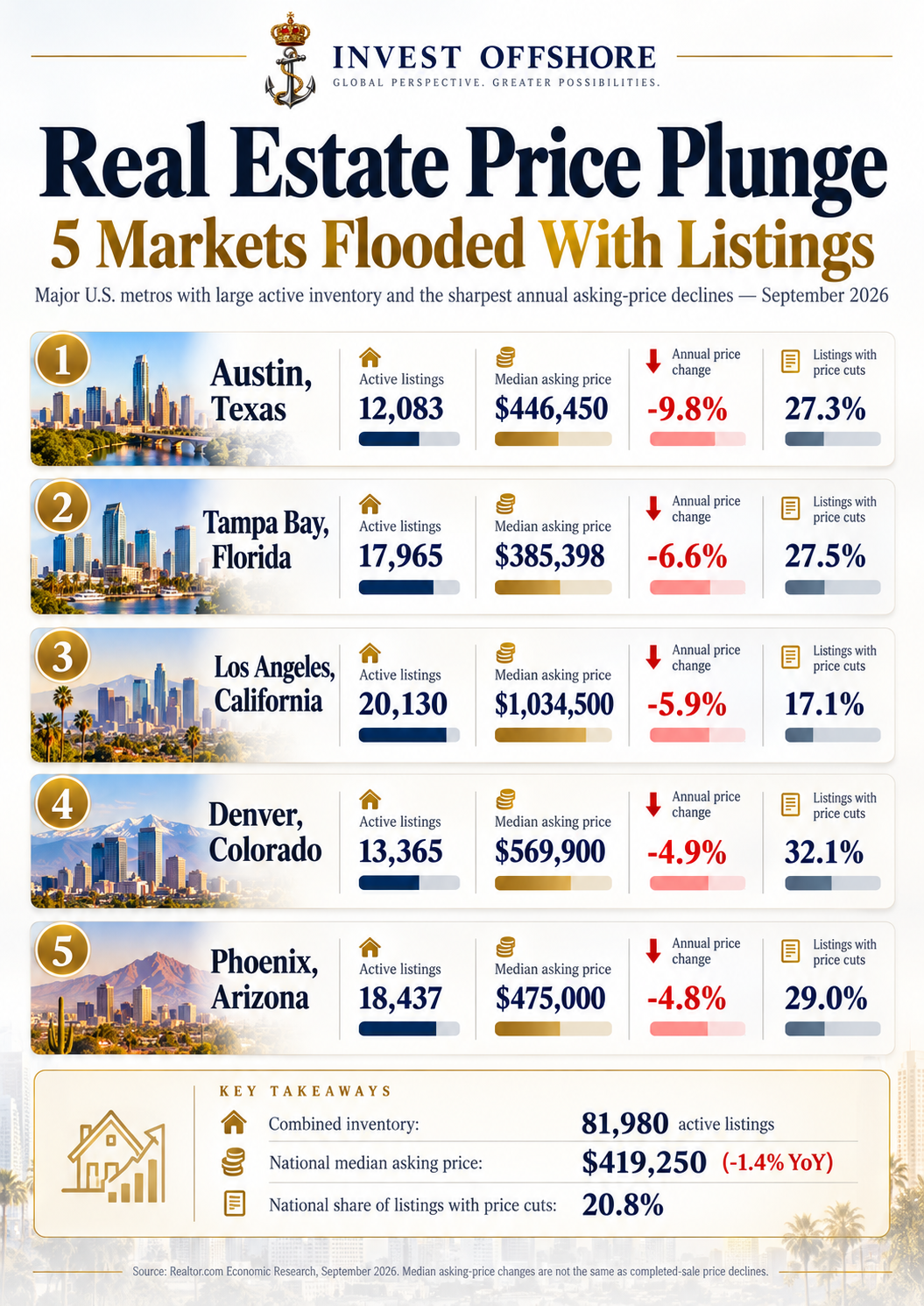
The following ranking examines the 50 largest U.S. metropolitan areas, selecting markets with at least 12,000 active residential listings and ranking them by the largest annual decline in median listing prices.
| Metropolitan market | Active listings | Median asking price | Annual price change | Listings with price cuts |
|---|---|---|---|---|
| 1. Austin, Texas | 12,083 | $446,450 | -9.8% | 27.3% |
| 2. Tampa Bay, Florida | 17,965 | $385,398 | -6.6% | 27.5% |
| 3. Los Angeles, California | 20,130 | $1,034,500 | -5.9% | 17.1% |
| 4. Denver, Colorado | 13,365 | $569,900 | -4.9% | 32.1% |
| 5. Phoenix, Arizona | 18,437 | $475,000 | -4.8% | 29.0% |
| Combined inventory | 81,980 |
Source: Realtor.com Economic Research, September 2026. All amounts are USD. Median asking-price changes are not the same as declines in completed transaction prices. The percentage of listings with price cuts describes how often sellers reduced asking prices, not the size of those discounts.
1. Austin, Texas — The Technology Boom Meets a Housing Reset
Austin experienced one of America’s most dramatic property booms during the pandemic, supported by corporate relocations, technology investment, population growth, and an influx of buyers from more expensive states.
The market has since been forced to adjust.
By September 2026, the median asking price had fallen 9.8% from a year earlier, reaching $446,450. More than 12,000 properties were actively listed, and approximately 27% of listings had undergone price reductions.
Homes remained on the market for a median of 80 days, considerably longer than the national average of 61 days.
The investment opportunity: Austin presents an opportunity to investigate residential properties acquired at prices substantially below those demanded during the boom.
Investors should pay particular attention to newer residential developments, motivated sellers, and properties with verifiable rental demand.
Austin’s challenge is not a lack of economic activity. It is determining whether valuations have fully adjusted to today’s financing costs and competitive supply.
2. Tampa Bay, Florida — Sunshine, Supply, and Seller Concessions
Florida remains one of America’s most attractive destinations for domestic migration, retirement, and international real estate investment.
However, even highly desirable locations are not immune to repricing.
Across the Tampa–St. Petersburg–Clearwater metropolitan area, nearly 18,000 residential properties were available in September 2026.
The median asking price declined 6.6% to $385,398, while 27.5% of listings experienced price reductions.
Properties spent a median of 76 days on the market.
Interestingly, Tampa’s active inventory actually declined 3.8% from September 2025. This is a market experiencing significant price adjustments despite tighter available supply, rather than a straightforward inventory glut.
The investment opportunity: Tampa offers potential entry points into Florida’s residential and retirement markets, particularly where motivated sellers are prepared to negotiate.
However, investors must account for a cost that cannot be ignored: insurance.
Flood exposure, hurricane risk, property insurance premiums, condominium association obligations, and potential special assessments can substantially alter an investment’s profitability.
A lower purchase price does not automatically produce a better investment.
3. Los Angeles, California — Luxury Property Meets Pricing Reality
Few metropolitan real estate markets have accumulated as much wealth and international investment interest as Los Angeles.
Yet even this historically expensive market is showing signs of adjustment.
The median asking price declined 5.9% year over year to approximately $1.03 million.
More than 20,000 residential properties were actively listed throughout the Los Angeles–Long Beach–Anaheim metropolitan area, the largest absolute inventory among our five selected markets.
Approximately 17.1% of listings had price reductions.
That percentage is below the national average, suggesting Los Angeles remains a comparatively competitive market despite declining median asking prices.
The investment opportunity: The most interesting possibilities may be found among individually distressed sellers, properties requiring renovation, and higher-priced homes that have remained unsold.
International investors should recognize that Los Angeles is not experiencing a uniform market collapse.
Real estate is intensely local. Two properties separated by only a few kilometres can experience entirely different demand, insurance costs, rental economics, and valuation trends.
This is a market for disciplined acquisition rather than indiscriminate bargain hunting.
4. Denver, Colorado — One in Three Listings Gets a Price Cut
Denver offers perhaps the clearest example of sellers adjusting their expectations.
The metropolitan market recorded 13,365 active residential listings in September 2026, an increase of 6.7% year over year.
The median asking price declined 4.9% to $569,900.
More significantly, 32.1% of listings had experienced price reductions.
That is nearly one in three properties.
Denver therefore stands out not merely for declining median prices, but for the unusually widespread nature of seller repricing.
The investment opportunity: Investors may discover motivated sellers who purchased near previous market highs or who must compete against newly available properties.
Suburban single-family homes, residential income properties, and selected renovation opportunities merit investigation.
The essential consideration is whether purchase prices can generate acceptable returns after financing, taxes, maintenance, insurance, and vacancy allowances.
5. Phoenix, Arizona — The Desert Housing Boom Recalibrates
Phoenix was another major beneficiary of America’s pandemic-era migration and housing boom.
Its economic appeal, relatively affordable housing, and expanding metropolitan footprint attracted buyers and developers.
But the market is now confronting a more competitive environment.
Phoenix recorded 18,437 active residential listings in September 2026, representing annual inventory growth of 7.5%.
The median asking price declined 4.8% to $475,000.
Approximately 29% of listings experienced price reductions.
Unlike Tampa, Phoenix is experiencing both growing available inventory and falling asking prices.
The investment opportunity: Phoenix deserves attention from investors seeking income-producing residential properties at more sustainable entry valuations.
Potential opportunities may emerge among competing suburban developments, properties requiring cosmetic improvements, and sellers facing extended marketing periods.
Investors must nevertheless consider long-term water availability, climate exposure, property maintenance, and the economics of rental demand.
What About Miami and Dallas?
Two enormous metropolitan markets deserve special attention, even though their recent asking-price declines were less dramatic.
Miami–Fort Lauderdale–West Palm Beach recorded approximately 41,277 active listings in September 2026, with the median asking price declining 2.0%.
Dallas–Fort Worth recorded 29,364 active listings, but its median asking price declined only 0.6%.
Both offer large pools of potential acquisitions. Their smaller annual price adjustments, however, place them outside this particular ranking.
For international investors, Miami remains especially relevant because of its established cross-border property market, condominium inventory, and appeal to Latin American and Canadian capital.
The Opportunity: Buying During a Repricing Cycle
These five selected markets collectively account for 81,980 actively listed residential properties.
That figure represents a substantial pool of potential acquisitions, but inventory alone does not prove that properties are undervalued.
Investors should distinguish between three separate conditions:
- Asking-price corrections: Sellers are lowering advertised prices to attract buyers.
- Completed-sale price declines: Actual transaction prices are falling.
- Investment-value opportunities: An individual property can be acquired at a price that supports an attractive risk-adjusted return.
The third condition is what matters most.
A property discounted from $600,000 to $500,000 is not necessarily a bargain if its sustainable rental income only supports a $400,000 valuation.
Likewise, a property with a modest discount may prove attractive when it has strong rental demand, reliable tenants, conservative financing, and limited future maintenance requirements.
International investors should also assess exchange-rate exposure, property management, ownership structures, tax consequences, and eventual exit liquidity.
What Investors Should Watch Heading Into 2027
The direction of the American housing market will depend heavily on financing costs, employment, household affordability, and the relationship between available inventory and qualified buyers.
Three indicators will be particularly revealing.
First, whether price reductions translate into actual completed sales. Asking-price adjustments alone cannot establish a sustainable market bottom.
Second, whether available inventory continues expanding faster than housing demand. Excessive supply can create further downward pressure, particularly in markets with extensive residential construction.
Third, whether declining purchase prices are sufficient to restore attractive investment yields.
A genuine investment opportunity requires more than a lower price. It requires an economically defensible entry point.
Conclusion: The Buyers With Liquidity May Have the Advantage
Real estate markets rarely adjust uniformly.
The correction in Austin looks different from the repricing in Los Angeles. Tampa’s insurance challenges differ from Phoenix’s climate considerations. Denver’s widespread seller price reductions tell a different story from markets where owners remain reluctant to negotiate.
Nevertheless, one common theme is emerging.
The era when sellers could confidently expect buyers to absorb almost any asking price appears to be giving way to a more disciplined market.
For investors with available liquidity, patience, and the ability to conduct thorough due diligence, these changing conditions can create opportunities unavailable during the speculative buying frenzy.
The objective should not be to predict the exact bottom of the housing market.
It should be to acquire quality real estate at prices that make financial sense.
And with nearly 82,000 properties listed across these five markets, investors have a substantial selection to investigate.
Invest Offshore will continue examining international real estate markets, price adjustments, capital flows, and opportunities for investors seeking geographically diversified property holdings.
Research sources
Leave a Reply