
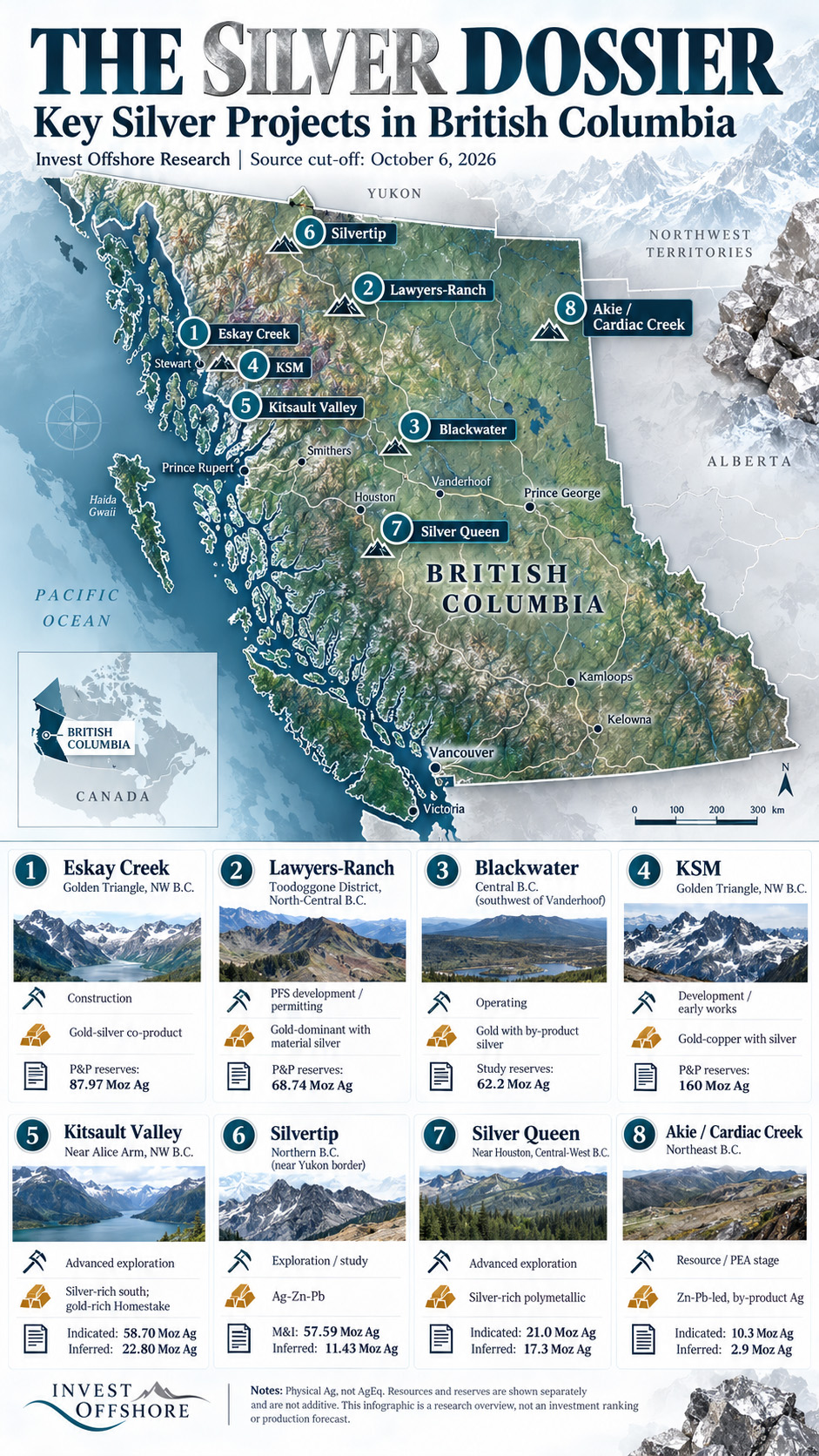
Invest Offshore prepares a comprehensive examination of British Columbia’s silver mining industry for the Vancouver Mining Exploration Group’s December 3, 2026 Short Course.
British Columbia may be better known for its gold and copper, but beneath the province’s mountains lies another significant mineral story: silver.
From high-grade underground deposits in the province’s northwest to enormous polymetallic developments capable of producing silver alongside gold, copper, lead and zinc, British Columbia possesses a remarkably diverse silver mining landscape.
Invest Offshore is preparing The Silver Dossier, a research presentation examining the province’s silver mining industry, its historical foundations, significant deposits, development pipeline and emerging investment opportunities.
The research will form the basis of a 30-minute presentation at the Vancouver Mining Exploration Group (Vancouver MEG) annual Short Course on December 3, 2026.
At its heart is a fundamental question:
Where does British Columbia’s silver stand today, and which projects could shape its mining future?
Eight Projects, Eight Different Silver Stories
One of the central components of The Silver Dossier is a comparative examination of eight significant British Columbia mining projects.
Rather than treating every silver-bearing deposit as equivalent, our research distinguishes between primary silver opportunities, gold-silver co-products and large polymetallic operations where silver contributes additional economic value.
The accompanying comparison identifies each project’s development stage, silver’s role within the mineral deposit, the applicable mineral resource or reserve classification, reported grade, and contained silver ounces.
British Columbia Silver: Project Comparison
The Silver Dossier | Research Cut-Off: October 6, 2026
The comparison presents reported physical silver inventories, rather than silver-equivalent figures. Mineral resources and reserves are presented separately and should not be added together. Estimates have different effective dates and require updating before the December presentation.
The Projects Under Examination
The dossier moves beyond headline silver prices and examines the geological and development realities behind eight noteworthy projects.
Eskay Creek — Silver as a Significant Co-Product
Currently classified as under construction in our October research, Eskay Creek illustrates the importance of silver within a gold-silver deposit.
Its reported Proven and Probable reserves contain approximately 87.97 million ounces of silver at an average grade of 68.7 grams per tonne, based on the November 2023 reserve estimate.
Lawyers-Ranch — A Substantial Gold-Silver Inventory
At the pre-feasibility development and permitting stage, Lawyers-Ranch demonstrates how silver can represent a material component of a gold-dominant mining project.
Its reported Proven and Probable reserves contain approximately 68.74 million ounces of silver.
Blackwater — Silver Within an Operating Gold Mine
Blackwater provides an important operating-mining perspective.
Its cited study reserves include 62.2 million ounces of silver at 5.8 grams per tonne. However, these figures retain a September 2021 reserve estimate and represent the study inventory before subsequent mining depletion.
This distinction highlights why research must differentiate historical estimates from remaining mine inventories.
KSM — The Power of Scale
KSM offers a striking illustration of the difference between mineral grade and contained metal.
Although its reported reserve grade is approximately 2.2 grams of silver per tonne, the enormous scale of the gold-copper development translates into approximately 160 million ounces of contained silver in its cited Proven and Probable reserves.
The estimate dates to May 2022.
KSM demonstrates why low-grade silver contained within large polymetallic deposits deserves attention when evaluating British Columbia’s broader mineral endowment.
Kitsault Valley — A Developing Silver-Rich Opportunity
Kitsault Valley combines silver-rich southern deposits with the gold-rich Homestake deposit.
Its September 2026 technical report identifies approximately 58.70 million ounces of silver in Indicated resources and a further 22.80 million ounces in Inferred resources.
These are resources, not mineral reserves, and are reported separately in the dossier.
Silvertip — High-Grade Polymetallic Potential
Silvertip stands out for its reported silver grades.
Year-end 2025 resource tables identify approximately 57.59 million ounces of silver in Measured and Indicated resources, averaging 214.68 grams per tonne.
A further 11.43 million ounces are classified as Inferred.
The silver-zinc-lead deposit illustrates the potential significance of high-grade polymetallic resources, although its ultimate revenue mix and project economics require separate evaluation.
Silver Queen — Advanced Exploration with Meaningful Silver Grades
Silver Queen is another notable advanced-exploration opportunity.
The September 2026 resource announcement identifies 21 million ounces of silver in Indicated resources at 184 grams per tonne, alongside 17.3 million ounces in Inferred resources at 104 grams per tonne.
Verification of the supporting technical report remains part of the dossier’s research agenda.
Akie/Cardiac Creek — Silver Beyond the Precious Metals Sector
Finally, Akie/Cardiac Creek demonstrates silver’s supporting role in base-metal development.
Its cited resource inventory contains approximately 10.3 million ounces of Indicated silver and 2.9 million ounces of Inferred silver, based on the 2018 preliminary economic assessment resource figures.
The project reinforces an important theme: British Columbia’s silver potential cannot be understood by examining precious-metal-focused companies alone.
Why Silver Deserves a Closer Look
Silver occupies an unusual position in the global commodity landscape.
It is simultaneously a precious metal, an investment asset and an industrial material.
Its applications extend across electronics, photovoltaic technologies, electrical infrastructure and other advanced manufacturing processes. This combination gives silver exposure to monetary sentiment and industrial demand.
For British Columbia, however, the investment story involves more than anticipating a higher silver price.
The province’s mining future depends on exploration success, metallurgy, infrastructure, permitting, capital availability and the commercial feasibility of bringing individual deposits into production.
Importantly, silver recovered as a co-product or by-product of gold, copper, zinc and lead production can contribute to a project’s economics even when silver is not its principal revenue source.
Understanding these distinctions is central to The Silver Dossier.
From Historical Silver Camps to Modern Mining Opportunities
The December presentation will extend beyond the eight-project comparison.
It will connect British Columbia’s historical silver mining legacy with the evolution of modern exploration, resource estimation and mine development.
The study will consider how the industry has progressed from historic underground mining districts to increasingly sophisticated geological modelling, large-scale mineral projects and the economic importance of recovering multiple metals from a single operation.
It will also examine the distinction between mineral resources, economically mineable reserves and actual silver production.
These categories are frequently confused in public discussions of mining investment.
A resource estimate does not establish that a mine will be built. Similarly, contained silver ounces do not automatically translate into recoverable or payable production.
Invest Offshore believes that presenting these distinctions clearly is essential to understanding both the opportunity and the associated investment risks.
Vancouver MEG: December 3, 2026
The upcoming Vancouver Mining Exploration Group Short Course provides an opportunity to bring this research to an audience familiar with the geological, technical and commercial realities of mineral exploration.
The Silver Dossier is being developed around three principal objectives:
- Present an accessible historical overview of British Columbia’s silver mining industry.
- Compare significant operating, development and exploration-stage projects using clearly defined technical measurements.
- Identify the geological, economic and strategic factors that could influence the province’s next generation of silver mines.
The research will be updated ahead of the December presentation to incorporate material changes in technical reporting, project development and available mineral inventory information.
The Bigger Picture: British Columbia’s Silver Future
What emerges from the initial research is not a single winning project, but a province with multiple forms of silver exposure.
Some opportunities derive from exceptionally large deposits. Others offer considerably higher grades within smaller mineral inventories. Still others demonstrate the economic contribution silver can make to gold and base-metal mining.
For investors, analysts and mining professionals, understanding these differences is more valuable than simply comparing headline ounces.
The Silver Dossier is an invitation to look more closely at a mineral that has helped shape British Columbia’s mining history and may play an important role in its industrial future.
Invest Offshore looks forward to presenting its findings at the Vancouver Mining Exploration Group Short Course on December 3, 2026.
Invest Offshore | Independent Mining, Markets & Investment Research
Research note: The accompanying comparison uses source material reviewed through October 6, 2026. Figures reflect different technical-report effective dates. Physical silver inventories, mineral resource categories and mineral reserves are deliberately distinguished. The comparison is not an investment ranking, a province-wide reserve calculation or a forecast of future production.
The project figures and qualifications above follow the supplied two-page research chart.
Leave a Reply