
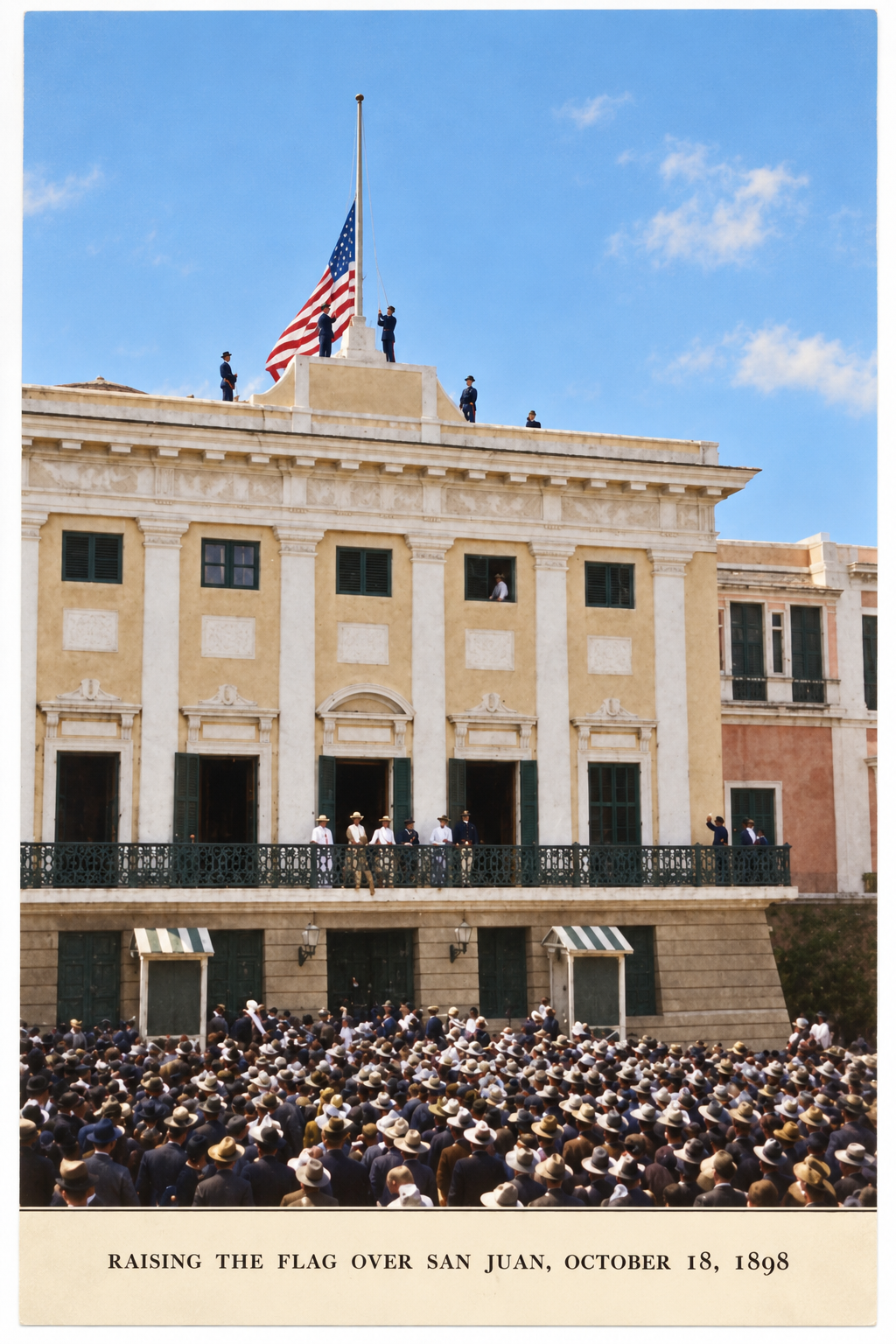
On this day in history, Puerto Rico exchanged more than 400 years of Spanish colonial rule for American sovereignty. What was presented as a new beginning became one of the longest unresolved political questions in modern American history.
The Day Puerto Rico Changed Hands
On October 18, 1898, the American flag was raised over Puerto Rico, formally marking the beginning of United States military administration following the Spanish-American War.
The ceremony represented a decisive geopolitical victory for Washington. For Puerto Ricans, however, it began another complicated chapter in their long pursuit of political equality, economic independence, and self-determination.
The island had endured more than four centuries of Spanish colonial domination. Its people had developed a distinct national identity, fought for political reforms, and struggled to secure greater control over their own affairs.
By 1897, Spain had granted Puerto Rico an Autonomic Charter, creating an opportunity for limited self-government. Elections followed in March 1898.
That experiment was abruptly interrupted by war.
July 25, 1898: The American Invasion
On July 25, American troops commanded by General Nelson A. Miles landed at Guánica, beginning the United States invasion of Puerto Rico.
The military campaign lasted approximately three weeks.
With Spain’s defeat imminent, an armistice was agreed upon on August 12, followed by arrangements for the evacuation of Spanish military forces.
On October 18, the remaining Spanish forces departed and Major General John R. Brooke assumed military administration of the island.
The transition was initially welcomed by some Puerto Ricans who hoped American democracy would deliver greater freedoms, economic opportunity, and meaningful political representation.
Others recognized that the departure of one colonial power did not necessarily guarantee independence from another.
History would demonstrate the importance of that distinction.
The Treaty of Paris: A Nation’s Future Decided Without Its People
On December 10, 1898, Spain and the United States signed the Treaty of Paris, formally establishing the terms of Spain’s territorial concessions.
Under Article II, Spain ceded Puerto Rico, Guam, and other Spanish possessions in the West Indies to the United States.
Puerto Rico had no independent delegation negotiating its future.
Its inhabitants were not given the opportunity to determine whether they wished to become independent, enter the United States, or pursue another political arrangement.
Indeed, Article IX left the civil rights and political status of the inhabitants of the ceded territories to the determination of the United States Congress.
It was a remarkable contradiction: a republic founded upon the principle of government by consent had acquired an island without obtaining the consent of its people.
Puerto Rico had changed flags, but it had not secured sovereignty.
From Spanish Colonialism to American Economic Control
The political transition of 1898 also fundamentally transformed Puerto Rico’s economy.
American investment expanded rapidly, particularly within the sugar and tobacco industries. Large mainland corporations increasingly controlled agricultural production, while many local landowners lost economic influence.
Sugar became a defining export of the new economic order.
Puerto Rico experienced industrial and commercial development, but the resulting prosperity was distributed unevenly.
Foreign ownership, agricultural concentration, poverty, and dependence on external markets exposed a fundamental weakness in the island’s development model: economic expansion did not necessarily translate into economic empowerment for its inhabitants.
The Library of Congress documents how American investment brought substantial growth without resolving the severe social inequalities affecting much of Puerto Rico’s population.
This is an important historical lesson for international investors.
Capital entering a jurisdiction is not automatically equivalent to prosperity for the communities living there. The ultimate questions concern ownership, productive capacity, economic participation, and who retains the benefits.
American Citizens Without Full Political Equality
The twentieth century introduced important reforms, but none conclusively resolved Puerto Rico’s political status.
1900 — The Foraker Act: Established civilian government under American authority, with significant powers retained by federally appointed officials.
1917 — The Jones-Shafroth Act: Granted United States citizenship to Puerto Ricans and reorganized the island’s government, expanding elected representation.
1952 — Commonwealth Status: Puerto Rico adopted its own constitution and established the Commonwealth of Puerto Rico, known locally as the Estado Libre Asociado.
Although these developments expanded local self-government, they did not establish Puerto Rico as an independent sovereign nation or grant it American statehood.
Today, Puerto Ricans are United States citizens, but residents of the island cannot vote in the general election for President.
Puerto Rico elects a Resident Commissioner to the U.S. House of Representatives, but that representative cannot cast a vote on final legislation on the House floor.
Congress continues to exercise ultimate constitutional authority over the territory.
For critics of the existing arrangement, this represents a fundamental democratic contradiction: American citizenship without equal national political representation.
The Financial Dimension: Who Controls Puerto Rico’s Future?
For Invest Offshore readers, Puerto Rico’s experience illustrates how political status, sovereign authority, and financial independence are deeply interconnected.
In 2016, Congress enacted the Puerto Rico Oversight, Management, and Economic Stability Act (PROMESA), establishing a federally created Financial Oversight and Management Board in response to the island’s debt crisis.
The board was empowered to oversee fiscal planning and facilitate debt restructuring.
Supporters regarded this intervention as necessary to restore fiscal stability and access to capital markets. Critics viewed the imposition of an unelected oversight authority as another demonstration of Puerto Rico’s limited self-government.
The central issue remains relevant: how much control does a territory possess over its economic destiny when its financial administration can be subjected to an authority established by an external legislature?
Puerto Rico has also emerged as an attractive jurisdiction for international investors, entrepreneurs, and high-net-worth individuals through preferential tax arrangements, including incentives consolidated under Act 60.
Yet these opportunities have raised important questions about the distribution of economic benefits.
A December 2025 U.S. Government Accountability Office report found that recipients of Puerto Rico’s resident-investor tax incentive were generally high-income individuals who experienced substantial reductions in federal taxes after relocating. The GAO also noted that the overall economic effect of these incentives was difficult to isolate.
Puerto Rico’s challenge is therefore not simply attracting foreign capital.
It is ensuring that investment supports local enterprise, infrastructure, employment, affordable housing, and sustainable prosperity for Puerto Ricans themselves.
128 Years Later: The Question of Self-Determination Remains
Puerto Rico’s future continues to inspire competing political visions.
Some advocate statehood, arguing that equal American citizenship requires equal political representation.
Others support independence and the restoration of full national sovereignty.
Still others favor forms of autonomous government or free association that would redefine Puerto Rico’s relationship with the United States.
These differences matter. Puerto Ricans do not speak with a single political voice, and any genuine exercise of self-determination must respect that diversity.
But the fundamental question that emerged in 1898 remains unanswered:
Who should ultimately determine Puerto Rico’s political future?
The people who inhabit the island, or the government that acquired it through a treaty negotiated between two foreign powers?
Invest Offshore Perspective: Sovereignty Is More Than a Flag
Puerto Rico occupies a strategically important position in the Caribbean, connecting American capital markets with Latin America and the wider Atlantic economy.
Its opportunities in finance, tourism, technology, manufacturing, and international investment are substantial.
Yet the history of October 18, 1898, offers a reminder that political sovereignty and economic sovereignty cannot be entirely separated.
An economy can attract billions in external investment while its people continue struggling with questions of representation, ownership, and control.
A territory can possess its own constitution, cultural identity, and elected government without enjoying the full powers of an independent nation.
And citizenship, however valuable, does not automatically deliver political equality.
On the 128th anniversary of the American takeover, Puerto Rico’s story deserves to be remembered not merely as a chapter of the Spanish-American War, but as an unfinished historical journey.
More than four centuries of Spanish rule ended on October 18, 1898. Another era began.
The flag changed. The struggle for self-determination continued.
Invest Offshore | October 18, 2026
Historical and research references:
- Library of Congress — Today in History: October 18
- Library of Congress — The Changing of the Guard: Puerto Rico in 1898
- U.S. Department of State — Treaty of Paris, December 10, 1898
- Library of Congress — Puerto Rico and the United States
- U.S. Government Accountability Office — Puerto Rico Investor Tax Incentives, December 2025

Archival photograph: Raising the American flag in San Juan on October 18, 1898. National Park Service historical collection, via Fundación Luis Muñoz Marín.
Leave a Reply