
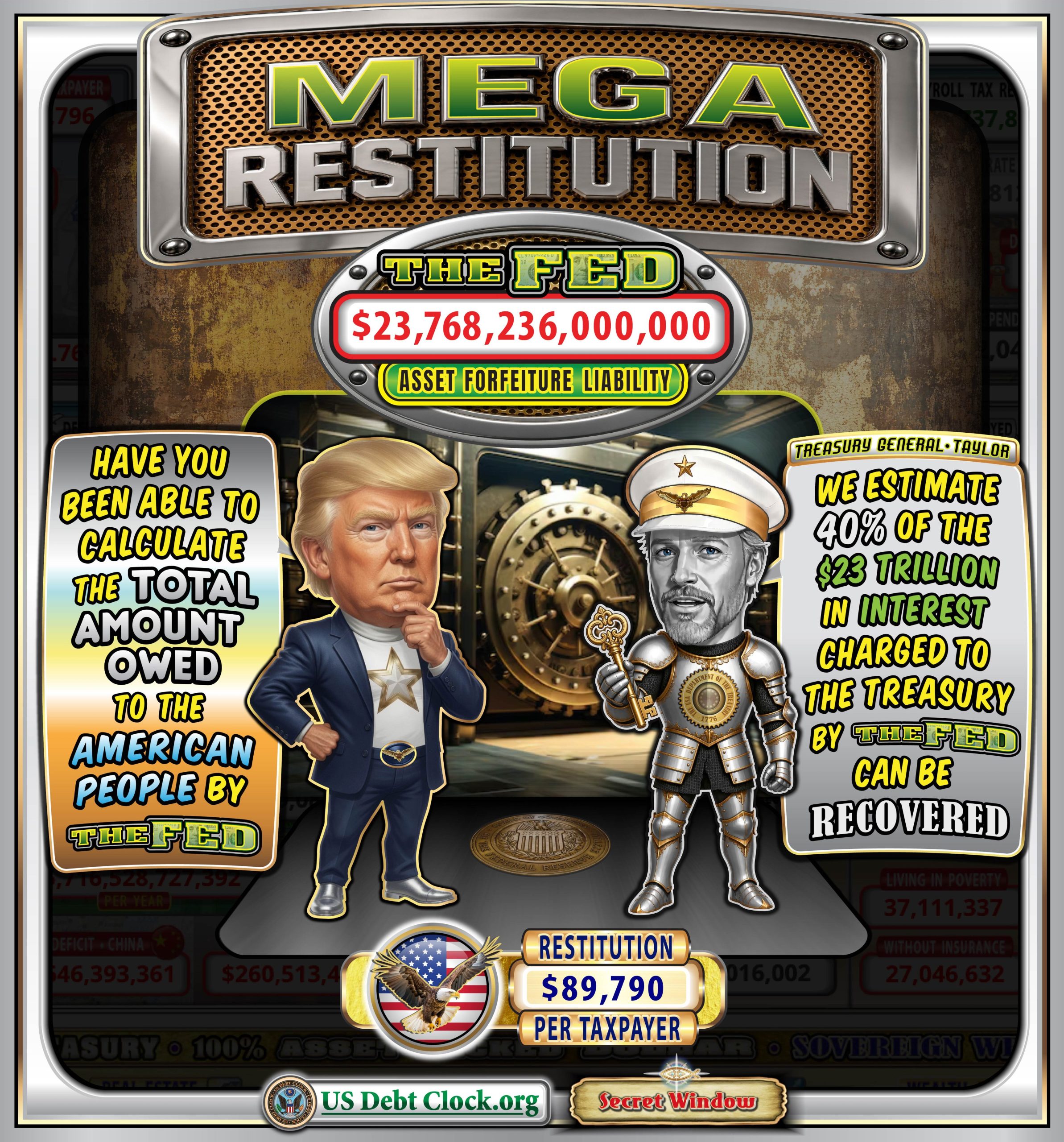
The US Debt Clock has released another explosive Secret Window poster, and the New Money Revolution has taken a remarkable turn.
Following The American Jubilee, which proposed eliminating national debt through asset revaluation, the latest poster reverses the question entirely.
What if America is not merely a debtor? What if there is money to recover?
The headline reads:
MEGA RESTITUTION
Standing before an enormous bank vault, DJT asks Treasury General Taylor:
“Have you been able to calculate the total amount owed to the American people by the Fed?”
The illustrated Treasury General responds:
“We estimate 40% of the $23 trillion in interest charged to the Treasury by the Fed can be recovered.”
Above them sits an extraordinary figure:
THE FED: $23,768,236,000,000
Asset Forfeiture Liability
And beneath it, the number designed to capture every taxpayer’s attention:
RESTITUTION: $89,790 PER TAXPAYER
The Debt Clock has moved beyond questioning the debt-money system. It is now presenting the possibility of financial recovery.
From American Jubilee to Mega Restitution
The progression is striking.
The American Jubilee asked when the nation’s debt could be eliminated. Its proposed answer was to revalue America’s underlying assets.
Mega Restitution goes further.
It suggests examining the financial obligations, interest flows, and potential recoverable claims associated with the existing monetary architecture.
One poster asks what America owns.
The next asks what America might be owed.
Together, they introduce an entirely different way of looking at the sovereign balance sheet.
For generations, Americans have been reminded of their share of the national debt. The Debt Clock is now inviting them to consider another possibility: whether a comprehensive monetary accounting could reveal value recoverable for public benefit.
The $23.8 Trillion Question
The image attributes approximately $23.8 trillion in purported asset-forfeiture liability to the Federal Reserve, while suggesting that 40% of an associated $23 trillion interest figure could be recovered.
These are extraordinary claims, and they require extraordinary documentation.
The poster does not establish an audited liability, an authorized forfeiture, or a legally enforceable restitution claim. Nor should interest paid on Treasury securities be confused with money owed by the Federal Reserve to taxpayers. Treasury interest reaches numerous debt holders, and Federal Reserve earnings have historically been remitted to Treasury.
Nevertheless, the question behind the illustration deserves examination:
Who ultimately benefits from America’s debt-service system, and how much of its financial burden could be reduced through genuine monetary reform?
That is the debate the Debt Clock is bringing into the foreground.
$89,790 Per Taxpayer: Making Restitution Personal
Trillions are difficult to comprehend.
Nearly $90,000 per taxpayer is not.
The poster’s restitution figure turns an abstract monetary argument into a household balance-sheet proposition.
Imagine the implications of a genuine, lawfully funded recovery program.
Families could reduce mortgages and consumer debt. Retirement accounts could be strengthened. Savings could become investment capital. Money previously committed to debt service could return to productive economic activity.
This connects directly to the Debt Clock’s recurring message: citizens should participate in national wealth rather than exist primarily as taxpayers servicing expanding liabilities.
Importantly, the $89,790 figure is an illustrative claim in the artwork, not an approved government payment or established taxpayer entitlement.
But its rhetorical purpose is unmistakable.
The poster wants Americans to think like stakeholders, not perpetual debtors.
The Vault, the Key, and the Treasury Dollar
The enormous vault behind the central characters is more than decoration.
Throughout the New Money Revolution series, vaults, precious metals, treasure chests, and Treasury seals have represented the search for America’s underlying wealth.
This time, Treasury General Taylor holds the key.
The symbolism suggests opening the financial books: examining reserves, assets, interest flows, ownership, liabilities, and recoverable claims.
It also connects Mega Restitution to the proposed 100% asset-backed USA Treasury Dollar.
The Debt Clock’s developing narrative now follows a recognizable sequence:
- Identify and revalue America’s national assets.
- Examine the true cost of the debt-money system.
- Determine whether legitimate financial recoveries exist.
- Strengthen the sovereign balance sheet.
- Build a Treasury-centered monetary framework designed to benefit the public.
This is the proposed transformation from debt dependency toward an ownership-based economy.
For investors, however, the distinction between a claimed asset and a legally recoverable asset remains essential. A credible monetary system requires verified valuations, enforceable ownership, transparent accounting, and genuine reserves.
Why Offshore Investors Should Pay Attention
For Invest Offshore readers, the significance extends beyond the dramatic headline.
Sovereign balance sheets underpin currency confidence, Treasury markets, precious-metals valuations, private banking, and international capital flows.
Any serious restructuring of American monetary policy would raise fundamental questions about the ownership, valuation, custody, and liquidity of national assets.
Gold and silver would remain central to that conversation. So would productive infrastructure, strategic resources, sovereign credit, and asset-backed financial instruments.
But the most important principle is simpler:
Real restitution must represent recoverable value — not another layer of unsupported monetary issuance.
That distinction separates genuine wealth restoration from financial illusion.
Conclusion: What If the Balance Sheet Has Two Sides?
The US Debt Clock’s Mega Restitution poster delivers one of the boldest propositions in its New Money Revolution series.
The conventional narrative asks how Americans will repay the national debt.
The American Jubilee asks whether properly recognized national assets could help reduce that burden.
Mega Restitution asks whether additional value could be recovered on behalf of the people.
The poster’s trillion-dollar figures remain unverified, and no restitution program is established by the artwork. But its central challenge is worth considering.
America’s financial future should not be evaluated exclusively by what it owes. It must also account for what it owns, what it produces, and any value it can legitimately recover.
The American Jubilee asks how the debt might disappear.
Mega Restitution asks whether the people might receive something back.
That is a remarkable reversal of the national debt conversation.
And it brings the New Money Revolution to its most provocative question yet:
What if the next great American financial transformation begins not with another bill to the taxpayer, but with a full accounting of the nation’s wealth?
Invest Offshore continues tracking the New Money Revolution, Treasury reform, precious-metals revaluation, asset-backed finance, and the global implications of America’s evolving monetary debate.
Leave a Reply