
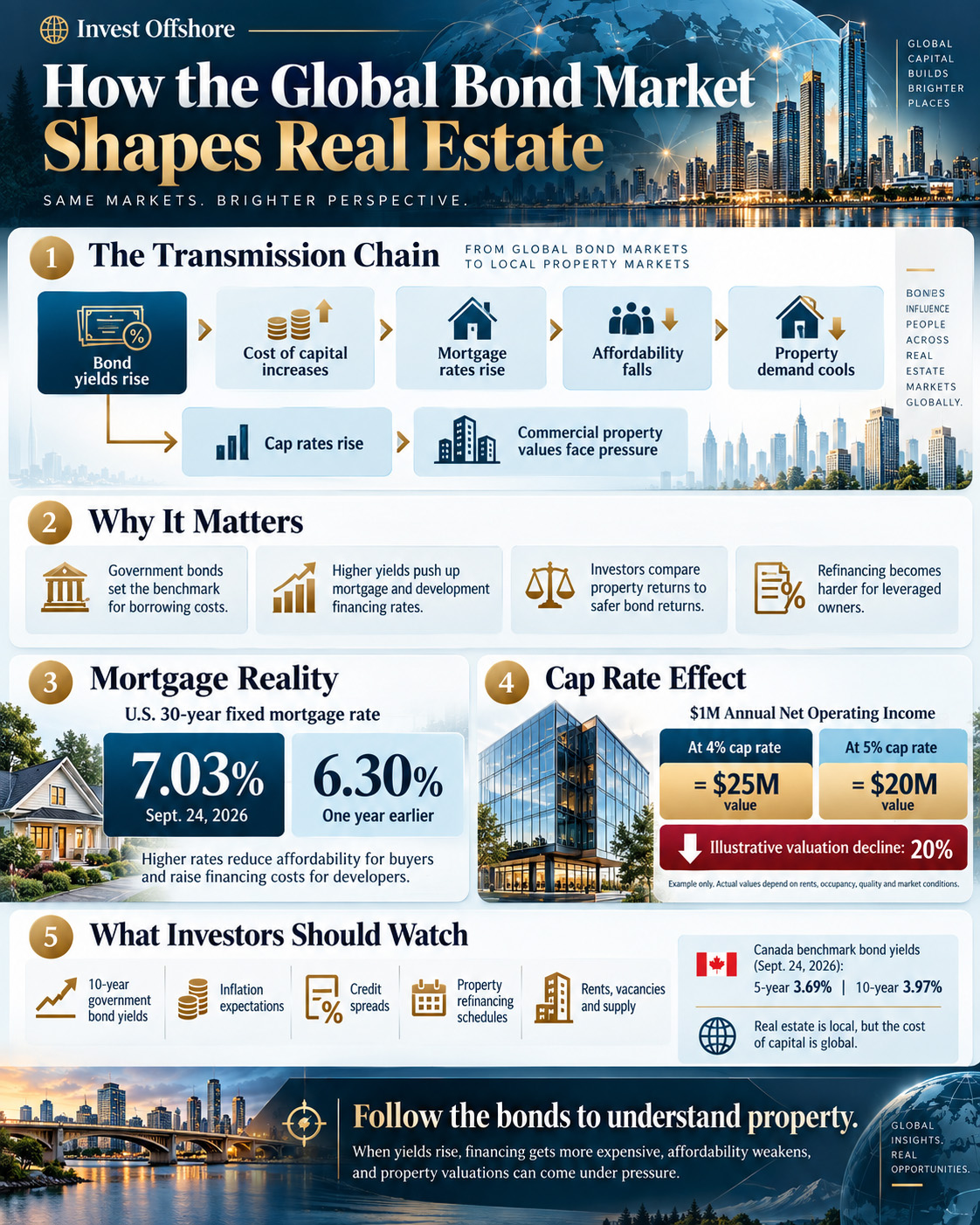
How government debt, rising bond yields and the global cost of capital are reshaping property markets—and what investors should watch.
The global real estate market has a powerful financial force operating behind the scenes: the bond market. From luxury condominiums in Vancouver to commercial office towers in Manhattan, property valuations are increasingly influenced by movements in government bond yields, inflation expectations and international capital flows.
For property investors, understanding the relationship between bonds and real estate has become essential. Governments are borrowing, investors are demanding returns on their capital, and central banks are navigating the competing pressures of inflation and economic growth.
Consider the American housing market. As of September 24, 2026, the average US 30-year fixed mortgage rate stood at 7.03%, compared with 6.30% a year earlier, according to Freddie Mac.
Freddie Mac
Higher financing costs have direct consequences for prospective homeowners, property developers and institutional investors.
But mortgage rates are only the beginning. The bond market also influences commercial real estate valuations, construction financing, international property investment and the refinancing of existing debt.
To understand where the property market may be heading, investors need to understand what is happening in the world’s bond markets.
1. Understanding the world’s bond market
The global bond market is where governments, financial institutions and corporations borrow money from investors.
When the United States issues Treasury bonds, Germany sells Bunds, Japan issues Japanese Government Bonds or Canada auctions federal debt, they are competing for capital in interconnected financial markets.
According to the Bank for International Settlements, debt securities markets encompass government and corporate bonds, commercial paper and asset-backed securities, across both domestic and international markets.
BIS Data Portal
The most important relationship for property investors is between bond prices and bond yields. When bond prices fall, their yields rise, and vice versa.
Government bond yields establish a benchmark against which other investments are priced. Mortgage lenders, commercial property investors and real estate developers must all consider the returns available from government debt when deciding how much they are willing to lend, borrow or pay for property.

2. Why government borrowing matters to property investors
Governments can issue enormous quantities of debt to finance deficits, refinance maturing obligations and support public spending.
When investors demand higher yields to absorb that debt, the effects can extend across the financial system.
In its April 2026 Global Financial Stability Report, the International Monetary Fund highlighted elevated public debt, higher energy prices, inflation pressures and rising bond yields as important financial-stability concerns.
IMF
The implications for real estate are substantial.
Banks and other lenders must attract funding at competitive rates. If government bonds offer higher returns, investors may demand correspondingly higher returns from mortgage-backed securities and corporate lending.
Property developers therefore face a difficult combination: higher borrowing costs, potentially higher construction costs and buyers with less purchasing power.
Importantly, central banks do not control all these factors. Even when a central bank cuts its policy rate, longer-term bond yields can rise because of inflation expectations, government borrowing requirements or changing investor risk preferences.
3. The mathematical relationship between bond yields and property values
Commercial real estate is particularly sensitive to interest rates because income-producing property is generally valued according to its expected cash flow.
One common valuation tool is the capitalization rate, or cap rate.
The calculation is straightforward: property value equals annual net operating income divided by the capitalization rate.
Consider an office building generating $1 million in annual net operating income.

This demonstrates why relatively modest changes in interest rates can significantly affect commercial property valuations.
Higher government bond yields do not automatically force every property’s cap rate higher. Rental growth, occupancy, building quality and expectations about future interest rates also matter.
Nevertheless, bonds establish an important alternative investment return. When investors can earn attractive yields on comparatively liquid government securities, they may become less willing to accept low returns from illiquid property assets.
4. The global refinancing challenge
One of the most consequential effects of higher bond yields is felt when existing real estate loans mature.
A developer who financed an office tower during a period of exceptionally low interest rates may discover that refinancing now requires substantially higher annual interest payments.
Even when a building maintains its rental income and occupancy, the economics of ownership can deteriorate.
This creates three pressures simultaneously: debt-service costs increase, lenders may reduce the amount they are willing to advance, and property valuations may decline.
In its May 2026 Financial Stability Review, the European Central Bank reported that euro-area commercial real estate markets were showing signs of stabilization, but transaction volumes remained approximately 60% below their 2019 peak. It also identified persistent structural challenges in the office sector, particularly among lower-quality properties.
European Central Bank
For investors, refinancing risk is therefore as important as current rental income. A property that appears profitable on existing financing terms may face a very different outlook when that debt matures.
5. Why a global bond market creates global property risks
Real estate may be local, but the capital financing it is increasingly international.
Canadian mortgage rates are influenced by global bond markets, not simply the Bank of Canada’s overnight policy rate. The Bank of Canada itself notes that international interest-rate movements affect Canadian banks’ funding costs and domestic fixed-rate mortgages.
Bank of Canada
On September 24, 2026, Canada’s benchmark five-year government bond yielded 3.69%, while its ten-year benchmark yielded 3.97%.
Bank of Canada
International investors must also account for currency risk. A property investment in London, Toronto or Dubai may generate an attractive local-currency return but a disappointing return when translated into the investor’s home currency.
Currency hedging introduces another financing cost, which can be influenced by differences between countries’ interest rates.
This explains why property capital can move between markets even when local rental fundamentals have barely changed.
6. Not all real estate responds the same way
Higher bond yields do not necessarily produce a universal property downturn.
Residential markets with severe housing shortages may maintain relatively resilient prices despite higher mortgage costs. Commercial properties with strong rental growth and long-term tenants may also absorb higher financing costs.
By contrast, highly leveraged developments and buildings facing substantial vacancies are generally more exposed to refinancing pressures.
Newer property sectors are introducing additional distinctions. The IMF’s April 2026 report identifies data centers as an expanding component of commercial real estate, supported by AI infrastructure investment, while also highlighting risks associated with speculative development, financing structures and power constraints.
IMF eLibrary
Investors should consequently avoid treating all property sectors as a single asset class.
7. What investors should watch next
The bond and property investor’s watchlist
Five indicators that help explain changing property-market conditions.
| 10-year government bond yields | Benchmark for longer-term financing and investment returns. |
| Inflation expectations | Influence future interest rates, construction costs and bond pricing. |
| Credit spreads | Reveal how much additional compensation lenders require for taking private credit risk. |
| Property refinancing schedules | Identify when existing loans must be replaced at prevailing market rates. |
| Rent, vacancies and supply | Show whether operating fundamentals can offset higher financing costs. |
Investors should pay particular attention to the reason bond yields are rising or falling. Higher yields driven by stronger economic growth can accompany improving rental demand, while lower yields caused by a recession may coincide with falling occupancy and declining income.
That distinction can matter more than the direction of yields alone.
Conclusion: Follow the bonds to understand property
The global bond market is not simply a separate arena for investors seeking fixed-income returns. It is a central part of the financial system that determines how property is financed, how much investors are willing to pay for it and whether existing debt can be refinanced sustainably.
For investors evaluating international real estate, the central questions extend beyond location, rental yield and potential capital appreciation. They include the cost and maturity of debt, government bond yields, credit conditions and currency exposure.
The price of a property may be negotiated locally, but the cost of the capital financing it is increasingly determined globally.
Understanding that relationship can help investors distinguish properties supported by sustainable cash flows from those whose valuations depend heavily on cheap financing.
Leave a Reply