
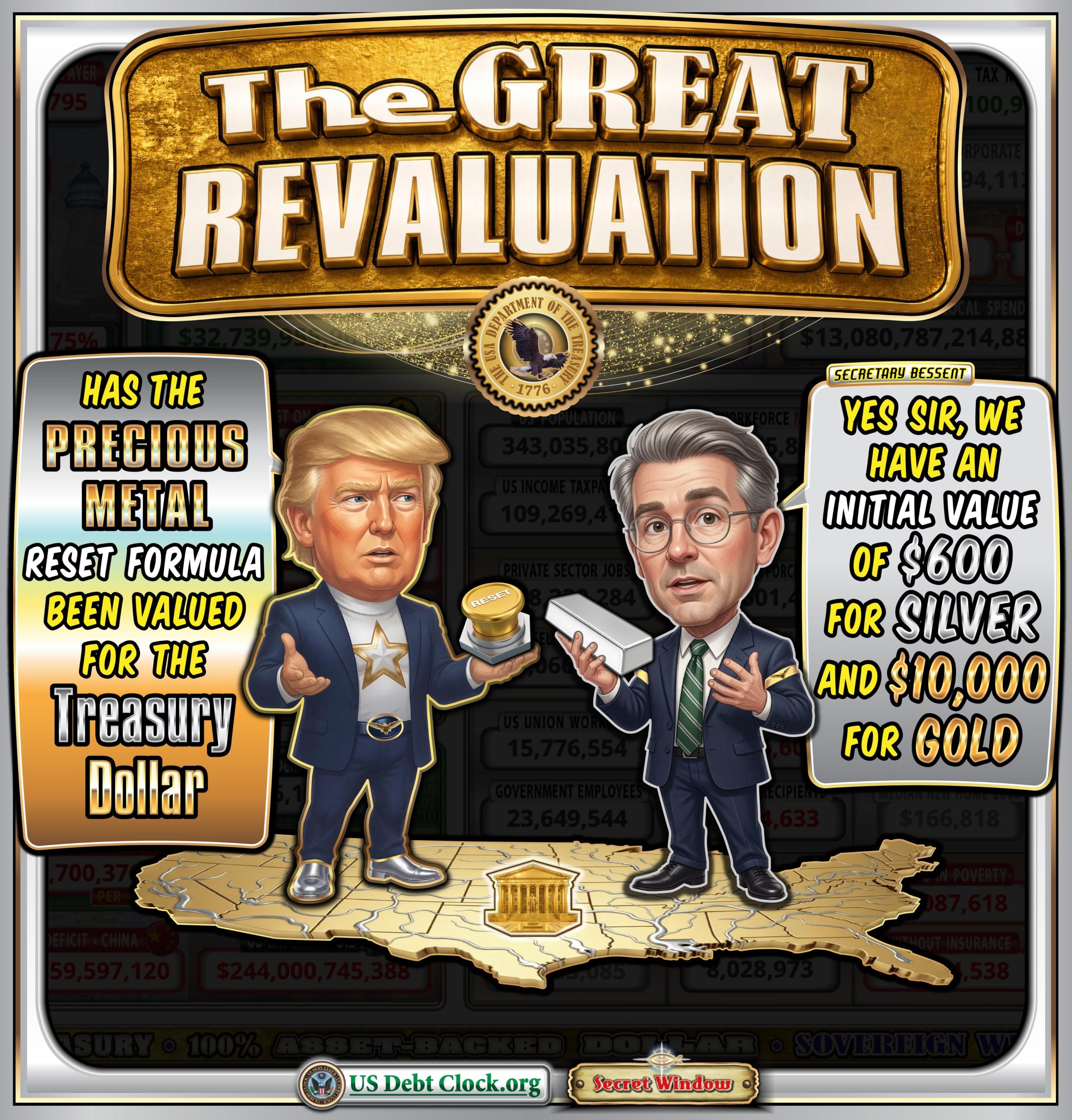
The US Debt Clock has released another “DJT” poster, and this one goes straight to the heart of the New Money Revolution:
The Great Revaluation
The poster shows the familiar DJT figure asking:
“Has the precious metal reset formula been valued for the Treasury Dollar?”
The answer comes from the Secretary Bessent figure:
“Yes sir, we have an initial value of $600 for silver and $10,000 for gold.”
That is the entire decode in one exchange.
The US Debt Clock is no longer merely talking about a new Treasury Dollar, tax deletion, credit reform, or a seamless transition. It is now suggesting that the proposed Treasury Dollar requires a precious-metals reset — a new reference value for gold and silver powerful enough to support an asset-backed monetary system.
Why This Poster Matters
Every monetary reset needs an anchor.
The Debt Clock has been hinting at a future system built on Treasury authority, sovereign wealth, public ownership, state credit unions, lower interest, and asset-backed money. But asset-backed money requires a question to be answered:
Backed by what — and valued at what price?
This poster answers: gold and silver must be revalued.
In the poster’s symbolic formula:
Gold becomes the sovereign reserve anchor.
Silver becomes the people’s monetary metal.
Treasury becomes the issuing authority.
The dollar becomes tied to real assets rather than endless debt.
That is the meaning of The Great Revaluation.
$10,000 Gold and $600 Silver
The numbers are dramatic.
$10,000 gold would represent a major repricing of sovereign reserves.
$600 silver would represent an even more explosive revaluation, especially because silver has both monetary and industrial demand.
The poster is not presenting a normal market forecast. It is presenting a reset value — an “initial value” for a new monetary architecture.
That distinction matters.
A market price is discovered through daily buying and selling.
A reset value is a reference price used to rebalance a system.
The Debt Clock is suggesting that if the Treasury Dollar is to be asset-backed, then the metals behind it cannot remain priced as ordinary commodities. They must be repriced as monetary foundation stones.
Why Gold Is the Anchor
Gold is the classic reserve metal. It is held by central banks, trusted across civilizations, and understood as ultimate settlement.
The U.S. Mint states that Fort Knox holds about 147.3 million ounces of gold, while Mint-held gold reserves across locations total more than 248 million ounces. United States Mint
That is why gold keeps returning in the Debt Clock storyline.
Gold is not just a shiny asset. It is monetary memory.
It represents a time before infinite paper expansion, before the debt-money machine, before confidence had to be manufactured through interest-rate policy.
A $10,000 gold value in the poster implies that America’s existing gold base could be revalued upward to support a much larger Treasury balance sheet.
That is the gold side of the reset.
Why Silver Is the Wild Card
Silver is different.
Gold is the king’s metal.
Silver is the people’s metal.
Silver has served as coinage, savings, wages, trade money, and crisis money for centuries. It also powers modern industry: electronics, solar, defense, medical devices, and advanced manufacturing.
That makes silver uniquely dangerous to the old fiat system.
If silver is revalued upward, the signal is not only monetary. It is industrial, strategic, and psychological.
A $600 silver value would tell the world that the old paper price of silver no longer reflects its true monetary importance.
That is why an earlier Debt Clock poster called silver a steamroller.
Gold may back the system.
Silver may break the illusion.
The Treasury Dollar Needs a Balance Sheet
The proposed Treasury Dollar has been the centerpiece of the recent Debt Clock series.
But a Treasury Dollar cannot simply be declared into existence. It needs backing, credibility, custody, accounting, and public confidence.
That is where The Great Revaluation fits.
If gold and silver are revalued upward, the Treasury balance sheet changes. Assets previously carried at old or suppressed values suddenly become powerful reserve instruments.
The poster’s implied sequence is:
Revalue the metals.
Strengthen the Treasury balance sheet.
Back the new Treasury Dollar.
Reduce dependence on Fed debt-money.
Move toward an asset-backed monetary system.
That is the alchemy.
Reality Check: The Current Dollar Still Operates Under Existing Law
This poster should be read as symbolic monetary commentary, not as current law.
Federal Reserve notes remain obligations of the United States and are legal tender for debts, taxes, customs, and public dues. Federal Reserve Federal Reserve financial services also state that Federal Reserve notes have not been redeemable in gold since 1934. Federal Reserve Financial Services
So the Debt Clock poster is not describing the present system.
It is describing a proposed future system.
And that future system appears to require a metals reset.
The Invest Offshore Decode
For Invest Offshore readers, this poster may be one of the most important yet because it links the entire New Money Revolution to real asset valuation.
If the world moves from debt-based money toward asset-backed money, the central question becomes:
Who owns the assets?
Who owns gold?
Who owns silver?
Who owns mines?
Who owns vaults?
Who owns royalties?
Who owns land?
Who owns energy?
Who owns strategic metals?
Who owns the collateral behind the next monetary system?
This is why precious metals remain central to asset protection.
They are not someone else’s liability.
They do not require a bank’s promise.
They do not depend on a government’s interest-rate policy.
They exist.
In a debt-based world, paper promises rule.
In an asset-backed world, custody rules.
Conclusion: The Reset Price Is the Message
The US Debt Clock’s Great Revaluation poster delivers a clear message:
The Treasury Dollar cannot be born from the old pricing system.
If the new money is asset-backed, then the assets must be revalued.
Gold at $10,000.
Silver at $600.
Treasury as the anchor.
The old debt-dollar system under pressure.
Whether these numbers become prophecy, policy, or simply symbolic targets, the direction of the narrative is unmistakable:
The New Money Revolution is moving from slogans to balance sheets.
And once gold and silver are placed at the center of the Treasury Dollar discussion, the question is no longer whether precious metals matter.
The question is whether they have been mispriced all along.
Invest Offshore will continue tracking the New Money Revolution, Treasury reform, gold, silver, asset-backed finance, sovereign wealth, digital settlement, and the global capital shifts that follow when real assets begin to challenge debt-based money.
Leave a Reply