
Canada wants to diversify away from its historic dependence on the United States. Yet at the country’s first major Investment Summit, the biggest foreign delegation came from exactly where you might least expect: America.
Prime Minister Mark Carney’s inaugural Canada Investment Summit, held September 14–15, 2026 in Toronto, was designed to make a very large statement to global capital.
Canada is open for investment.
The gathering brought together some of the world’s most influential institutional investors, pension funds, sovereign wealth funds, banks and asset managers to examine opportunities spanning energy, mining, critical minerals, artificial intelligence, infrastructure, advanced manufacturing and transportation.
The objective is ambitious: help catalyze approximately C$1 trillion of investment into Canada over the next five years.
But buried inside the guest list is perhaps an even more interesting story.
The Americans Came to Invest
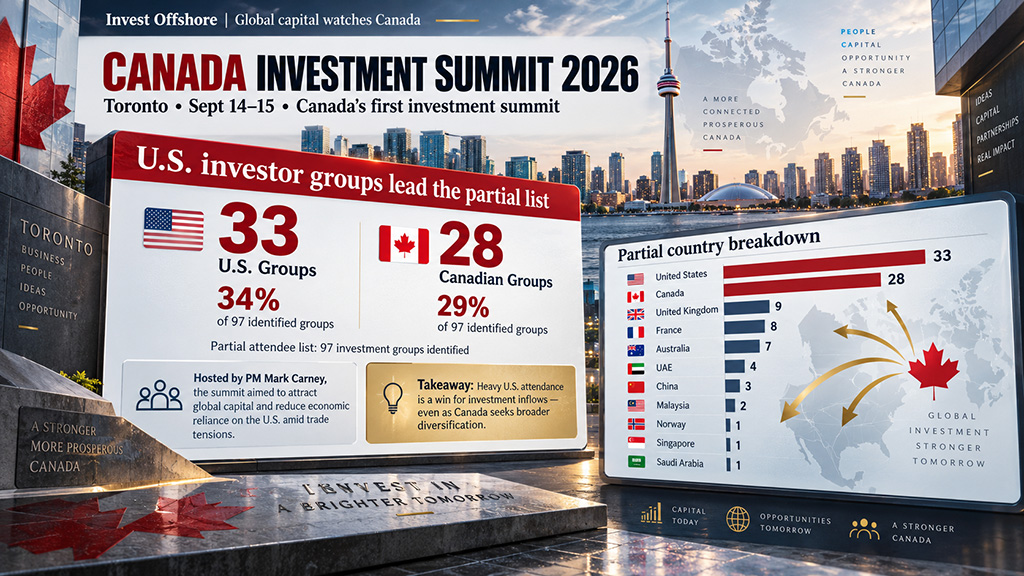
According to a partial country breakdown reported ahead of the summit, 33 U.S. investment groups were attending — more than from any other country.
Canada itself accounted for 28.
The partial list of 97 investment groups broke down as follows:
| Country | Investment Groups | Share of Partial List |
|---|---|---|
| United States | 33 | 34.0% |
| Canada | 28 | 28.9% |
| United Kingdom | 9 | 9.3% |
| France | 8 | 8.2% |
| Australia | 7 | 7.2% |
| United Arab Emirates | 4 | 4.1% |
| China | 3 | 3.1% |
| Malaysia | 2 | 2.1% |
| Norway | 1 | 1.0% |
| Singapore | 1 | 1.0% |
| Saudi Arabia | 1 | 1.0% |
The figures are important because they represent a partial attendee breakdown, rather than the summit’s complete delegate roster. Reports have placed overall institutional participation at more than 100 organizations, with roughly 250 high-level delegates expected around the event.
Nevertheless, the message from the available numbers is unmistakable.
American investors accounted for roughly one-third of the identified investment organizations — and outnumbered Canadian groups 33 to 28.
Diversification Does Not Have to Mean Divorce
There is a wonderful irony here.
One of the central motivations behind Canada’s new economic strategy is to reduce excessive dependence on the United States, particularly after another period of trade tensions between Ottawa and Washington.
Carney has been pushing Canada to develop deeper commercial relationships with Europe, Asia, the Middle East and other global markets while promoting Canada as a stable jurisdiction for international capital.
Reuters described the summit as part of an effort to attract massive new investment while Canada confronts continuing economic tensions with the United States. The summit is showcasing more than 160 potential projects across mining, energy, technology and infrastructure.
Yet diversification apparently does not mean American investors have lost interest in Canada.
Quite the opposite.
They arrived as the largest national investment contingent.
That should be viewed as a victory.
Canada can simultaneously build new relationships with Europe, Asia and the Middle East while continuing to attract enormous pools of American capital.
The two objectives are not contradictory.
They may actually reinforce one another.
Wall Street Still Sees Opportunity North of the Border
Among the financial heavyweights associated with the summit are executives from BlackRock and Blackstone, alongside major institutional investors from Europe, Asia, Australia and sovereign wealth funds from the Middle East.
Associated Press reported that executives attending the summit represent organizations overseeing more than $120 trillion in global assets.
That puts the scale of the event into perspective.
Canada does not need to persuade the entire world to move its money north.
It needs to persuade a relatively small group of enormous capital allocators that Canada offers attractive risk-adjusted opportunities.
Mining projects need billions.
Nuclear projects need billions.
Ports, transmission networks, pipelines, data centres, AI infrastructure and critical-mineral processing facilities require enormous pools of patient institutional capital.
Those are precisely the investors Toronto is trying to put in the same room with Canadian governments and project developers.
Canada Has Something Institutional Capital Wants
For decades, Canada’s natural-resource wealth has sometimes been discussed almost defensively.
In the new geopolitical economy, those resources are becoming strategic assets.
Canada possesses many of the ingredients governments and corporations are suddenly desperate to secure: energy, uranium, copper, nickel, lithium, potash, gold, hydroelectricity, critical minerals, agricultural resources and enormous amounts of land suitable for new infrastructure.
Add political stability, established capital markets, a sophisticated banking system and access to numerous international trade agreements, and the investment proposition becomes considerably more interesting.
Carney summarized the sales pitch succinctly during the summit period: Canada has the energy, resources, talent, technology and capital the world wants.
Now comes the harder part.
Turning interest into projects.
From “Come to Canada” to “What Can I Buy?”
Perhaps the most revealing comment surrounding the summit came from a source quoted in reporting about the investors.
The message from some participants was essentially: they were not coming merely to listen to speeches. They wanted to know what was actually available to invest in.
That represents a significant shift in tone.
Canada has historically struggled with the gap between possessing extraordinary natural resources and actually approving, financing and constructing major projects.
Global institutional money wants scale.
It wants predictable regulations.
It wants bankable projects.
And increasingly, it wants exposure to the physical infrastructure underpinning energy security, AI, electrification, defence, manufacturing and critical-mineral supply chains.
The Canada Investment Summit is attempting to connect those two worlds.
The 34% Surprise
For Invest Offshore, one number deserves particular attention:
34%.
That is the U.S. share of the 97 investment groups identified in the partial country breakdown.
Canada: 28 groups.
America: 33.
At a summit partially motivated by Canada’s desire to become less economically dependent on the United States, American investors nevertheless formed the largest national contingent.
That is not evidence that diversification has failed.
It may be evidence that Canada is becoming more investable.
A successful diversification strategy should not replace American capital with European, Asian or Middle Eastern capital.
It should attract all of them.
If Canadian projects can simultaneously bring in Wall Street capital, European pension money, Middle Eastern sovereign wealth and Asian institutional investment, Canada gains something far more valuable than simply changing trading partners.
It gains competition for Canadian assets.
And competition among global pools of capital is exactly what a resource-rich country should want.
Invest Offshore View
The Canada Investment Summit may ultimately be judged not by the speeches delivered in Toronto, but by how many mines, energy projects, data centres, ports, transmission systems and advanced manufacturing facilities actually receive financing and get built.
But the opening signal is encouraging.
Canada invited the world.
America showed up first.
And rather than seeing that as a contradiction in Canada’s attempt to diversify, investors might see it as confirmation that the strategy is beginning from a position of strength.
Canada does not need less American investment.
It needs more global investment alongside it.
If the 2026 Canada Investment Summit succeeds in creating that competition for Canadian opportunities, the biggest winner will not be Washington, London, Paris, Abu Dhabi or Beijing.
It will be Canada.
Leave a Reply