
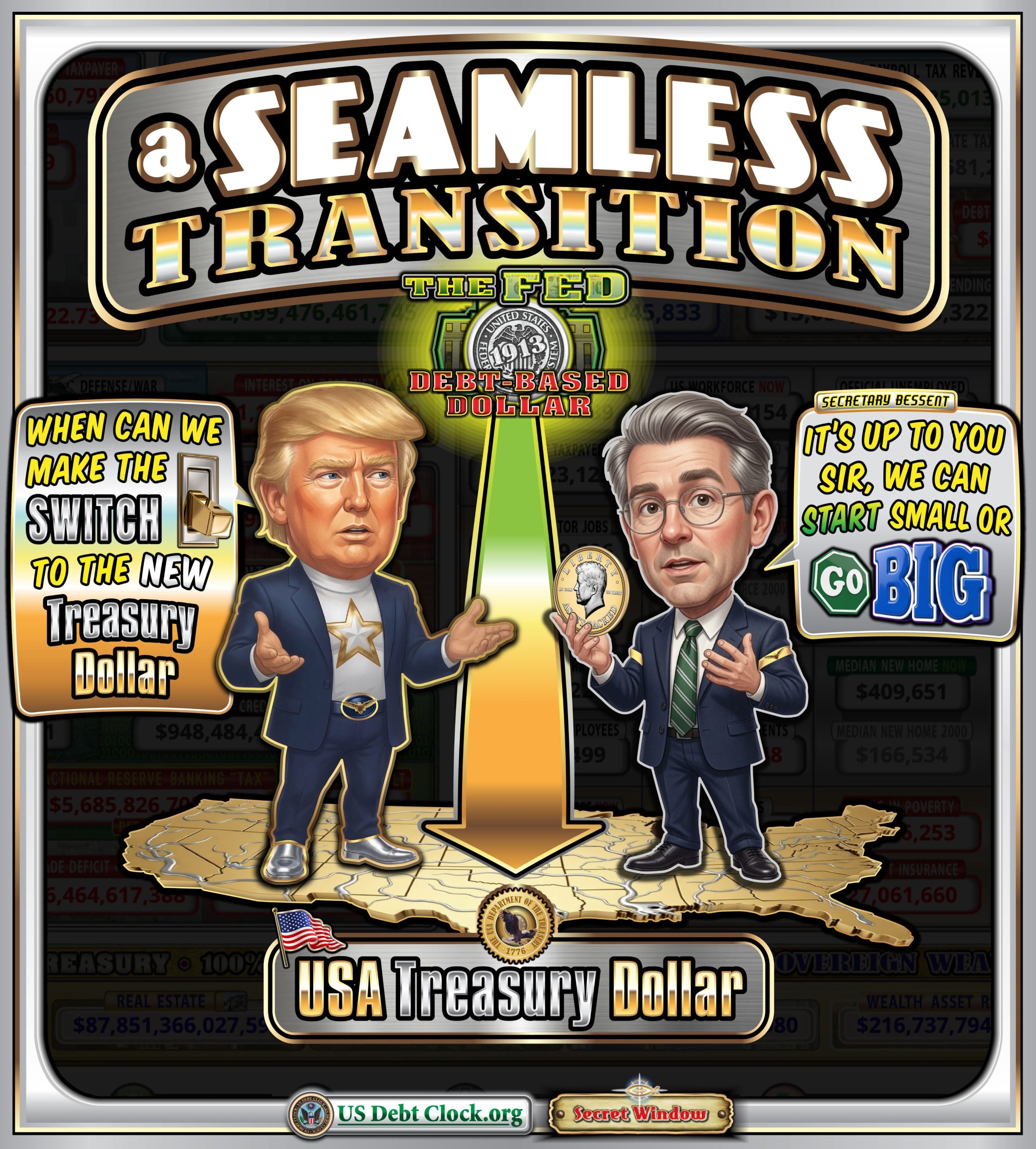
The US Debt Clock has released another “DJT” poster, and this one may be the most operational yet.
The headline reads:
A Seamless Transition
Below it, the poster shows the old system at the top:
The Fed Debt-Based Dollar — 1913
A large arrow points downward across the map of the United States toward the proposed new system:
USA Treasury Dollar
DJT asks:
“When can we make the switch to the new Treasury Dollar?”
Secretary Bessent answers:
“It’s up to you sir, we can start small or go big.”
That is the entire message in one image: the US Debt Clock is no longer only talking about exposing the old system. It is now talking about transition mechanics.
Not collapse.
Not panic.
Not chaos.
A switch.
A structured move from the Federal Reserve debt-dollar system into a Treasury-centered monetary architecture.
The Meaning of “A Seamless Transition”
The word seamless is the key.
The Debt Clock is suggesting that a monetary change does not have to arrive as a catastrophic break. It could be introduced gradually, cleanly, and strategically.
That is why Bessent says:
“We can start small or go big.”
Starting small could mean pilot programs, Treasury-backed instruments, state-level credit models, special-purpose settlement rails, digital Treasury accounts, asset-backed certificates, or limited-use Treasury Dollar mechanisms.
Going big would mean something far more dramatic: a full-scale monetary reset where the debt-based Federal Reserve note gives way to a 100% reserve, asset-backed Treasury Dollar.
The poster leaves both doors open.
That is what makes it so important.
From Fed Dollar to Treasury Dollar
At the top of the poster is the old symbol:
The Fed Debt-Based Dollar — 1913
That date has appeared again and again in the US Debt Clock’s New Money Revolution storyline. It represents the birth of the Federal Reserve era — a system built on debt issuance, interest payments, banking leverage, monetary expansion, taxation, and refinancing.
At the bottom is the proposed replacement:
USA Treasury Dollar
The visual message is simple:
The old dollar flows downward into the new dollar.
The old system is not merely criticized.
It is transitioned out.
That is a major evolution in the Debt Clock narrative.
Earlier posters asked: who stole the wealth?
Then: where are the assets?
Then: how do we fight the cartel?
Then: how do we delete the income tax?
Then: what happens when silver is revalued?
Now: how do we make the switch?
This poster is the bridge.
Start Small or Go Big
The phrase “start small or go big” may be the most realistic line the Debt Clock has used.
Major monetary systems rarely change all at once in public view. They usually shift through layers:
Payment rails change first.
Settlement options change next.
Treasury instruments evolve.
Regulatory permissions expand.
Digital infrastructure appears.
Collateral rules adjust.
Banks adapt or lose privilege.
Then the public notices the new system already operating.
That is what a “seamless transition” implies.
The Debt Clock is saying the switch can begin quietly, in controlled form, before becoming visible at national scale.
For offshore investors, that matters because capital never waits for the official ribbon-cutting. Capital watches the rails, the collateral, the custody, and the law.
Executive Order • Alchemy
Once again, the poster carries the phrase:
Executive Order • Alchemy
In this series, “alchemy” means transformation.
Debt becomes wealth.
Paper becomes asset-backed.
Fed dependency becomes Treasury authority.
Taxpayer burden becomes ownership.
Financial extraction becomes sovereign restoration.
But this poster gives alchemy a new meaning: not just transformation of money, but transformation without disorder.
That is the real ambition.
A chaotic reset destroys confidence.
A seamless transition preserves confidence while changing the foundation underneath it.
That is the dream of every serious monetary reformer: change the operating system without crashing the machine.
The Map of America
The arrow points directly through the United States.
That detail matters.
This is not being framed as a Wall Street product or an offshore banking trick. It is being framed as a national conversion.
A Treasury Dollar would not merely be another instrument. It would represent a new relationship between citizens, states, federal finance, public credit, and national assets.
The Debt Clock has already connected this vision to:
Asset-backed money
Gold and silver
State credit unions
Lower interest
Tax reduction
Sovereign wealth
Public ownership
A new incentive-based society
This poster says all of those themes require a transition path.
Why the Switch Matters
The old system depends on debt expansion.
The government borrows.
Banks lend.
Interest compounds.
Taxes collect.
The currency loses purchasing power.
Debt rolls forward.
The public carries the burden.
The proposed Treasury Dollar reverses the psychology.
Instead of money born from debt, the poster imagines money backed by assets. Instead of citizens servicing the system forever, citizens would participate in a system tied to national wealth.
That is why the word “switch” is so powerful.
It suggests a change from debt citizenship to ownership citizenship.
From recurring obligation to restored value.
The Invest Offshore Decode
For Invest Offshore readers, this poster is not an official policy announcement. The Federal Reserve note remains legal tender, the income tax remains in place, and no public Treasury Dollar replacement has been formally launched.
But as a signal, this poster is very important.
It tells us that the Debt Clock narrative has matured from protest into process.
The question is no longer only:
What is wrong with the old system?
The question is now:
How does America move into the new one without breaking everything?
That is exactly the question serious investors should be asking.
Because if a Treasury-centered, asset-backed monetary system is ever introduced — even gradually — it would affect every major capital category:
Gold
Silver
Treasuries
Private banking
Real estate
Offshore structures
Digital settlement
Collateral finance
Dollar deposits
Cross-border capital flows
This is not just a currency story.
It is an asset protection story.
Seamless Does Not Mean Small
Do not mistake the word seamless for weak.
A seamless transition can still be enormous. It simply means the public experiences continuity while the underlying architecture changes.
The dollar may still be called a dollar.
Payments may still clear.
Accounts may still function.
Taxes may still be filed until changed by law.
Banks may still operate.
But behind the scenes, the backing, rails, reserve logic, collateral structure, and Treasury authority could shift.
That is the kind of transition the Debt Clock is hinting at.
The name stays familiar.
The foundation changes.
Conclusion: The Bridge Between Two Dollars
The US Debt Clock’s A Seamless Transition poster may be one of the most important in the series because it answers the practical question behind the New Money Revolution.
How do you move from the Fed Debt-Based Dollar to the USA Treasury Dollar?
The poster’s answer:
Carefully.
Strategically.
With executive authority.
Through Treasury.
By starting small or going big.
But above all — by making the switch.
That is the decode.
The old system was born in 1913.
The new system is being imagined as Treasury-centered, asset-backed, and ownership-based.
The bridge between them is the seamless transition.
For Invest Offshore readers, the message is clear: do not only watch the debt clock. Watch the switch.
Because when the monetary system changes, the first sign may not be panic.
It may be a smooth arrow pointing from the old dollar to the new one.
Invest Offshore will continue tracking the New Money Revolution, Treasury reform, asset-backed finance, gold, silver, digital settlement, sovereign wealth, and the global capital shifts that follow when the world’s reserve currency begins to change its foundation.
Leave a Reply