
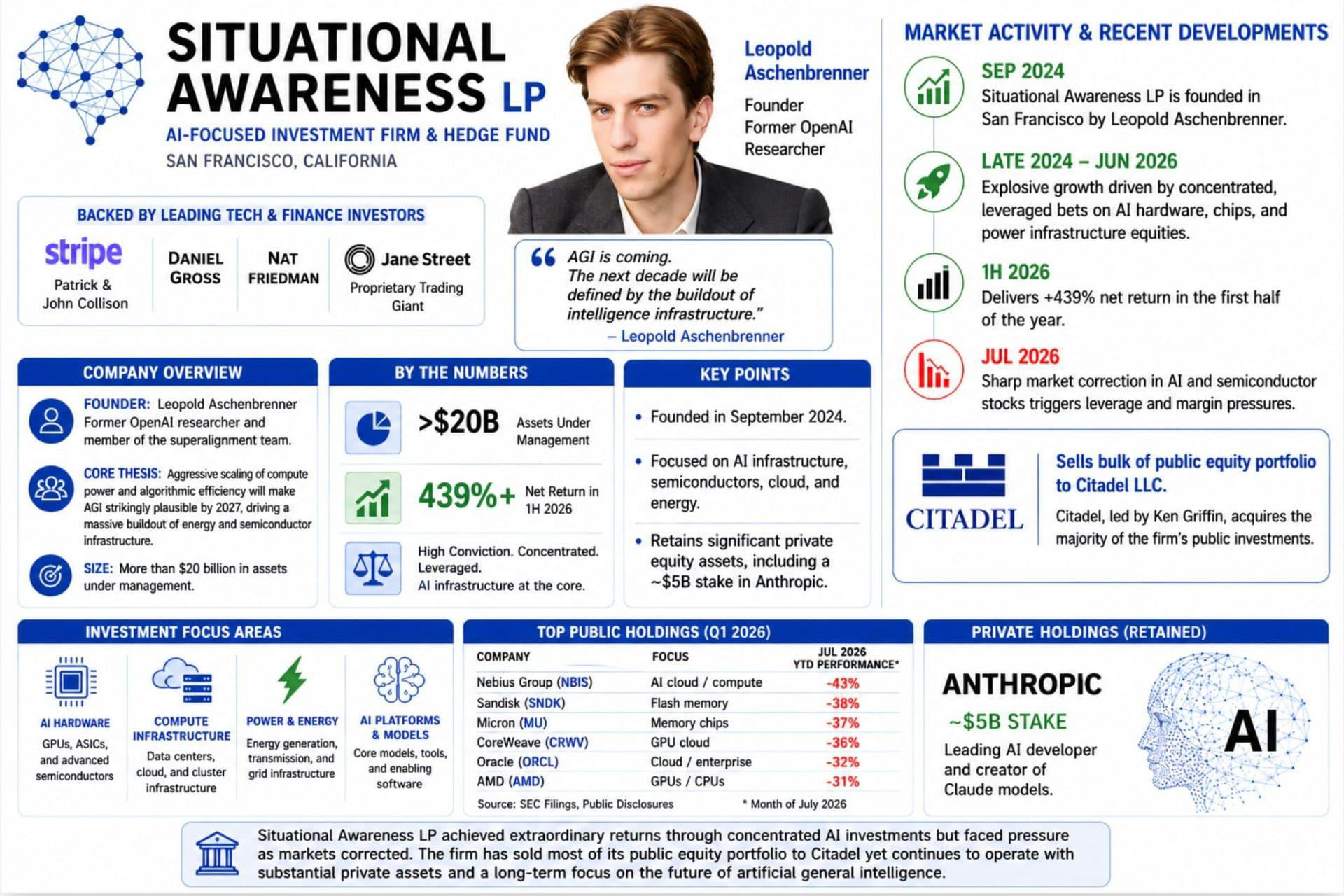
For a man who became famous for writing about “Situational Awareness,” Leopold Aschenbrenner has just provided Wall Street with one of the most spectacular demonstrations in modern history of what happens when situational awareness meets leverage.
The 25-year-old former OpenAI researcher built an extraordinary investment franchise around essentially one grand thesis: artificial intelligence would advance far faster than conventional Wall Street models anticipated, requiring enormous amounts of semiconductors, memory, electricity, data centers and computing infrastructure.
For nearly two years, that thesis worked brilliantly.
Then July 2026 arrived.
Aschenbrenner’s AI-focused hedge fund, Situational Awareness, reportedly went from a peak valuation of approximately $45 billion to around $10 billion, an evaporation of roughly $35 billion in a matter of weeks. Forbes characterized the decline as a 77% wipeout, while Reuters reported that the fund’s portfolio fell 67% during July.
And then came the extraordinary ending: Ken Griffin’s Citadel stepped in and bought most of the distressed public-equity portfolio at a substantial discount.
That transaction saved Situational Awareness from what could have become complete destruction.
It also created the ingredients for one of the most irresistible conspiracy theories on Wall Street in years.
From AI Prophet to Hedge-Fund Phenomenon
Aschenbrenner became an unlikely financial celebrity after publishing his lengthy 2024 essay series, Situational Awareness: The Decade Ahead. His central argument was enormous in scope: AI capability would accelerate rapidly toward AGI, potentially followed by superintelligence, while corporations and governments raced to build trillion-dollar computing infrastructure.
His original thesis explicitly envisioned a massive industrial mobilization involving GPUs, power generation and data centers.
Rather than merely writing about the boom, Aschenbrenner decided to trade it.
Situational Awareness concentrated capital into precisely the companies expected to provide the physical plumbing of the AI revolution.
Semiconductors.
Memory.
Data centers.
Power.
Compute infrastructure.
The returns were initially astonishing. Financial News reported that the fund gained approximately 439% during the first half of 2026, while leverage reportedly climbed toward 400%.
That leverage transformed a spectacular investment thesis into something considerably more dangerous.
The Two Stocks That Helped Break the Trade
By the end of June, the concentration had become extreme.
MarketWatch reported that approximately 56% of Situational Awareness’s disclosed portfolio was concentrated in just two semiconductor names: SanDisk and Micron Technology. SanDisk subsequently fell approximately 43% and Micron around 24% during the rout. Other large positions, including Bloom Energy, TSMC and Nebius, were also hammered.
Business Insider reported roughly $5.7 billion of SanDisk and $5.6 billion of Micron in the fund’s U.S. portfolio at quarter-end.
The problem wasn’t necessarily that the long-term AI thesis had suddenly become wrong.
The problem was that time and leverage don’t negotiate.
A leveraged investor can ultimately be correct about an asset’s destination and still go bankrupt before it gets there.
At four times exposure, relatively ordinary declines can become existential. Falling securities reduce equity collateral. Prime brokers demand additional capital. Selling begins. Selling depresses prices further. Reduced prices generate additional collateral demands.
The process feeds upon itself.
That appears to be essentially what happened.
The $35 Billion Margin Call

Prime brokers reportedly including Goldman Sachs, JPMorgan and Bank of America began demanding collateral as the portfolio deteriorated. Eventually Situational Awareness was forced to unload most of its public positions.
Reuters subsequently reported that the portfolio fell 67% in July and that Aschenbrenner acknowledged coming dangerously close to permanent capital impairment. The fund ultimately removed its leverage and sold most of its publicly traded equity exposure.
The $45 billion peak-to-$10 billion figure has consequently become financial folklore almost overnight.
And there is a legitimate basis for calling it historic.
The Financial Times recently placed Aschenbrenner’s approximately $35 billion loss at the top of a leaderboard of the largest trading losses ever recorded, ahead of many famous hedge-fund and institutional disasters. But investors should treat the phrase “world record” carefully: there is no official governing body maintaining standardized records for trading catastrophes, and comparisons between AUM destruction, realized trading losses and institutional balance-sheet losses are imperfect.
So perhaps the better description is:
the largest widely reported hedge-fund trading wipeout on the commonly cited historical leaderboard.
That is remarkable enough.
Then Citadel Appeared
As the fund approached the edge, Ken Griffin’s Citadel emerged as buyer.
Situational Awareness sold most of its approximately $16 billion public-equity portfolio, with some positions reportedly changing hands at discounts greater than 10%.
This is where the story becomes fascinating.
Citadel wasn’t buying obscure distressed debt expected to remain impaired for years. It was purchasing some of the most strategically important securities in the AI infrastructure boom—after their forced owner had lost the ability to hold them.
In other words, Citadel was buying somebody else’s margin call.
And it moved extraordinarily quickly.
By August 21, Reuters reported that Citadel had already eliminated more than 80% of the aggregate risk acquired from Situational Awareness, using nearly 100 block trades representing more than $4 billion. Citadel’s Wellington fund gained 5.94% during July and was up more than 12% for the year.
The Financial Times reported that many of the underlying technology shares subsequently rebounded and that Citadel likely profited significantly from the transaction.
That sequence naturally generated suspicion.
The Bailout Conspiracy
Consider how this appears from 30,000 feet.
A young hedge-fund manager builds one of the fastest-growing fortunes on Wall Street.
His positions become enormous and highly leveraged.
Many of those positions suddenly collapse simultaneously.
Prime brokers demand collateral.
The fund becomes a forced seller.
One of the world’s most sophisticated hedge funds steps in.
Citadel purchases the distressed assets at discounts exceeding 10%.
The liquidation pressure disappears.
Some of the securities rebound.
Citadel rapidly unloads much of the risk.
From the outside, it almost writes its own conspiracy screenplay:
Did Wall Street know exactly where Situational Awareness’s liquidation price was?
Were sophisticated traders deliberately pushing crowded positions lower to trigger margin calls?
Did Citadel receive a once-in-a-generation portfolio because everyone else understood the fund couldn’t survive another trading session?
And the most provocative question:
Was this a rescue—or one of the greatest distressed-asset trades ever engineered?
Those questions deserve examination.
But questions aren’t evidence.
What the Evidence Says
So far, the evidence does not establish that Citadel—or some coordinated Wall Street group—engineered the collapse.
Short-selling analytics firm S3 Partners examined the affected securities and reportedly found no clear pattern indicating Situational Awareness was the victim of a coordinated predatory short attack. Its analysis concluded that highly concentrated positions in crowded trades offered the more convincing explanation.
That distinction is important.
There is an enormous difference between Wall Street causing a vulnerable fund to collapse and Wall Street recognizing that a vulnerable fund is collapsing.
The latter happens constantly.
Once counterparties determine that a leveraged investor is experiencing collateral trouble, markets become merciless. Other traders reduce exposure, hedges are adjusted, liquidity disappears, and everyone begins calculating approximately where forced selling must occur.
It can look conspiratorial because the outcome becomes self-reinforcing.
But leverage itself can create the conspiracy-like behavior.
Everybody sees the same wounded animal.
Was It Really a “Bailout”?
Not in the conventional sense.
There is currently no credible reporting indicating taxpayer money or government capital rescued Situational Awareness.
This wasn’t Washington rescuing a bank.
It was a private-market distressed transaction.
Citadel accepted assets and risk at a price sufficiently attractive to make the trade worthwhile, while Situational Awareness obtained the liquidity required to survive.
“Bailout” therefore describes the economic effect on Aschenbrenner’s fund—but shouldn’t be confused with a government rescue.
The comparison with Long-Term Capital Management in 1998 is instructive. LTCM involved a private-sector recapitalization assembled after the Federal Reserve Bank of New York brought major counterparties together because regulators feared disorderly liquidation could destabilize markets.
Situational Awareness appears far more straightforward:
a forced seller met a buyer with an enormous balance sheet.
The Most Extraordinary Part: The Fund Survived
The story doesn’t end at zero.
Situational Awareness retained important private investments, including a substantial stake in Anthropic. Reuters reported that after the disastrous July decline the fund nevertheless remained approximately 80% ahead for 2026, reflecting the extraordinary profits accumulated before the crash.
That produces one of the strangest hedge-fund statistics imaginable:
A manager can suffer what may be the largest hedge-fund trading loss ever recorded—and still be up for the year.
Only extraordinary leverage and extraordinary preceding gains can produce mathematics like that.
The Offshore Investor’s Lesson
The obvious lesson is “don’t use 400% leverage.”
But there is a deeper lesson for global investors.
Liquidity is an asset class.
Investors routinely analyze jurisdiction, taxation, currencies, custody, political risk, portfolio diversification and counterparty exposure. Yet liquidity is often treated as something automatically available.
It isn’t.
Situational Awareness apparently owned securities tied to what could still prove one of the largest capital-investment cycles in history.
AI isn’t disappearing because one hedge fund received a margin call.
Micron still makes memory.
Data centers still require electricity.
Semiconductor fabs still matter.
Anthropic still matters.
Aschenbrenner’s fundamental vision of enormous AI infrastructure requirements may ultimately prove remarkably prescient.
But a portfolio doesn’t merely need to predict the future.
It must survive the journey to the future.
That is why leverage has destroyed brilliant investors for centuries.
The Bigger Question
There is also something uncomfortable about watching $35 billion apparently evaporate and then seeing one of Wall Street’s most powerful institutions arrive with enough liquidity to purchase the wreckage at a discount.
It demonstrates where financial power actually resides.
Not necessarily with whoever has the boldest thesis.
Not with whoever generates the largest percentage return.
Not even with whoever correctly predicts the next technological revolution.
Power resides with the institution that still possesses liquidity when everybody else needs it.
Citadel didn’t need to invent the semiconductor rout.
It merely needed to be standing there when the margin calls arrived.
That may be less exciting than the conspiracy theory.
It is also considerably more instructive.
Invest Offshore Bottom Line
Leopold Aschenbrenner may have just produced the closest thing modern hedge-fund history has to a world-record trading wipeout: roughly $35 billion from peak to trough.
The reported 400% leverage made a violent semiconductor correction catastrophic. Margin calls converted paper losses into forced transactions. And Citadel performed perhaps the ultimate Wall Street maneuver—buying valuable assets from a seller that had lost the luxury of saying no.
Was there a conspiracy?
There is currently no credible evidence proving one.
Was there a bailout?
Economically, yes—a private-sector lifeline. But it was not a taxpayer rescue.
Was somebody positioned to make enormous money from the wreckage?
Almost certainly.
And that might be the most enduring lesson from the entire episode:
When leverage creates a forced seller, the investor with cash doesn’t need a conspiracy. The margin call does the work for them.
Leave a Reply