
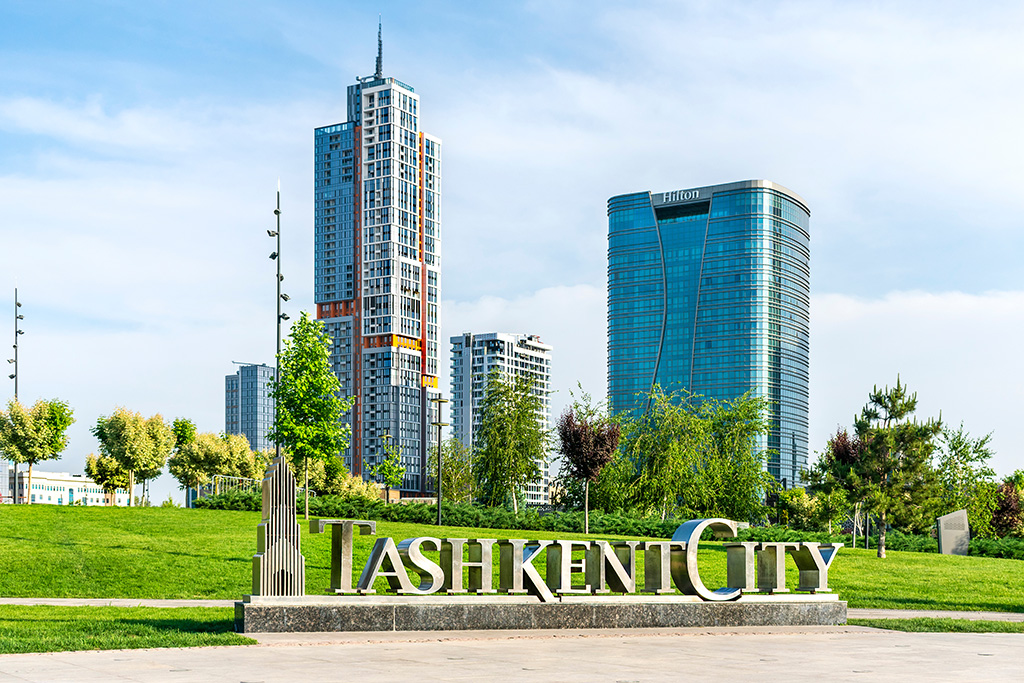
Uzbekistan may be moving from an overlooked frontier economy to a serious regional real estate story.
For years, international property investors searching beyond established markets have focused on destinations such as Dubai, Istanbul and Tbilisi. Tashkent rarely made the shortlist.
That may be starting to change.
Uzbekistan’s capital entered 2026 with a remarkable increase in market activity. Property transactions in Tashkent City rose 64% year over year during the first quarter, according to the Central Bank of the Republic of Uzbekistan. The city recorded 32,790 transactions between January and March, including 13,854 in March alone.
The increase was part of a broader national acceleration. Uzbekistan registered approximately 110,100 property transactions during the quarter—48.4% more than during the same period in 2025. Tashkent’s performance was surpassed only by the smaller Syrdarya region, where transactions increased 67%. Central Bank of Uzbekistan
For a market still largely overlooked by international capital, these are difficult numbers to ignore.
More Than a One-City Property Boom
Tashkent is the commercial, financial and administrative centre of a country undergoing rapid economic change. Its property market is benefiting from rising household incomes, growing mortgage availability, new construction and continued urbanization.
Uzbekistan’s economy expanded 8.7% during the first quarter of 2026, supported by domestic demand and strong activity in services, construction and trade. The Central Bank subsequently increased its full-year economic-growth forecast to between 7% and 7.5%. Central Bank Monetary Policy Review
That economic momentum is now showing up in housing demand.
Mortgage lending reached 5.7 trillion Uzbek soums during the first quarter, an increase of 29% from a year earlier. Real household incomes grew 7.8%, giving more families the financial capacity to enter the housing market or move into newer properties.
This combination matters. A sustainable property expansion generally requires more than speculative buying. It needs employment, income growth, financing and population movement. Uzbekistan is beginning to demonstrate all four.
Prices Are Rising—but the Currency Tells Two Stories
The transaction surge has been accompanied by higher residential prices, although the scale of that increase depends on the currency used.
By March 2026, nationwide primary-market apartment prices were up 8.1% year over year in U.S.-dollar terms. Secondary-market prices increased 9.4%.
Measured in Uzbek soums, however, the increases were much more moderate: 1.8% for primary-market apartments and 3% for secondary properties.
That difference is significant for offshore investors.
Dollar-denominated performance can be affected by movements in the soum as well as by changes in the underlying value of the property. A foreign buyer therefore has to analyze two separate questions: Is the local property appreciating, and will the currency preserve or reduce that return when the investment is converted back into dollars?
The stronger increase in secondary-market prices may also indicate demand for completed, immediately usable homes rather than units still under development. Existing properties can offer clearer information about location, building quality, occupancy and rental potential, while new projects may carry construction and completion risks.
The Land-Price Paradox
The most revealing part of the Central Bank’s report may not be the 64% transaction increase. It may be what is happening to land.
Despite accelerating apartment sales and rising residential prices, the cost of land in Tashkent declined 6.4% year over year. At the end of the first quarter, 100 square metres of land averaged approximately 301 million soums.
The Central Bank attributed the decline primarily to an increasing supply of land in districts farther from the city centre. Central Bank Q1 Real Estate Analysis
This creates an important supply-versus-demand story.
Demand for housing is expanding, but the physical footprint of Tashkent is expanding with it. New land becoming available on the urban periphery can relieve pressure on central prices while creating development corridors around future roads, transit links, schools and commercial centres.
For developers, falling outer-district land prices can reduce the cost of assembling sites. For investors, however, cheaper land does not automatically mean better value. The decisive question is whether infrastructure and employment will follow residential construction.
A peripheral district without transportation, utilities or commercial activity may remain inexpensive for years. A district connected to a major infrastructure project can be transformed much more quickly.
New Supply Is Arriving
Uzbekistan is not responding to increased housing demand with prices alone. Construction activity is adding supply.
During the first quarter, approximately 3.3 million square metres of housing were commissioned nationwide, an increase of 6.6% year over year. Individual residential construction expanded 6.8%, while the share of total investment directed toward construction rose from 7.4% to 10.8%.
Multi-storey construction is also spreading beyond Tashkent into other regional cities. This suggests that Uzbekistan’s property awakening may eventually become a national urban-development story rather than a single-city boom.
The distinction is important. Tashkent will likely remain the country’s deepest and most liquid market, but growing regional centres could offer different opportunities in logistics, workforce housing, retail and mixed-use development.
The Escrow Effect Requires Caution
Not all of the first-quarter increase should be interpreted as purely organic growth.
Uzbekistan introduced a new escrow system for property transactions on April 1, 2026. According to the Central Bank, buyers, sellers and developers accelerated the formalization of agreements before the new procedure came into effect.
That timing effect was especially visible in March. Nationwide monthly transactions were 112% higher than in March 2025, while Tashkent City and the surrounding Tashkent Region each recorded increases of 118%.
The new escrow framework could ultimately improve buyer protection and confidence by separating purchaser funds from a developer’s general operating capital until specified obligations are met. In the short term, however, it complicates comparisons.
The real test will come in the following quarters. If transaction activity remains elevated after the pre-escrow rush has passed, the case for a structural property expansion will become considerably stronger.
Why Offshore Investors Should Pay Attention
Tashkent is not yet a conventional international property market. That is precisely why its development deserves attention.
The market now combines several characteristics commonly seen during the early stages of a real estate revaluation:
- Rapid economic and household-income growth
- Expanding mortgage availability
- Strong urbanization and housing demand
- Rising transaction volumes
- Increasing construction investment
- New supply in outer districts
- Moderate local-currency price growth
- Improving transaction infrastructure
There are also meaningful risks. Foreign investors must evaluate ownership and residency rules, title registration, developer quality, taxation, currency exposure, financing availability and the practical ability to repatriate sale proceeds. Market data and comparable transactions may be less transparent than in more established jurisdictions.
The 64% headline should therefore be treated as a signal—not a guarantee.
What to Watch Next
Several indicators will reveal whether Tashkent is experiencing a temporary transaction spike or the beginning of a longer property cycle.
First, transaction volumes must remain healthy after the April escrow introduction. Second, mortgage growth needs to remain aligned with household-income growth rather than becoming dependent on increasingly aggressive lending. Third, investors should watch whether outer-district infrastructure improves quickly enough to absorb expanding land and housing supply.
The difference between primary- and secondary-market performance will also be important. Continued strength in existing apartments could indicate immediate end-user demand, while accelerating new-home sales would demonstrate confidence in developers and future urban expansion.
Finally, dollar-based investors must separate genuine property appreciation from exchange-rate effects. The gap between local-currency and U.S.-dollar price growth is already a defining feature of the market.
An Overlooked Capital Steps Forward
Tashkent’s property market is no longer behaving like a quiet frontier.
A 64% increase in transactions, combined with rising incomes, 29% mortgage growth and expanding construction, suggests that Uzbekistan’s capital is entering a more active stage of urban development. At the same time, declining land prices on the city’s outskirts show that new supply may shape this cycle very differently from property booms in land-constrained global cities.
That tension—surging demand alongside expanding urban supply—is what makes Tashkent especially interesting.
Uzbekistan has not yet become Central Asia’s answer to Dubai, nor should investors approach it as though it has. But the data indicate that the country is moving from an overlooked frontier economy toward a more credible regional real estate story.
For offshore investors willing to study infrastructure, currency exposure and local execution carefully, Tashkent may be a market to watch before it becomes an obvious one.
This article is for informational purposes only and does not constitute investment, legal or tax advice.
Leave a Reply