
America’s new investment accounts for children are rapidly creating something larger than a savings program: a generation introduced to capital ownership from birth.
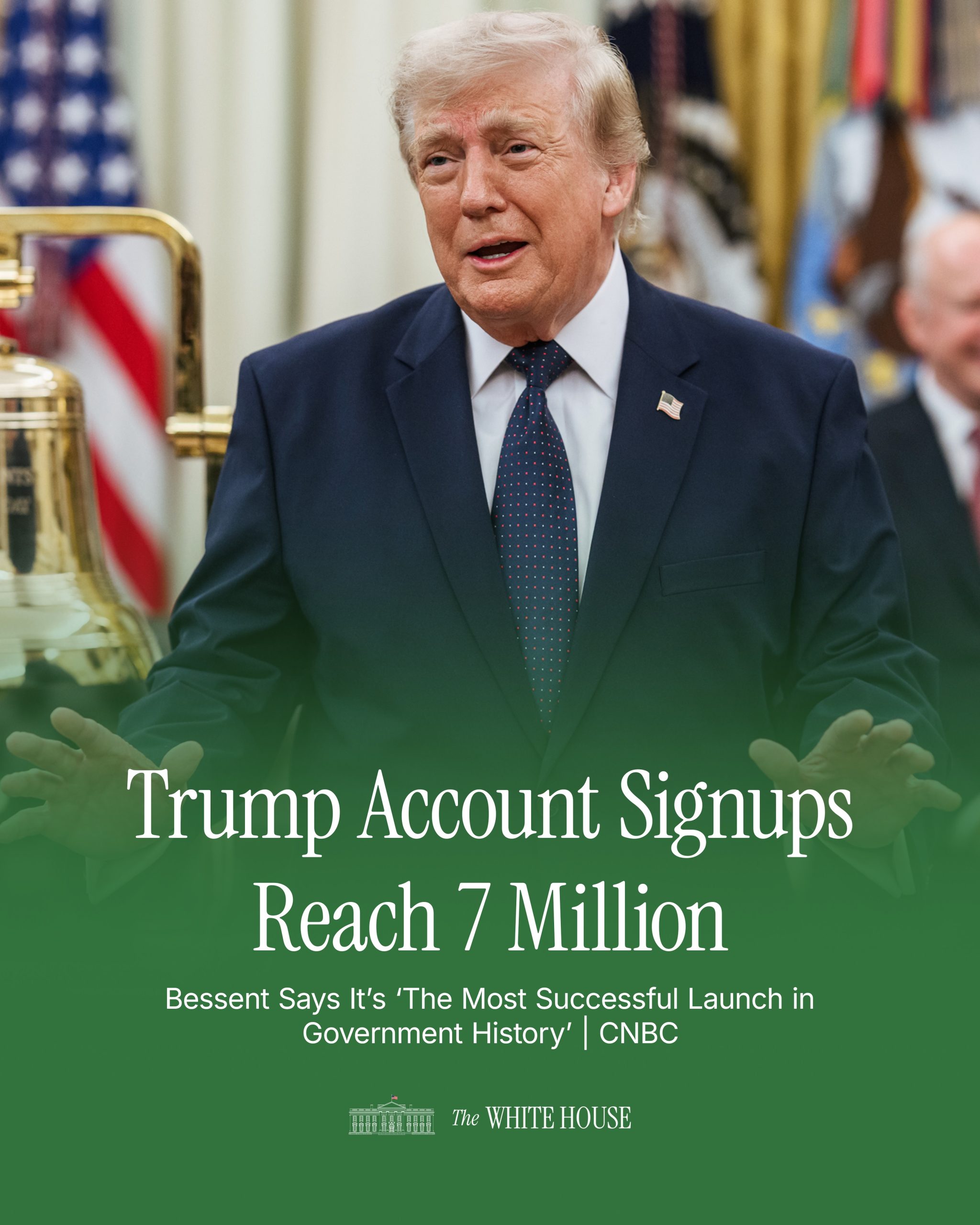
Trump Accounts have reached approximately 7 million signups only weeks after their official July 4, 2026 launch—a pace Treasury Secretary Scott Bessent described as “the most successful launch in government history.”
the most successful launch in government history.
Treasury Secretary Scott Bessent
The milestone represents a remarkably fast increase from the 6.5 million signups reported by the U.S. Treasury earlier in July. According to Bessent, early participation has outpaced the adoption of other government digital programs and financial products.
The record is about more than a popular government benefit. Trump Accounts could fundamentally change how millions of Americans first encounter investing, compound growth and ownership of the nation’s largest companies.
Seven Million Young Investors—and Counting
Trump Accounts are tax-advantaged investment accounts established for eligible children under age 18 who have a valid Social Security number. Unlike an ordinary savings account, the money is placed into low-cost funds holding primarily American equities.
The program officially became operational on July 4, 2026, coinciding with the 250th anniversary of American independence. By July 15, Treasury reported that more than 6.5 million children had been signed up, including over 1.5 million eligible for the federal pilot contribution. The latest figure has now reached approximately 7 million children. U.S. Treasury
The rapid adoption appears to validate one of the program’s central ideas: families are more likely to participate in the financial markets when the entry point is simple, automatic and designed around their children.
But the number should be interpreted carefully. Seven million signups do not mean that every account has received the federal contribution or is being funded regularly. Eligibility for the government deposit is narrower than eligibility to open an account.
How Trump Accounts Work
A Trump Account can generally be opened for a child who:
- Is under age 18 at the end of the election year;
- Has a valid Social Security number; and
- Does not already have a Trump Account election filed on their behalf.
Children born from January 1, 2025, through December 31, 2028, may also qualify for a one-time $1,000 contribution from the U.S. Treasury. The child must be a U.S. citizen and satisfy the pilot program’s other requirements. Parents and other authorized individuals can make the election using IRS Form 4547 or the official digital platform. IRS Trump Accounts guidance
Families, friends, employers and certain charitable organizations can contribute. The general annual contribution limit is $5,000 per child, adjusted for inflation after 2027, while qualifying employer contributions receive special tax treatment and are subject to their own limits.
During the account’s growth period, withdrawals are generally prohibited. The purpose is to keep the capital invested until the year in which the child turns 18.
After that point, the account is generally treated like a traditional IRA. The young adult may continue investing for retirement or take distributions under IRA rules. Withdrawals for qualified higher education or a first home may avoid the additional early-distribution tax, although ordinary income-tax rules can still apply. IRS account and distribution rules
From Savings Accounts to Shareholder Accounts
The most important feature may be what Trump Accounts are not.
They are not conventional bank accounts earning a fixed rate of interest. They are investment accounts designed to give children exposure to the productive economy.
At launch, contributions are automatically invested in the State Street SPDR Portfolio S&P 500 ETF, or SPYM. Treasury has also selected four additional low-cost index funds that are expected to become available as alternatives:
- iShares Core S&P 500 ETF;
- Vanguard Total Stock Market ETF;
- State Street SPDR Portfolio S&P 1500 Composite Stock Market ETF; and
- iShares Core S&P Total U.S. Stock Market ETF.
These funds provide broad exposure to publicly traded American companies while keeping expenses low. They also carry market risk: values will rise and fall, and future returns are not guaranteed. Treasury investment lineup
This distinction matters. Trump Accounts are introducing children to ownership—not merely encouraging them to accumulate cash.
A child with an account becomes an indirect shareholder in American businesses. Over time, families can watch the balance change, learn how markets work and see how recurring contributions interact with compound growth.
The Power of Starting at Birth
Most investors discover compounding too late. Trump Accounts reverse that timeline by placing time—the most valuable investment advantage—at the beginning of a child’s life.
Even when a family cannot contribute the annual maximum, the initial deposit and occasional contributions can remain invested for decades. Parents, grandparents, employers and philanthropists can all help build the account.
The system therefore combines several sources of capital:
- Federal seed funding for qualifying newborns;
- Voluntary family contributions;
- Employer-sponsored deposits;
- State or local initiatives;
- Charitable and philanthropic funding; and
- Long-term returns from the American equity market.
That architecture turns the account into a public-private capital formation vehicle. Government creates the framework and initial incentive, while families and institutions determine how much additional capital enters the system.
Why Offshore Investors Should Pay Attention
For Invest Offshore readers, the significance extends well beyond a domestic American savings program.
Trump Accounts demonstrate how governments can use tax policy, digital onboarding and passive investment funds to expand public participation in capital markets. Instead of relying exclusively on pensions or future social benefits, the program begins establishing individually owned financial assets at birth.
This represents a broader policy shift from assistance to ownership.
Other countries may eventually study the model and develop their own versions using domestic equity funds, sovereign wealth allocations, tokenized securities or internationally diversified portfolios. Financial institutions should also watch how the program connects government administration, digital identity, custodial infrastructure and low-cost asset management through one platform.
If millions of accounts receive regular contributions, Trump Accounts could also create a persistent new stream of capital flowing into U.S. equity index funds.
A Record Launch Is Only the Beginning
Reaching 7 million signups is an extraordinary opening result, but the program’s long-term success will depend on more than enrollment.
The real measures will be how many accounts are fully activated, how consistently families and employers contribute, whether fees remain low and whether young beneficiaries preserve the capital after gaining control at 18.
Market downturns will also test the program’s educational mission. A generation introduced to equities must learn that long-term ownership includes volatility as well as growth.
Still, the early response is unmistakable. Millions of American children are being connected to the capital markets before they are old enough to understand what a stock is.
Trump Accounts may ultimately be remembered not simply for setting an enrollment record, but for turning childhood financial security into a national ownership strategy.
Featured image: The White House announcement marking 7 million Trump Account signups.
This article is for informational purposes only and does not constitute investment, legal or tax advice.
Leave a Reply