
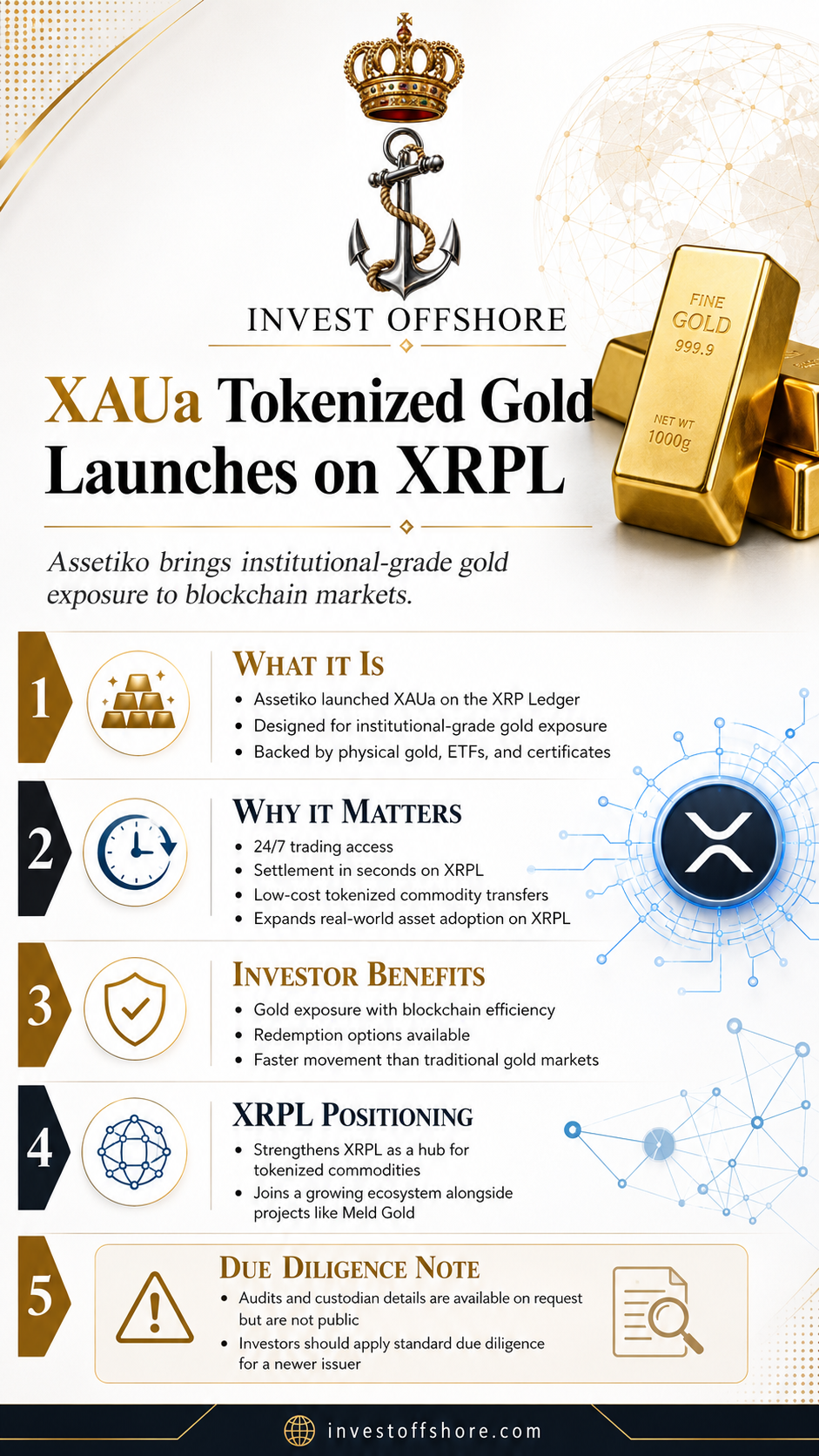
Assetiko’s new XAUa token brings institutional-style gold exposure to the XRP Ledger, combining physical bullion, gold ETFs and certificates with 24-hour blockchain trading. Its real test, however, will be whether reserve transparency can keep pace with the technology.
Gold may be one of the oldest stores of value, but its market infrastructure is rapidly entering a new era.
Assetiko Commodities Ltd. has introduced XAUa, a tokenized gold product issued on the XRP Ledger, or XRPL. The product is designed to give investors blockchain-native exposure to gold while supporting around-the-clock transfers, rapid on-chain settlement and both digital and eligible physical redemption.
According to Assetiko, each XAUa represents exposure equivalent to one fine troy ounce of gold. Unlike tokens backed exclusively by allocated bullion, however, XAUa may be supported by a diversified reserve portfolio containing physical gold, institutional gold ETFs or exchange-traded commodities, gold certificates and a limited allocation to cash or digital settlement assets. (Assetiko)
That hybrid structure could make XAUa more flexible and liquid than a strictly vaulted-bullion product—but it also means investors must understand precisely what they own.
Gold Exposure Built for Digital Markets
Assetiko describes XAUa as an institutional-grade tokenized commodity product rather than a conventional cryptocurrency.
The reserve methodology calls for physical gold to provide core long-term backing, while ETFs and exchange-traded commodities can support liquidity and reserve management. Gold certificates may provide additional exposure, with cash equivalents and settlement assets available for operational liquidity and redemptions. (Assetiko)
The issuer’s indicative allocation ranges are:
- 40% to 80% physical gold
- 10% to 50% gold ETFs or ETCs
- Up to 30% gold certificates
- Up to 10% cash, cash equivalents or settlement assets
This is an important distinction. Holding XAUa does not automatically give the investor title to a specific numbered gold bar, ETF share, certificate or vault account. The token instead represents a contractual right against Assetiko under its product terms and redemption procedures. (Assetiko)
In other words, XAUa is intended to track the economic value of gold, but the legal claim is ultimately against the issuer and its reserve structure.
Why Assetiko Chose the XRP Ledger
The XRP Ledger is technically well suited to tokenized commodities.
XRPL transactions typically reach settlement within approximately three to five seconds and normally cost fractions of a cent. The network also includes native token issuance, decentralized exchange infrastructure, automated market makers and continuously operating on-chain order books. (XRP Ledger)
For gold investors, this can remove several limitations of the traditional market:
- No dependence on banking hours for token transfers
- Near-instant on-chain settlement
- Potential trading against XRP, stablecoins and other issued assets
- Transparent token supply and transaction history
- Easier integration with wallets, exchanges and digital collateral systems
Assetiko says XAUa may trade against assets including USDV, RLUSD, XRP and USDC, although its terms explicitly state that continuous liquidity, market availability and price stability are not guaranteed. (Assetiko)
The distinction between on-chain settlement and redemption settlement is also important. An XRPL transaction can become final within seconds, but Assetiko currently describes expected settlement as T+0 for on-chain transfers, approximately T+2 for digital redemption and approximately T+14 for eligible physical delivery. (Assetiko)
The blockchain moves the token quickly. Converting that token into another asset or obtaining physical gold remains an issuer-managed process.
Redemption: Digital or Physical
Eligible XAUa holders may request redemption into supported digital settlement assets, subject to compliance, fees, liquidity and operational availability.
Physical redemption is more restricted. Assetiko’s published methodology sets a minimum threshold of 100 XAUa, representing 100 fine troy ounces of gold exposure. Applicants must also satisfy identity verification, compliance review, jurisdictional, tax, insurance, delivery and custodian requirements. (Assetiko)
Physical delivery is therefore aimed primarily at institutions, family offices, professional investors and other substantial holders—not necessarily the average retail wallet.
Assetiko also reserves the right to delay or reject redemptions when legal, regulatory, operational, liquidity or custodian conditions prevent orderly completion. These provisions are not unusual for tokenized real-world assets, but they reinforce why investors must assess the issuer as carefully as the blockchain.
Another Step Forward for Real-World Assets on XRPL
XAUa advances the broader movement to bring commodities, securities, credit instruments and other real-world assets onto public blockchain infrastructure.
XRPL allows issuers to create and manage tokenized assets using functions embedded directly into the ledger rather than relying entirely on separately deployed smart contracts. Its native exchange and automated market-making capabilities can then connect those assets with on-chain liquidity. (XRP Ledger)
Precious metals have already been an important part of this development.
Meld Gold established an earlier blueprint for bringing gold and silver into the XRPL ecosystem. Meld describes its tokens as representing one gram of the corresponding metal, backed through a network of vaults and facilities and redeemable for physical metal. Its broader platform has been promoted as a way to connect miners, refiners, vaults, traders and investors through blockchain-based ownership records. (Meld Gold)
Assetiko introduces a different model. Rather than relying entirely on physical bullion, XAUa combines bullion with exchange-traded gold exposure, certificates and liquidity reserves.
That may improve capital efficiency and redemption management, but it also introduces ETF, certificate, brokerage and counterparty risks that would not exist in the same form with a purely allocated-bullion token.
The Transparency Question
Assetiko publishes aggregate reserve information through its XAUa product page, including reported reserve value, physical allocation, ETF holdings, certificate exposure, coverage ratio, insurance scope and the number of custodian relationships.
However, the underlying custodian statements, detailed holdings, bar lists, brokerage records, insurance certificates and independent audit reports are classified as restricted documents. Assetiko says these materials may be made available through a request process, potentially requiring identity verification, customer status, confidentiality undertakings and issuer approval. (Assetiko)
At the time of writing, the public product materials do not identify the individual custodians or provide a directly accessible independent audit report substantiating the reserve figures.
That does not automatically mean the reserves are deficient. It does mean that the published numbers should presently be regarded as issuer-reported figures rather than fully public, independently verifiable proof of reserves.
For a newer issuer seeking institutional participation, prospective investors should request and independently verify:
- The legal registration and ownership of Assetiko Commodities Ltd.
- The governing jurisdiction and enforceability of token-holder claims
- Named custodians, vault operators, brokers and certificate issuers
- Current independent audit or attestation reports
- Confirmation that reserve assets are segregated from operating assets
- Insurance coverage, exclusions and beneficiary arrangements
- Complete redemption fees, minimums and processing conditions
- The official XRPL issuer address and circulating token supply
- Treatment of holders in an insolvency or product wind-down
- Regulatory permissions applying to issuance, distribution and redemption
These are standard institutional due-diligence questions, not accusations. Tokenization may improve settlement and recordkeeping, but it does not eliminate issuer, custody, legal or counterparty risk.
Gold Is Becoming Programmable
The larger significance of XAUa is not simply that another gold token has entered the market.
It is that gold exposure can now move across the XRP Ledger at blockchain speed, trade continuously and potentially interact with stablecoins, decentralized exchanges, collateral systems and other tokenized financial instruments.
A market that once depended on vault receipts, brokerage accounts and limited trading hours is becoming increasingly programmable.
Assetiko has assembled many of the components required for an institutional tokenized commodity: a reserve methodology, published product terms, redemption routes, XRPL settlement and a public reserve dashboard.
The next stage will be proving that the off-chain assets are as dependable as the on-chain infrastructure.
For XAUa, technology opens the door. Transparent custody, independent verification and enforceable redemption rights will determine whether serious capital walks through it.
Leave a Reply