
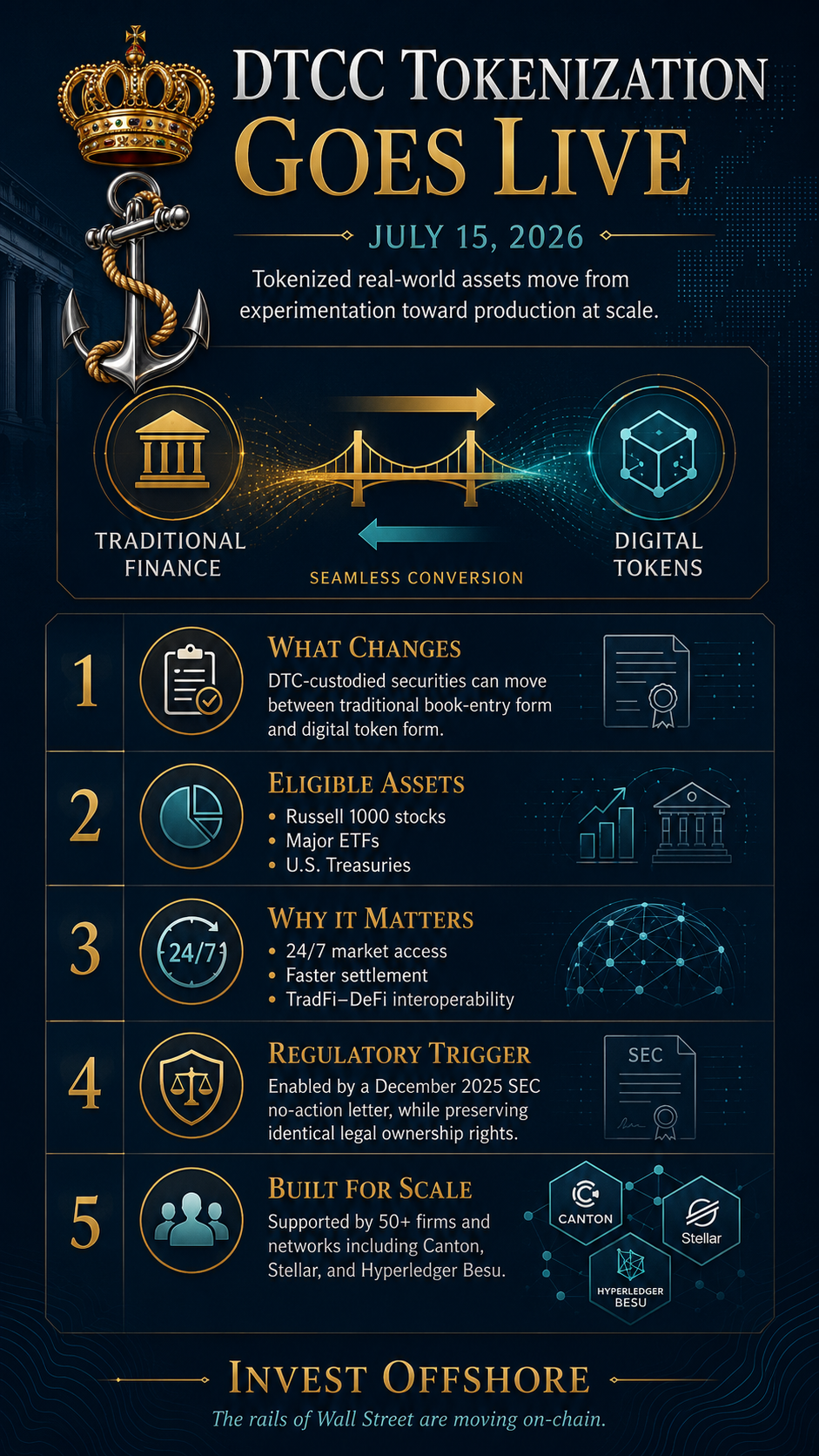
For years, the tokenization of real-world assets has existed somewhere between a compelling demonstration and a permanent promise. Banks launched pilots, blockchain companies built prototypes and financial conferences predicted that securities would eventually operate around the clock.
On July 15, 2026, that conversation is scheduled to change.
The Depository Trust & Clearing Corporation—better known as DTCC—is preparing to facilitate limited production transactions involving real securities tokenized through its Depository Trust Company subsidiary. DTCC Global Head of Digital Assets Nadine Chakar has identified July 15 as the point when the organization’s tokenization roadmap begins moving into operational reality. A broader commercial release is planned for October 2026. (X (formerly Twitter))
This distinction matters. July 15 is not another laboratory exercise or closed proof of concept. It is the beginning of controlled production activity using assets that exist inside the regulated U.S. securities system.
From Blockchain Experiment to Market Infrastructure
DTCC occupies a position few blockchain startups could ever replicate. Through DTC, it provides custody and asset-servicing infrastructure for securities valued at more than $114 trillion.
Rather than constructing a parallel market outside Wall Street, DTCC is bringing blockchain functionality directly into the infrastructure where traditional liquidity, custody and ownership records already reside. Its tokenization service is being developed with input from more than 50 organizations spanning banking, asset management, brokerage, custody, market making, exchanges and digital assets.
Participants in the working group include Bank of America, BlackRock, BNP Paribas, Charles Schwab, Citadel Securities, Citi, Goldman Sachs, HSBC, JPMorgan, Morgan Stanley, Nasdaq, the New York Stock Exchange, State Street, UBS, Wells Fargo, Circle, Ondo Finance, Ripple Prime, Robinhood, Kraken’s parent company and numerous infrastructure providers. (DTCC)
This is not crypto attempting to replace Wall Street.
It is Wall Street beginning to adopt blockchain as part of its own operating system.
What Can Be Tokenized?
The initial regulatory authorization covers a defined group of highly liquid, widely held securities:
- Constituents of the Russell 1000
- Exchange-traded funds tracking major market indices
- U.S. Treasury bills
- U.S. Treasury notes
- U.S. Treasury bonds
DTC participants and their clients will be able to convert supported holdings between conventional book-entry form and digital token form. The traditional security and its tokenized representation will share the same CUSIP, allowing the asset to move between established financial markets and approved blockchain environments without creating a legally separate substitute. (DTCC)
A tokenized Treasury will not merely be a crypto instrument tracking the price of a Treasury. It will represent an entitlement to an actual Treasury security held within DTC’s custody system.
That difference may prove decisive for institutional adoption.
The SEC Permission Slip
The project follows a December 11, 2025 no-action letter from the Securities and Exchange Commission’s Division of Trading and Markets.
The letter permits DTC to operate a defined tokenization service for its participants and their clients on approved blockchain networks for a three-year period. The digital representation is intended to preserve the same entitlements, investor protections and ownership rights as the security held in traditional form. (SEC)
This regulatory structure addresses one of the largest obstacles confronting real-world asset tokenization: legal certainty.
Institutional investors cannot rely solely on a smart contract’s claim that a token represents an asset. They need to know who maintains the authoritative ownership record, how insolvency would be handled, whether corporate actions will be processed and what happens if a wallet is compromised.
DTCC’s approach places tokenization within the established DTC custody and entitlement framework rather than asking investors to abandon it.
One Asset, Two Financial Worlds
The most important feature may be the ability to move an asset between traditional and tokenized formats.
Consider a financial institution holding U.S. Treasury securities through DTC. Under the new model, that institution could request that an eligible position be converted into tokens and transferred to a registered blockchain wallet. The tokens could then potentially be used in approved digital-market activities such as collateralization, financing or settlement.
When required, the position could be returned to traditional book-entry form.
That creates a bridge between two pools of liquidity:
Traditional finance, where the deepest institutional securities markets currently operate, and digital finance, where assets can move continuously, interact with programmable contracts and settle through blockchain-based workflows.
DTCC says tokenized assets will be capable of moving among registered participant wallets inside approved blockchain ecosystems around the clock. Its wider vision includes near-real-time processing, extended market access, greater collateral mobility and more programmable financial assets. (DTCC)
Why U.S. Treasuries Come First
U.S. Treasuries are an ideal starting point because they are not merely investments. They are foundational collateral for the global financial system.
Banks, hedge funds, broker-dealers and corporations use Treasuries in repo transactions, secured lending, liquidity management and margin arrangements. Yet moving collateral across institutions, time zones and disconnected systems can still require multiple reconciliations and operational handoffs.
A tokenized Treasury could be mobilized outside conventional operating hours, programmed into a transaction and exchanged alongside tokenized cash or regulated stablecoins.
DTCC’s partnership with Digital Asset is designed to place a subset of DTC-custodied Treasuries on the Canton Network. The initiative is expected to expand over time to additional DTC-eligible assets and network providers. (DTCC)
The potential benefit is not simply faster trading. It is greater velocity of collateral.
An asset that can be located, verified, pledged and transferred more efficiently may support more financial activity without requiring institutions to hold as much idle liquidity against operational delays.
A Multi-Chain Future
DTCC is not betting that one blockchain will control every financial asset.
Its model is deliberately standards-based and multi-chain. Canton provides an institutionally oriented network emphasizing privacy and interoperability. DTCC has also announced that DTC-tokenized assets are expected to become available through the Stellar public blockchain during the first half of 2027. (DTCC)
Hyperledger Besu and other enterprise blockchain technologies have also formed part of DTCC’s wider digital-infrastructure development. However, it is important not to describe every technology relationship as a July 15 launch network. Canton is central to the initial Treasury work, while Stellar connectivity is scheduled for a later phase. (American Banker)
The larger objective is chain interoperability: an asset should not become trapped inside a single digital silo simply because it has been tokenized.
That is essential if tokenization is to produce deeper liquidity rather than fragmenting existing markets.
TradFi-DeFi Interoperability—with Guardrails
The term “TradFi-DeFi interoperability” may suggest that regulated securities will immediately become available to anonymous users across unrestricted decentralized applications.
That is not the model DTCC is building.
The service incorporates registered participants, approved networks, compliance-aware tokens and controlled wallets. DTCC has described administrative functions that can include minting, burning, pausing, freezing, forced transfers and clawbacks. These controls are intended to support legal orders, sanctions compliance, asset recovery and established market responsibilities. (DTCC)
The result is closer to institutional DeFi: blockchain-based markets with identity, permissions, legal accountability and regulated custody embedded into their design.
Crypto purists may object that this is not fully decentralized. Institutions may answer that these controls are exactly what makes the system usable at scale.
What July 15 Does—and Does Not—Mean
July 15 does not mean that $114 trillion in DTC-custodied assets will suddenly appear on a blockchain.
It does not mean that the stock market instantly becomes open 24 hours a day.
It does not mean that conventional clearing, brokers, exchanges or custodians disappear.
The first stage is a limited production rollout intended to demonstrate that tokenized DTC assets can operate in real transactions, preserve ownership rights and interoperate with emerging digital networks. DTCC’s wider service launch remains targeted for October 2026, with additional networks and functionality expected afterward. (DTCC)
Nevertheless, the importance of the date should not be underestimated.
Financial transformation usually does not occur when a technology is invented. It occurs when trusted infrastructure makes that technology operational, repeatable and legally recognizable.
The Invest Offshore View
For offshore investors, international banks and global asset managers, DTCC’s initiative points toward a future in which high-quality U.S. securities become easier to mobilize across markets, jurisdictions and time zones.
Tokenized Treasuries could eventually support cross-border collateral, programmable escrow, digital repo, international treasury management and settlement against regulated stablecoins or tokenized bank deposits. Major ETFs and equities could gain similar mobility as the service expands.
The winners may not be the projects promising to destroy traditional finance. They may be the institutions capable of connecting regulated assets, digital money, compliant wallets and multiple blockchain networks without sacrificing legal certainty.
That is why July 15, 2026 deserves attention.
It marks the moment when tokenized real-world assets begin leaving the demonstration stage and entering the machinery of institutional finance—not at the edges of the system, but at its very center.
The blockchain revolution may not replace Wall Street. Wall Street may simply place its assets on blockchain rails.
Leave a Reply