
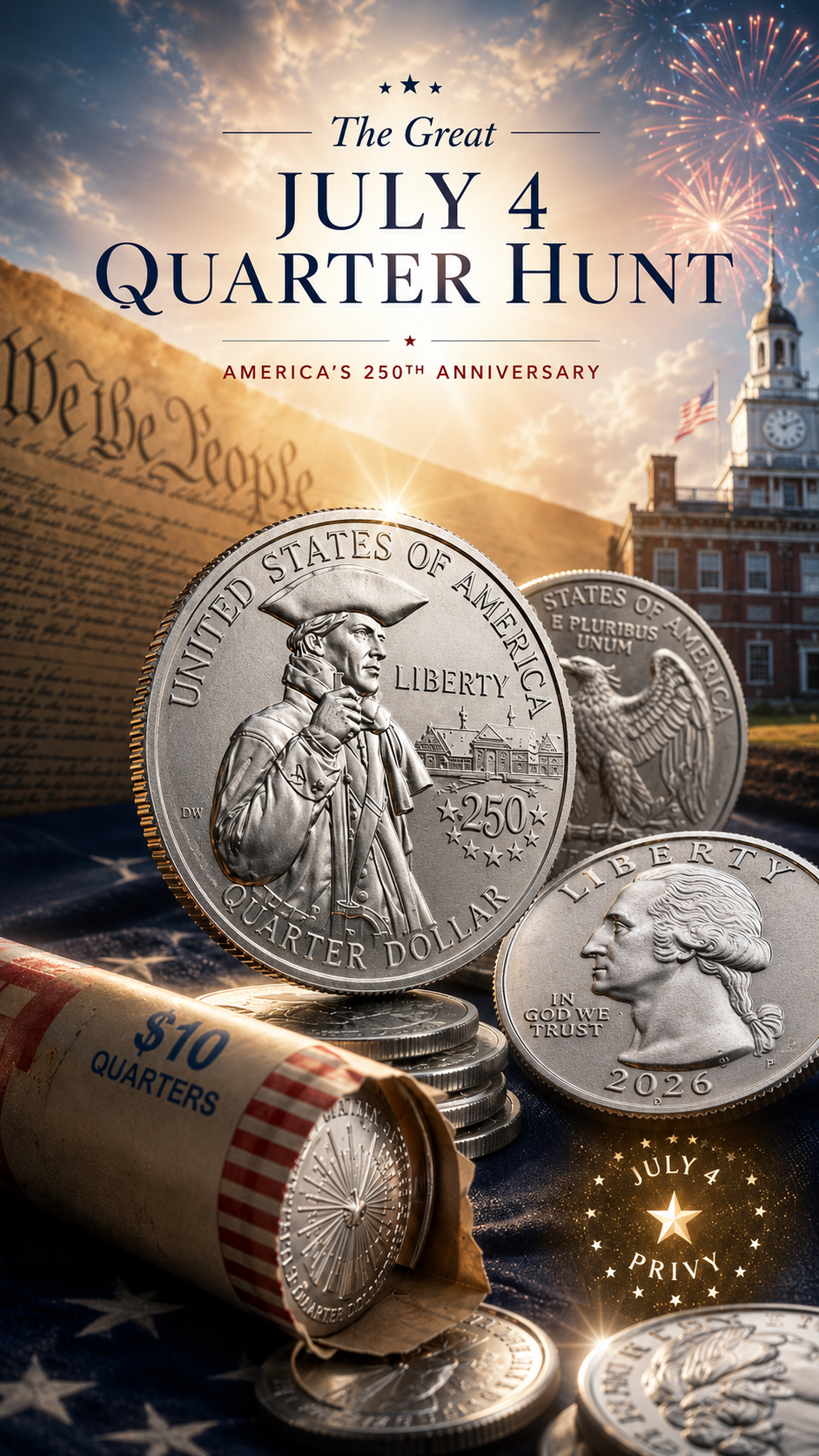
America’s 250th birthday now has a circulating treasure hunt
The United States Mint has just turned pocket change into a national treasure hunt.
On June 23, 2026, the Mint announced that it will release only 250,000 special Semiquincentennial 2026 Declaration of Independence quarters bearing a “July 4” privy mark. These coins celebrate America’s 250th anniversary and, unlike most modern commemorative products, they are not being sold directly to collectors in neatly packaged rolls or bags.
They are being mixed into ordinary circulation.
That means the next great American coin hunt will not begin at a coin show, auction house, or dealer counter. It will begin at the bank teller window, the grocery store register, the gas station counter, and the loose-change jar sitting on the kitchen table.
The Mint confirmed three critical details: the special coins carry a “July 4” privy mark, they bear no mint mark, and they will be randomly distributed to banks and financial institutions nationwide in time for Independence Day.
That makes this release unusual, patriotic, scarce, and potentially valuable.
Why this quarter matters
The 2026 Declaration of Independence quarter is part of the larger Semiquincentennial coin program marking 250 years of American independence. The standard Declaration quarter features Thomas Jefferson on the obverse with the dual date “1776 ~ 2026,” while the reverse depicts the Liberty Bell ringing.
But the “July 4” privy mark version is a separate animal.
Only 250,000 will be made.
In modern circulating coin terms, that is tiny. By comparison, standard quarter mintages are measured in the tens or hundreds of millions. CoinNews reported that the Mint had already struck 89.8 million standard Declaration of Independence quarters through May, and the final standard mintage could potentially exceed 200 million. Against that backdrop, the 250,000 privy-mark coins represent a needle-in-the-haystack issue.
This is not bullion. It is not silver. It is not gold. Its base metal value is ordinary.
The value is in the story, the scarcity, the hunt, and the uniquely American method of release: anyone, in theory, can find one at face value.
How to get a roll
The important thing to understand is that the Mint is not selling rolls of the “July 4” privy mark quarter directly to the public.
The Mint does sell standard 2026 Declaration of Independence quarter rolls and bags, including P and D mint-mark versions, but those standard products do not carry the “July 4” privy mark. The special treasure-hunt coins are being randomly mixed into circulation and sent through the normal banking system.
So the practical method is simple:
Go to your local bank or credit union and ask for rolls of new quarters.
A standard quarter roll contains 40 quarters with a face value of $10. A full box of quarters contains 50 rolls, or $500 face value. Coin-roll hunters will likely focus on fresh bank-wrapped rolls and boxes that arrive after the Mint’s special release begins moving through the Federal Reserve and commercial banking system.
The best request is not “Do you have the rare July 4 quarters?” Most tellers will not know. The better approach is to ask:
“Do you have any new 2026 quarters or fresh quarter rolls?”
The hunt may be uneven. Some banks will receive fresh coin shipments quickly. Others may only have older mixed rolls. Some regions may see the new coins sooner than others. Since these are randomly mixed into circulation, there is no guaranteed branch, state, or Federal Reserve district where they can be found.
Collectors should also check ordinary pocket change. Because the point of the release is public discovery, some of these quarters may show up in real everyday use before coin-roll hunters find them in volume.
What to look for
The special quarter should have the 2026 Declaration of Independence design and a clear “July 4” privy mark. It should also have no mint mark.
That “no mint mark” detail is central. Standard Declaration quarters from Philadelphia and Denver carry P or D mint marks. The special privy version is different.
Use a magnifying glass or coin loupe. Look carefully before spending any 2026 Declaration quarter. If a coin has the “July 4” privy mark, set it aside immediately.
Do not clean it.
Do not polish it.
Do not put it loose in a pocket with other coins.
Place it in a coin flip or small protective holder. For modern coins, condition can be the difference between a fun collectible and a serious premium item.
What would each coin be worth?
Legally, each coin is worth 25 cents.
In the collector market, the answer is more interesting.
Because this release is brand new, there is not yet a stable price history. The first discovered examples could sell at aggressive premiums because collectors, dealers, YouTubers, and grading services will all want early examples. After the first rush, the market will likely settle into different value tiers.
A reasonable early framework looks like this:
A circulated or lightly handled raw example could trade in the $25 to $100 range depending on demand, condition, and how quickly the market becomes saturated with finds.
A choice uncirculated raw example from a fresh roll could command more, especially if the privy mark is sharp and the coin has strong eye appeal.
A certified high-grade example from PCGS or NGC could become the real prize. If the coin grades at the very top of the population, the value could move well beyond ordinary raw prices.
A damaged, scratched, stained, or heavily circulated example will still be collectible, but the premium may be much lower.
The comparison many collectors will make is the 2019-W and 2020-W quarters released into circulation. Those West Point quarters had much larger mintages than 250,000, yet they still created national excitement and meaningful premiums. The “July 4” quarter is scarcer by design, but final value will depend on condition, collector demand, verified sales, and how many coins are quickly pulled from circulation.
What is a roll worth?
A normal roll of quarters is worth $10.
A fresh, unsearched roll of 2026 Declaration of Independence quarters may carry a premium because of the chance that one of the 250,000 privy-mark coins is inside. But that premium is speculative. Unless the roll is transparent, opened, or searched, there is no way to know.
If final standard Declaration quarter mintage exceeds 200 million, then the rough math implies about one special privy quarter for every 800 standard Declaration quarters. That would suggest about one privy coin for every 20 rolls of actual Declaration quarters, assuming perfect random distribution.
Real life will be messier.
Rolls may contain older quarters. Distribution may be uneven. Some rolls may be searched before resale. Some “unsearched” rolls may not really be unsearched. Buyers should be cautious about paying large premiums for rolls unless they trust the source.
The cleanest strategy is still the old-fashioned one: get rolls from a bank at face value and search them yourself.
A modern rarity hiding in plain sight
The genius of this release is that it makes collecting democratic again.
There are plenty of expensive anniversary coins and medals that only serious collectors will buy from the Mint. But the July 4 privy mark quarter is different. It can be found by a child checking change after buying ice cream. It can be found by a cashier. It can be found in a bank roll by a retiree, a collector, a student, or someone who has never cared about coins before.
That is what gives the coin its cultural power.
For Invest Offshore readers, the lesson is familiar: scarcity, story, and access create markets. Not every scarce object is a serious investment, but every serious collectible market begins with a story people want to own.
The 2026 “July 4” Declaration of Independence quarter has all the ingredients: patriotic symbolism, a hard mintage cap, random circulation distribution, national timing, and a built-in treasure hunt.
The coin is only worth 25 cents until the market says otherwise.
But if you find one, do not spend it.
America’s 250th birthday may have just placed a small piece of history in your pocket.
For valuation context, CoinNews notes the privy-mark edition is capped at 250,000 while standard Declaration quarters had already reached 89.8 million struck through May and could exceed 200 million overall. (CoinNews) The closest modern comparison is the 2019-W circulation hunt: PCGS reported early raw 2019-W Lowell quarters sold around $120, then cooled to about $20 after several weeks, while Coin World reported early raw 2019-W examples settling around $35–$45 shortly after release. (pcgs.com)
Leave a Reply