
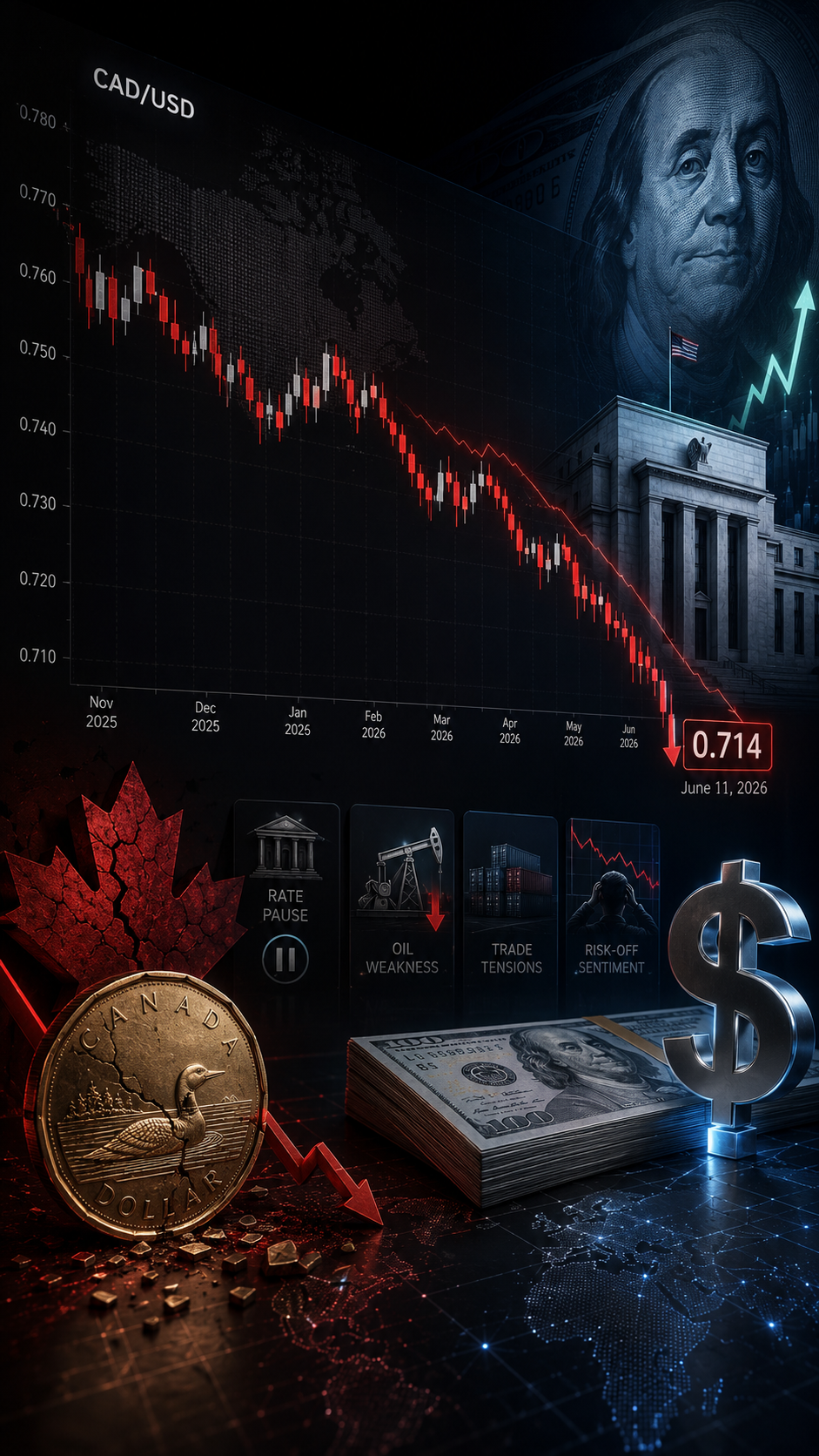
The Canadian dollar has just hit its weakest level of 2026 against the U.S. dollar, sliding toward the 0.714 area — roughly 71.4 U.S. cents — in a sharp decline visible on the daily candlestick chart from late 2025 through June 11, 2026.
For Canadian investors, exporters, importers, offshore allocators, and anyone holding U.S. dollar assets, this is not just another foreign exchange move. It is a signal.
The loonie has been under steady pressure for weeks, but the recent break lower gives the move a different character. The chart shows a currency that had been grinding sideways, failing to hold rallies, and then suddenly giving way. That kind of breakdown often reflects more than short-term trading noise. It reflects a change in market conviction.
The Rate Differential Problem
At the center of the move is the Bank of Canada.
The Bank of Canada held its policy rate at 2.25% on June 10, reinforcing expectations that Ottawa is not in a hurry to tighten policy. Normally, higher energy prices might push a central bank toward a more hawkish stance, but Canada’s domestic economy is too soft to make that an easy decision.
That leaves the Canadian dollar exposed.
Currency markets reward yield, and when U.S. rates look more attractive than Canadian rates, global capital tends to prefer the U.S. dollar. This is especially true when Canada is dealing with weak growth, trade uncertainty, and a central bank that sounds cautious rather than aggressive.
In plain English: the loonie is not falling because Canada suddenly became irrelevant. It is falling because global money is being paid more to sit elsewhere.
Soft Growth Is Now a Currency Issue
Canada’s economy has been sending warning signs. First-quarter GDP declined, following weakness in the prior quarter, raising concerns about a technical recession. Even where there are signs of resilience, such as employment, the broader growth story remains fragile.
That matters because currencies are not only priced on interest rates. They are priced on confidence.
If investors believe Canada is entering a period of slower growth while the United States remains comparatively stronger, the Canadian dollar becomes vulnerable. The market begins to ask a simple question: why hold the loonie when the U.S. dollar offers deeper liquidity, stronger yield support, and a safer global reserve profile?
That question is now being answered on the chart.
Speculators Are Pressing the Trade

The latest positioning data shows speculators increasing bearish bets against the Canadian dollar. That does not mean the move must continue in a straight line, but it does mean the market has found a popular target.
Once a currency breaks down and the speculative community leans into the move, momentum can become self-reinforcing. Traders see the break, add shorts, and force more technical selling. Importers hedge. Corporates adjust. Investors rebalance. The chart becomes the headline.
That appears to be what is happening now.
The Canadian dollar has slipped into the danger zone around 71 cents U.S., and a sustained break below that level would invite talk of further downside.
Commodities Are Not Providing Enough Support
The loonie is often treated as a commodity currency because of Canada’s exposure to oil, natural gas, metals, agriculture, and resource exports. In theory, elevated commodity prices should help Canada.
But this time, the support is uneven.
Oil volatility, global trade tension, and uncertain demand are complicating the story. Higher energy prices can help Canadian producers, but they can also raise inflation pressure, squeeze consumers, and weaken global growth. That creates a mixed signal for the currency.
In other words, commodities are not giving the loonie the clean tailwind it needs.
Trade Tensions Add Another Layer
The Canadian dollar is also carrying a trade-risk discount.
Canada remains deeply tied to the United States, and uncertainty around tariffs, trade policy, and the North American trade framework continues to weigh on sentiment. For a country whose economic model depends heavily on cross-border flows of goods, capital, energy, and services, trade tension is not background noise. It is a direct input into currency valuation.
Markets do not like uncertainty, and the loonie is being priced accordingly.
What It Means for Investors
A weaker Canadian dollar has clear winners and losers.
Canadian exporters may benefit because their goods become cheaper in U.S. dollar terms. Canadian investors holding U.S. stocks, U.S. real estate, U.S. cash, or USD-denominated private assets may see a currency translation gain. Offshore investors with U.S. dollar exposure may also benefit when measured back into Canadian dollars.
But importers, travelers, consumers, and businesses that rely on U.S.-priced goods face the opposite reality. A weaker loonie makes foreign goods more expensive. It can also feed inflation through imported products, technology, equipment, food, and energy-linked costs.
For investors, the lesson is straightforward: currency risk is no longer passive. It must be managed.
The Offshore Angle
For Invest Offshore readers, the Canadian dollar’s decline is a reminder of why currency diversification matters.
Holding all wealth, cash flow, and business exposure in a single domestic currency can feel comfortable during stable periods. But when the exchange rate breaks, the cost of concentration becomes visible.
The U.S. dollar remains the world’s dominant reserve currency. Gold remains a long-cycle hedge against monetary disorder. Select foreign assets can provide diversification when domestic growth slows. None of these are magic solutions, but together they form a stronger architecture than relying entirely on one national currency.
The loonie’s weakness is not a panic signal. It is a portfolio signal.
Final Thought
The daily candlestick chart from late 2025 to June 11, 2026 tells a simple story: the Canadian dollar has lost momentum, broken lower, and entered its weakest zone of the year.
The reasons are not mysterious. A cautious Bank of Canada, soft growth, bearish speculative positioning, trade uncertainty, and uneven commodity support have all lined up against the loonie.
Canada is not collapsing. But the currency market is voting, and right now that vote is going to the U.S. dollar.
For offshore investors, the message is clear: watch the loonie, watch the rate spread, and above all, do not ignore the currency layer of your wealth strategy.
Leave a Reply