
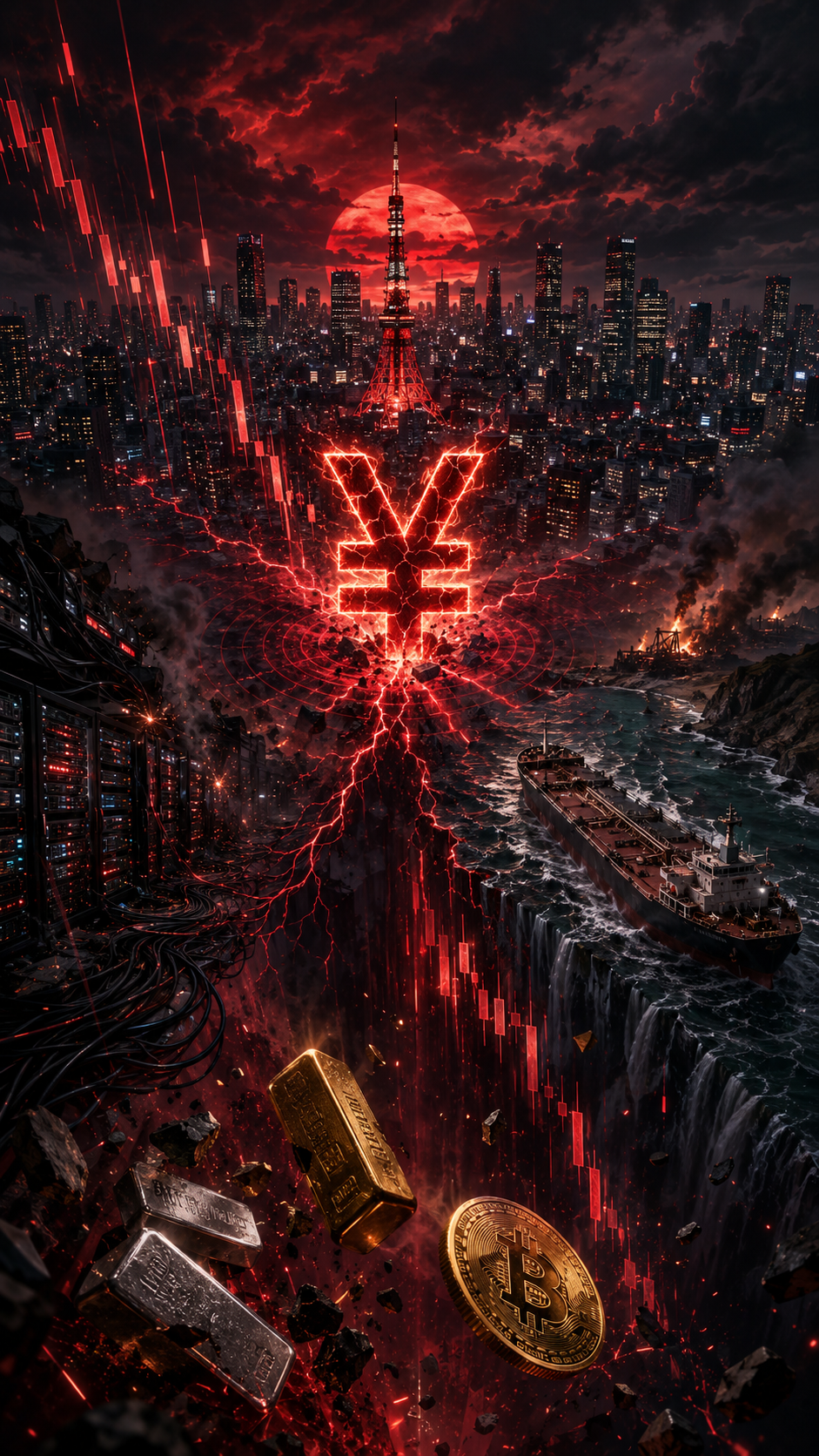
Everyone blamed America. But the deeper fault line runs through Japan.
On Friday, June 5, markets fell hard.
The Nasdaq dropped 4.2%. The S&P 500 lost roughly 2.6%. Gold fell more than 3%. Silver plunged almost 7%. Bitcoin dropped sharply and finished the week down nearly 18%.
The obvious explanation arrived before the opening bell.
The United States added 172,000 jobs in May—more than twice the 85,000 economists expected. Unemployment remained at 4.3%.
A stronger labour market meant the Federal Reserve had less reason to cut interest rates. Traders immediately pushed Treasury yields higher, bought dollars and sold assets whose valuations depended on cheaper money.
That explains the spark.
It does not fully explain the powder keg.
Invest Offshore has warned repeatedly that one of the largest threats to global markets does not sit in Washington, New York or London.
It sits in Tokyo.
America Lit the Match
The strong employment report changed expectations almost instantly.
The Federal Reserve’s target rate remains between 3.5% and 3.75%. Before Friday’s report, investors were still hoping that weaker economic data might eventually force the Fed toward easier policy.
Instead, 172,000 new jobs suggested that the American economy could tolerate higher rates for longer—and possibly another increase if energy-driven inflation persists.
The dollar surged. Bond yields climbed. Technology shares broke lower. Gold and silver were sold. Bitcoin fell again.
But the American data did something even more important.
It widened the psychological gulf between American and Japanese monetary policy.
The Bank of Japan’s policy rate is only 0.75%.
That difference is the heart of the yen carry trade.
The Cheapest Money in the World
For decades, Japan supplied the world with extraordinarily cheap funding.
Large investors could borrow yen at very low rates, convert the money into dollars or other currencies, and purchase assets offering higher returns.
The trade was simple:
Borrow cheaply in Japan.
Invest elsewhere.
Keep the difference.
That money found its way into government bonds, corporate credit, emerging markets, technology shares and other risk assets. Some of it flowed through leveraged funds whose portfolios also included commodities, precious metals and cryptocurrency.
It would be an exaggeration to claim that Japan directly financed every artificial-intelligence data centre or every Bitcoin purchase. The connection is broader and more important than that.
Japan helped supply the cheap global liquidity upon which leveraged markets were built.
The Bank for International Settlements estimated that yen-denominated loans to non-bank borrowers outside Japan had risen to approximately ¥40 trillion by March 2024. That figure does not capture every derivative, currency swap or offshore position, but it demonstrates that the funding channel is real.
Beneath many global asset prices sits an invisible liability.
Somebody borrowed the money.
Much of it was cheap.
Some of it was borrowed in yen.
Then Came the Oil Shock
The Strait of Hormuz has been largely closed during the conflict involving Iran, disrupting one of the world’s most important energy corridors.
Oil prices surged toward and, during parts of the crisis, beyond the psychologically important $100 level. By Friday, Brent crude was trading near $93, still high enough to keep inflation fears alive.
This matters everywhere, but it matters especially in Japan.
Japan imports most of its energy. A weak yen makes those imports even more expensive.
The result is a double blow: higher global oil prices and a falling domestic currency.
Japan’s yen-based import-price index jumped 17.5% from a year earlier in April. Wholesale inflation accelerated to 4.9%, its highest level in three years.
Bank of Japan Governor Kazuo Ueda has described the situation as a potential “fifth oil shock.”
Japan can no longer treat inflation as a temporary inconvenience while maintaining some of the cheapest money in the developed world.
Intervention Bought Time, Not a Solution
The yen has weakened to around 160 per U.S. dollar—a level that carries enormous political and financial significance in Japan.
Tokyo has already tried direct intervention.
Japan’s Ministry of Finance reported ¥11.7 trillion of foreign-exchange intervention between April 28 and May 27. The government sold foreign currency and bought yen in an attempt to halt the decline.
It produced temporary relief.
It did not repair the underlying imbalance.
Currency intervention can punish speculators and slow a disorderly move. It cannot permanently erase a wide interest-rate differential between two major economies.
Japan cannot sell foreign reserves forever.
If the Federal Reserve keeps American rates elevated while the Bank of Japan remains at 0.75%, money retains a powerful incentive to leave yen and seek higher returns in dollars.
That leaves the Bank of Japan with a more consequential tool.
It can raise interest rates.
June 16 Is Now a Global Date
The Bank of Japan meets on June 15 and 16.
A move from 0.75% to 1% is widely expected. A Reuters survey conducted in May found that 65% of economists anticipated a June increase, while subsequent reporting suggested that BOJ officials had moved closer to supporting it.
On paper, a quarter-point increase looks small.
In a highly leveraged funding system, it is not.
The direct borrowing cost rises. More importantly, the currency risk changes. If the yen strengthens while investors are holding foreign assets financed with yen debt, the cost of repaying those loans can increase rapidly.
The investor can lose on both sides:
The purchased asset falls.
The funding currency rises.
That is how an attractive carry trade becomes a trap.
The Black Swan Is Not the Rate Hike
Strictly speaking, a widely anticipated rate increase cannot be called a Black Swan.
A Black Swan is supposed to be unexpected.
The June meeting is on the calendar. The possible increase has been discussed openly. Large institutions know it is coming.
The real Black Swan would be a disorderly unwind.
It would begin if too many leveraged investors tried to reduce similar positions at the same time. Assets would be sold not because their long-term value had disappeared, but because funds needed dollars, yen or collateral immediately.
This distinction matters.
Markets do not have to wait until June 16.
Professional investors move before the decision. They reduce leverage, hedge currency exposure and sell liquid assets while markets are still functioning.
By the time the Bank of Japan makes its announcement, much of the first adjustment may already have occurred.
That may explain why markets can fall before a rate increase and then stabilize—or even rise—on the day it is delivered.
The rumour removes the leverage.
The news merely confirms the reason.
What History Actually Shows
The Bank of Japan has taken four major tightening steps since March 2024.
It ended negative interest rates in March 2024. It raised the policy rate to 0.25% in July 2024, to 0.5% in January 2025 and to 0.75% in December 2025.
The most powerful warning came after the July 2024 decision.
The yen strengthened sharply, leveraged carry positions began unwinding and global markets convulsed in early August. Bitcoin dropped heavily, technology shares sold off and Japan’s Nikkei suffered a historic one-day decline.
The Bank for International Settlements later concluded that a partial but sudden unwind of yen carry trades had helped transmit tighter financial conditions from Japan into the United States.
That episode proved the channel exists.
But investors should resist overly convenient statistics claiming that every BOJ increase automatically causes Bitcoin to fall by approximately 30%. Markets are influenced by several forces at once, and the timing of peaks and troughs can be selected to produce almost any percentage.
History does not offer a mechanical rule.
It offers a warning.
When Japanese policy changes, leveraged global markets can become unstable.
Why Gold Fell Too
Gold is called a safe haven, but that does not mean it rises during every crisis or every market decline.
Friday’s employment report pushed the dollar and Treasury yields higher. That increased the opportunity cost of owning an asset that produces no interest.
There was also a liquidity effect.
When losses spread through leveraged portfolios, funds often sell what they can sell—not necessarily what they want to sell.
Gold is deep, liquid and usually profitable to sell. The same can be true of silver.
The strongest asset can therefore become the source of cash used to cover losses elsewhere.
Gold does not fall because it has suddenly become worthless.
It falls because it has a bid.
During a genuine liquidity event, there may be no safe haven for several hours or several days. Cash becomes the safe haven until leverage has been cleared.
AI Was Already Vulnerable
Artificial intelligence remains one of the most important technological investment themes in the world.
It is also enormously capital- and energy-intensive.
Data centres require electricity to run processors, cool equipment and support expanding digital infrastructure. Higher energy costs pressure operating margins just as elevated interest rates increase the cost of financing new capacity.
That does not mean the AI revolution is ending.
It means the price paid for expected future profits becomes harder to defend when the discount rate rises, power becomes more expensive and investors begin questioning the return on hundreds of billions of dollars in capital expenditure.
The strongest American employment report did not create those concerns.
It forced investors to price them more honestly.
Tokyo Holds the Button
Friday’s decline was not caused by one event.
It was a collision.
The Strait of Hormuz disrupted energy flows.
Higher oil prices increased inflation pressure.
Japan’s weak yen magnified its import bill.
Currency intervention failed to produce a lasting recovery.
The Bank of Japan moved closer to another rate increase.
Strong American employment data suggested that the Federal Reserve would not come to the rescue with cheaper money.
Then leveraged investors began reducing risk.
That is the chain.
America supplied the headline. Japan supplied the vulnerability.
The next stage will depend not only on whether the Bank of Japan raises rates, but on what it says about future increases, bond purchases and inflation. A fully anticipated quarter-point move may produce only a temporary reaction.
An unexpectedly aggressive path toward normalization would be more dangerous.
The world has spent decades building asset prices on abundant liquidity and cheap leverage. Japan was one of the quiet engines behind that system.
Now that engine is changing direction.
Years from now, Friday’s decline may be remembered as a reaction to a strong American jobs report.
Or it may be remembered as one of the first visible tremors from the Black Swan we have been watching for years:
the great unwinding of Japan’s cheap money.
This article is market commentary and does not constitute investment advice.
Leave a Reply