
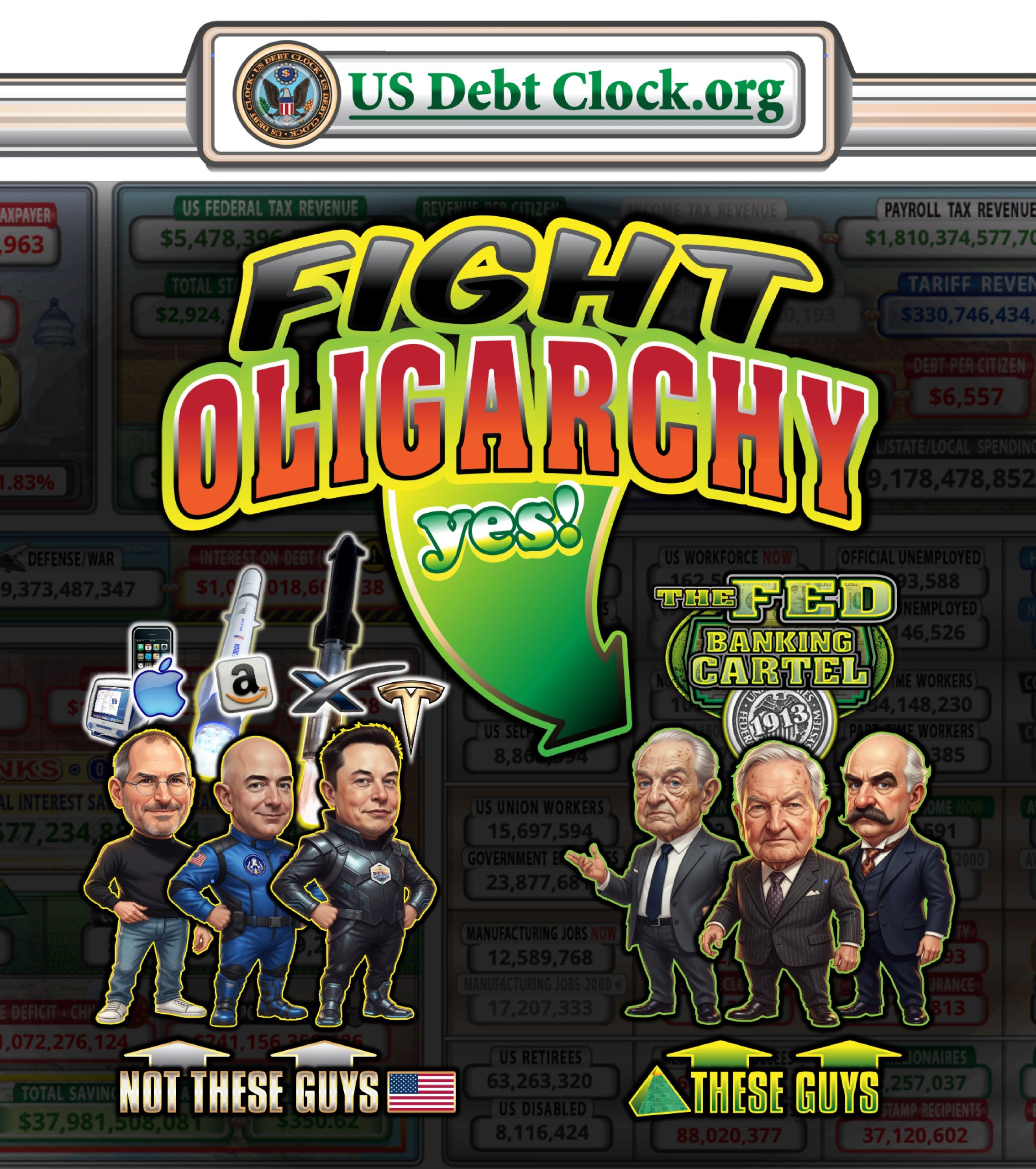
The US Debt Clock has released another loaded poster, and this one comes with a simple command:
Fight Oligarchy — yes!
At first glance, the image looks like a street-fight political cartoon. On the left are American builders, technology brands, rockets, electric vehicles, consumer platforms, and the modern innovation economy. Under them, the caption reads:
“Not These Guys”
On the right are the old banking faces, the Federal Reserve emblem, the year 1913, and the phrase:
“The Fed Banking Cartel”
Under them, the caption reads:
“These Guys”
That is the whole decode.
The poster is saying: do not confuse wealth creation with wealth extraction.
The Real Target: Financial Control, Not Success
The word “oligarchy” gets thrown around carelessly. In politics, it usually means rule by a small group of wealthy insiders. But the Debt Clock poster is making a sharper distinction.
It is not attacking entrepreneurs for becoming rich by building companies, products, platforms, vehicles, rockets, devices, or networks.
It is attacking the system that sits behind the money itself.
The message is this:
The problem is not the man who builds the factory.
The problem is the cartel that controls the credit.
The problem is not the innovator who creates value.
The problem is the monetary structure that taxes, inflates, borrows, and charges interest on the back of the citizen.
That is why the poster separates “these guys” from “not these guys.”
Why 1913 Matters
The poster’s reference to 1913 is not accidental.
That year marked the creation of the Federal Reserve System and the beginning of the modern central-bank era in America. From that point forward, the dollar moved deeper into a system managed through central-bank policy, commercial bank credit, Treasury debt, interest rates, and financial intermediation.
The Debt Clock’s message is that America’s real oligarchy is not simply rich people. It is the architecture of money.
Who issues it?
Who lends it?
Who collects interest on it?
Who controls access to it?
Who gets rescued when the system breaks?
Who pays when it all goes wrong?
That is the question behind the poster.
The Gekko Read: Builders Versus Rent-Seekers
In Gordon Gekko language, this is not about jealousy. Jealousy is for amateurs.
This is about the difference between capital formation and capital capture.
A builder creates something from nothing. A product. A company. A network. A machine. A new market.
A rent-seeker positions himself between the builder and the money, then charges a fee forever.
That is the “Money Mafia” theme the Debt Clock has been developing: not one villain, but a machine. A system of debt, interest, inflation, taxation, bailouts, and controlled access to liquidity.
The poster is telling readers to aim at the machine, not the builders.
Why the Tech Symbols Matter
The left side of the poster features icons of modern American enterprise: phones, online commerce, space technology, electric vehicles, and social media infrastructure.
These are not perfect industries. No industry is. But they are productive symbols.
They represent invention, scale, risk, engineering, logistics, distribution, software, manufacturing, and market competition.
The Debt Clock’s point is that these visible billionaires are often used as the face of “oligarchy,” while the deeper monetary oligarchy hides behind complexity.
The public sees the entrepreneur.
The public does not see the balance sheet.
The public sees the brand.
The public does not see the interest-rate regime.
The public sees the rocket.
The public does not see the debt rollover.
That is the trick.
The Banking Cartel Narrative
On the right side, the image places old financial power under the banner of the Fed.
The phrase “banking cartel” is intentionally provocative. It should be read as political and monetary commentary, not as a courtroom verdict.
But the emotional meaning is clear: the Debt Clock is accusing the old banking order of operating above normal democratic accountability.
The criticism is not that banks exist. Banking is necessary. Credit is necessary. Settlement is necessary. Custody is necessary.
The criticism is that the system has become too concentrated, too protected, too opaque, and too expensive for the productive economy beneath it.
When a country’s debt rises, when interest expense rises, when citizens lose purchasing power, and when the same financial institutions appear closest to the rescue window, people eventually ask:
Who is this system really serving?
Fight Oligarchy Means Fight the Debt Machine
The poster’s slogan is easy to misunderstand.
It does not mean fight wealth.
It means fight unearned control.
It does not mean punish success.
It means expose extraction.
It does not mean attack capitalism.
It means rescue capitalism from the debt cartel.
Real capitalism requires price discovery, honest money, productive credit, risk, reward, failure, discipline, and competition. The debt machine gives us something else: endless leverage, protected insiders, monetary distortion, asset inflation, and taxpayers left holding the bag.
That is not free-market capitalism.
That is financial feudalism with better branding.
The New Money Revolution Angle
This latest poster fits perfectly into the Debt Clock’s broader pattern.
Recent messages have pointed toward:
America’s Wealth Restoration
0% income tax, 0% property tax, 0% gains tax
The Money Mafia
The Fed Dollar versus the Treasury Dollar
Refund per taxpayer
A new incentive-based society
Now we get the political instruction:
Fight Oligarchy
In other words, the Debt Clock is building a storyline. The old order is debt-based. The new order must be asset-based. The old order rewards financial control. The new order must reward production, ownership, invention, and sovereign wealth.
The battle is not left versus right.
It is productive America versus extractive finance.
What Offshore Investors Should Understand
For Invest Offshore readers, this poster is not just American political theater. It is a global capital signal.
If the United States begins moving away from a Federal Reserve Note debt psychology and toward a Treasury-centered, asset-backed, lower-interest, production-driven monetary model, every offshore structure will need to be re-examined.
Gold changes.
Silver changes.
Bitcoin changes.
Private credit changes.
Sovereign bonds change.
Real estate changes.
Tax planning changes.
Infrastructure finance changes.
The world has been priced around the dollar system. If the dollar system changes, everything downstream changes with it.
Conclusion: Don’t Fight the Builder — Fight the Toll Booth
The US Debt Clock’s “Fight Oligarchy” poster is a warning against misdirection.
Do not waste your anger on the visible builder while ignoring the invisible toll booth.
The builder may be rich because he created value.
The cartel is rich because it controls access.
The builder risks capital.
The cartel prices capital.
The builder competes.
The cartel survives every cycle.
That is the decode.
The poster is telling America to stop confusing productive wealth with financial domination. The true oligarchy is not the man who builds the rocket, the phone, the marketplace, or the vehicle.
The true oligarchy is the system that turns public debt into private power.
And once the public understands that, the old magic starts to break.
Invest Offshore continues to monitor the New Money Revolution, Treasury reform, gold, digital settlement, and sovereign infrastructure opportunities, including investment opportunities in West Africa and the Copperbelt Region.
Leave a Reply