
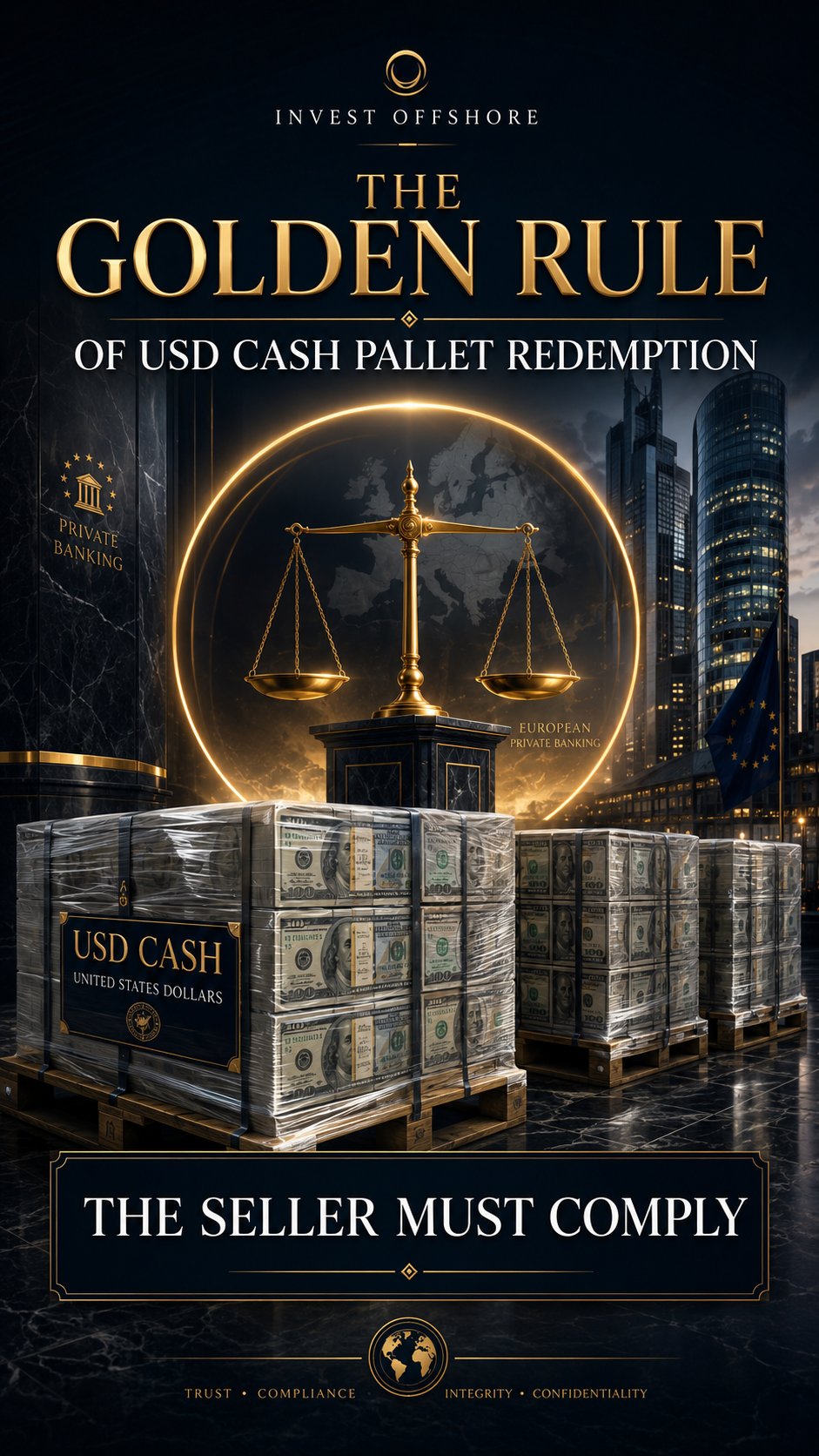
In the world of USD Cash Pallet Redemption, there is one principle that serious holders must understand before any transaction can move forward:
The Golden Rule: the institution with the banking rails, compliance authority, and redemption capacity sets the rules.
For months, Invest Offshore has been approached by sellers, mandates, representatives, and intermediaries claiming access to USD cash pallets in Europe, the Middle East, and beyond. Many of these offers are substantial. Some appear promising. Some may be real. But the same problem continues to appear again and again: sellers believe they get to dictate procedure.
They demand to see the buyer’s CIS. They demand Proof of Funds. They demand that the buyer expose themselves first. They demand documents before their own position has been verified.
This is backwards.
The Buyer Is Not a Street-Level Counterparty
Invest Offshore now has access to a European solution for the redemption of USD cash pallets through a bank-led consortium. This is not a casual buyer. This is not an open-market broker. This is not a speculative group shopping for paper.
This is a serious, institutional channel involving leading banks and compliance-driven financial procedures.
That changes everything.
Large banks do not solicit. They do not chase sellers. They do not send CIS and POF into unverified networks. They do not comply with seller-made procedures that bypass bank compliance, AML, custody verification, and lawful chain-of-title review.
The seller may own the pallets, or claim to own them, but the bank controls the redemption pathway.
That is the Golden Rule.
Why Sellers Cannot Make the Rules
Many USD cash pallet sellers appear to believe that possession equals control. In normal commerce, that may sometimes be true. But USD cash pallet redemption is not normal commerce.
This is not a commodity trade where a buyer simply wires funds after seeing inventory. This is a highly sensitive banking, compliance, custody, and regulatory matter involving physical cash, provenance, documentation, and legal authority.
A legitimate seller must be prepared to prove:
- Where the pallets are held.
- Who the lawful owner or authorized representative is.
- What custodian holds the assets.
- Whether there is a valid SKR or account reference.
- Whether the documentation is complete.
- Whether the pallets can be verified through proper banking or custodian channels.
- Whether the seller will attend a face-to-face meeting with the authorized parties.
Until that happens, no serious bank consortium will expose its buyer profile, compliance file, or proof of liquidity.
Big Banks Are Forbidden to Solicit
This is the point many sellers misunderstand.
Major banks are not allowed to behave like street brokers. They cannot appear to solicit questionable assets. They cannot circulate sensitive buyer documents to unverified sellers. They cannot allow a seller’s informal procedure to override internal compliance standards.
That means the seller must come into the bank’s process.
Not the other way around.
The seller’s procedure may have worked with brokers, intermediaries, or unqualified buyers. It will not work with serious European banking institutions.
The larger the buyer, the stricter the process.
The stronger the banking group, the less likely they are to negotiate procedure.
Time Is Running Out
The window for USD cash pallet redemption is narrowing. The world is changing. Banking scrutiny is increasing. Documentation standards are tightening. Custodians, banks, and regulators are becoming less tolerant of unclear ownership, incomplete paperwork, and speculative claims.
Sellers who waste time demanding CIS and POF from institutional buyers may lose the opportunity entirely.
The market is moving away from broker-driven chatter and toward verified, bank-led redemption.
That means one thing: serious sellers must comply.
The Correct Order of Procedure
The correct process begins with the seller proving that the asset is real, controlled, and verifiable.
The buyer’s side does not need to prove capacity to every claimant who appears with a pallet story. A legitimate European banking consortium already has the capacity, the structure, and the compliance obligations. What it needs is a seller who can pass verification.
At Invest Offshore, we are focused on introducing verified sellers to serious buyers and bank-led platforms. But the seller must be ready to act professionally.
That means no games. No circular demands. No daisy chains. No “send buyer CIS first.” No invented procedure.
The seller must provide enough verifiable information for the institutional channel to confirm the position and begin a proper process.
The Golden Rule Is the Key
The Golden Rule is not arrogance. It is reality.
The party with the regulated banking solution sets the procedure.
The party with the redemption capacity sets the compliance pathway.
The party with the institutional authority cannot be dragged into seller-side improvisation.
For USD cash pallet sellers, this is the lesson: if you want access to a real European redemption solution, you must be willing to comply with the bank-led process.
Invest Offshore is positioned at the chokepoint of this market, receiving new sellers and buyer inquiries from around the world. We are not here to entertain fantasy procedures. We are here to help serious parties reach serious channels.
For qualified sellers with lawful title, proper documentation, and a willingness to follow institutional procedure, the door remains open.
But the Golden Rule applies.
The seller must comply.
Invest Offshore continues to seek qualified counterparties and capital partners for structured opportunities, including clean energy and infrastructure projects in West Africa and the Copperbelt Region.
Leave a Reply