
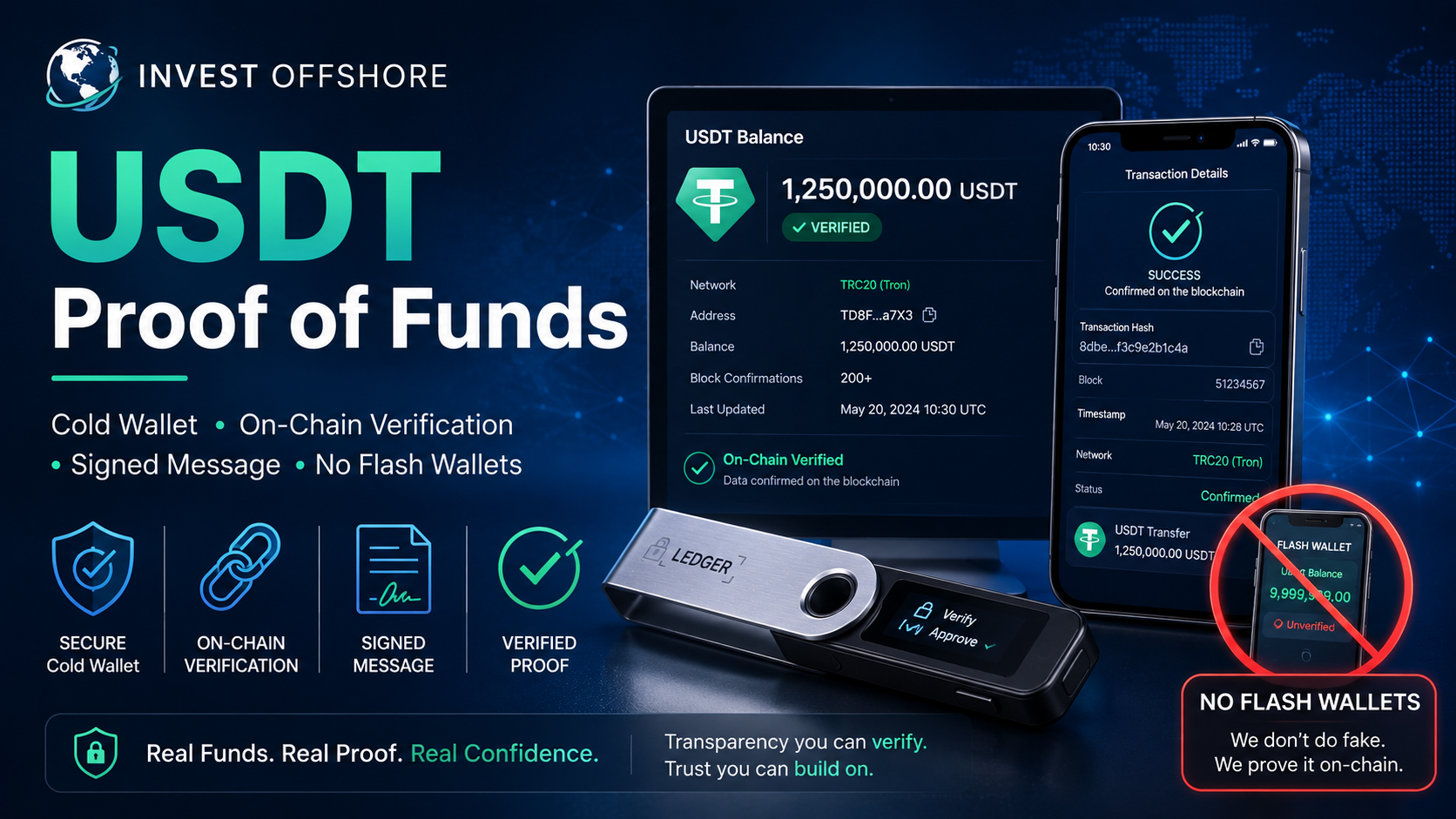
In high-value private transactions, speed matters. But in crypto settlement, speed without proof is just theatre. When a buyer says they can settle in USDT, the serious question is not whether they can show a screenshot. The serious question is whether they can prove real Tether funds exist, are under their control, and can be moved when the transaction conditions are met.
USDT has become one of the most used digital dollars in global private settlement because it moves quickly across blockchain networks and is designed to track the U.S. dollar. Tether states that its tokens are backed by reserves and publishes transparency data on tokens in circulation and reserve reporting. (tether.to) But in the private deal world, the issue is not only Tether’s reserve position. The issue is whether the person in front of you actually controls the wallet they claim to control.
The Golden Rule: Proof Without Control Transfer
A legitimate USDT proof-of-funds process should prove three things:
- The wallet exists.
- The USDT balance is real and visible on-chain.
- The owner controls the wallet without exposing the private key, seed phrase, or signing authority.
That last point is everything.
No serious buyer, seller, mandate, banker, paymaster, platform, or escrow agent should ever ask a wallet owner to reveal a seed phrase, private key, recovery phrase, device password, or remote-access credential. Those are not proof-of-funds documents. Those are the keys to the vault.
A proper proof method can include a wallet-signed message. Message signing allows a wallet holder to prove they control a particular address without moving the funds. Kraken describes message signing as a way to confirm control of a wallet address without transferring the asset, while Coinbase also uses self-hosted wallet message signing as a method of wallet verification. (Kraken Support)
What the USDT Owner Actually Provides
A clean USDT proof package may include the following:
Public wallet address
The owner provides the receiving or holding wallet address only. This is safe to share for verification, but it does expose balance and transaction history, so it should be shared only with qualified counterparties under NDA or deal-room control.
Network identification
USDT exists across multiple blockchain networks. The proof must state the exact chain being used, such as Ethereum ERC-20, Tron TRC-20, or another supported network. A USDT address without the network is incomplete.
Blockchain explorer evidence
The balance should be visible through the correct blockchain explorer. The verifier should not rely on a screenshot alone. Screenshots can be edited. Explorer data shows whether the balance exists on-chain.
Signed wallet message
The wallet owner signs a unique message, usually containing the deal name, date, wallet address, and counterparty reference. This proves control of the wallet without moving funds or revealing keys.
Example wording:
“I, [Name/Entity], confirm control of wallet [address] for purposes of USDT proof of funds related to [transaction/reference], dated [date]. This message does not authorize transfer.”
Optional micro-transaction
In some cases, the owner may send a tiny test transaction to prove movement capacity. This should only be done to a verified address and only after the parties agree on the network, amount, and purpose.
KYC/KYB and source-of-funds support
For serious transactions, wallet proof alone is not enough. The owner may also provide corporate documents, passport or director ID, source-of-funds declaration, exchange statements, OTC desk letter, custody statement, or bank/compliance attestation.
Why a Cold Wallet Is Preferred
A cold wallet is preferred because it keeps the signing authority offline or separated from internet-connected devices. That matters in large transactions because the real risk is not showing the balance. The real risk is exposing the wallet owner to phishing, fake wallet software, malware, SIM-swap attacks, malicious links, or bad actors trying to trick the owner into signing the wrong transaction.
Recent crypto-fraud reporting shows why this discipline matters. The FBI reported that cryptocurrency-related complaints produced more than $11 billion in losses, making crypto one of the highest-loss fraud categories reported by Americans. (Federal Bureau of Investigation) This is why a professional proof process should be boring, controlled, documented, and never rushed.
A cold wallet proof process says: “The funds are real, the owner controls them, and nobody gets operational access until closing conditions are satisfied.”
That is the standard.
Why Never a “Flash Wallet”
A “flash wallet” is a giant red flag.
In private crypto and cash-pallet circles, the term is often used to describe fake, temporary, spoofed, borrowed, non-spendable, or visually manipulated balances. Sometimes it means a fake wallet app. Sometimes it means a token that looks like USDT but is not real Tether. Sometimes it means a screenshot that cannot be verified on-chain. Sometimes it means a staged balance that disappears when actual settlement is required.
None of that is proof.
A flash wallet is not liquidity.
A screenshot is not settlement.
A balance that cannot be verified on-chain is not funds.
A wallet that cannot sign a message is not controlled by the claimant.
A token contract that is not the official USDT contract is not Tether.
In high-value transactions, the phrase “flash wallet” should stop the conversation until the claimant provides real on-chain verification, the correct token contract, and proof of wallet control.
The Risk Factor for the USDT Owner
The owner of the crypto is taking a real risk when providing proof, but the risk is manageable when the process is professional.
The main risks are:
Privacy risk
A public wallet address may reveal balances, prior transactions, counterparties, and movement patterns.
Security risk
If the owner interacts with a fake app, fake link, fake wallet connection, or malicious smart contract, funds can be compromised.
Targeting risk
A large visible USDT balance can attract hackers, impersonators, fake brokers, and pressure tactics.
Compliance risk
Large-wallet proofs may trigger questions about source of funds, sanctions screening, AML status, and transaction history.
Freeze risk
USDT is not the same as physical cash. Tether has the technical ability to freeze USDT in certain circumstances, and in April 2026 Tether announced it supported U.S. authorities in freezing more than $344 million in USDT across two addresses. (Tether) That makes clean provenance, wallet hygiene, and counterparty screening essential.
The wallet owner should never provide anything that gives access to the funds. The owner provides evidence, not control.
The Proper Deal-Room Standard
For Invest Offshore-style private settlement, the cleanest USDT proof-of-funds standard is:
Public address + correct network + visible on-chain USDT balance + signed message + KYC/KYB + source-of-funds support.
That is enough to establish seriousness without putting the owner’s assets at risk.
The receiving side should verify:
- The wallet address is real.
- The network is correct.
- The USDT token contract is legitimate.
- The balance is visible on-chain.
- The signed message verifies wallet control.
- The owner’s identity matches the transaction documents.
- The funds have no obvious compliance red flags.
The owner should provide:
- Public wallet address.
- Network name.
- Signed proof-of-control message.
- Explorer reference or transaction hash where applicable.
- Corporate or personal identity documents, as appropriate.
- Source-of-funds documentation.
- Settlement instructions only after closing conditions are met.
The owner should never provide:
- Seed phrase.
- Private key.
- Remote desktop access.
- Wallet password.
- Device access.
- Blind signature approval.
- “Connect wallet” approval from an unknown link.
- Screenshots as the only proof.
- Flash wallet demonstrations.
Conclusion: Real Funds Leave Real Footprints
USDT proof of funds is simple when the parties are real. Real funds can be verified. Real wallet control can be proven. Real owners do not need gimmicks. Real settlement does not require exposing keys.
The safest rule is this:
Prove the wallet. Prove the balance. Prove control. Never surrender control.
Cold wallet: yes.
Signed message: yes.
On-chain verification: yes.
Flash wallet: never.
Leave a Reply