
Every so often, a message lands in your inbox that does more than make a claim. It reveals a mentality.
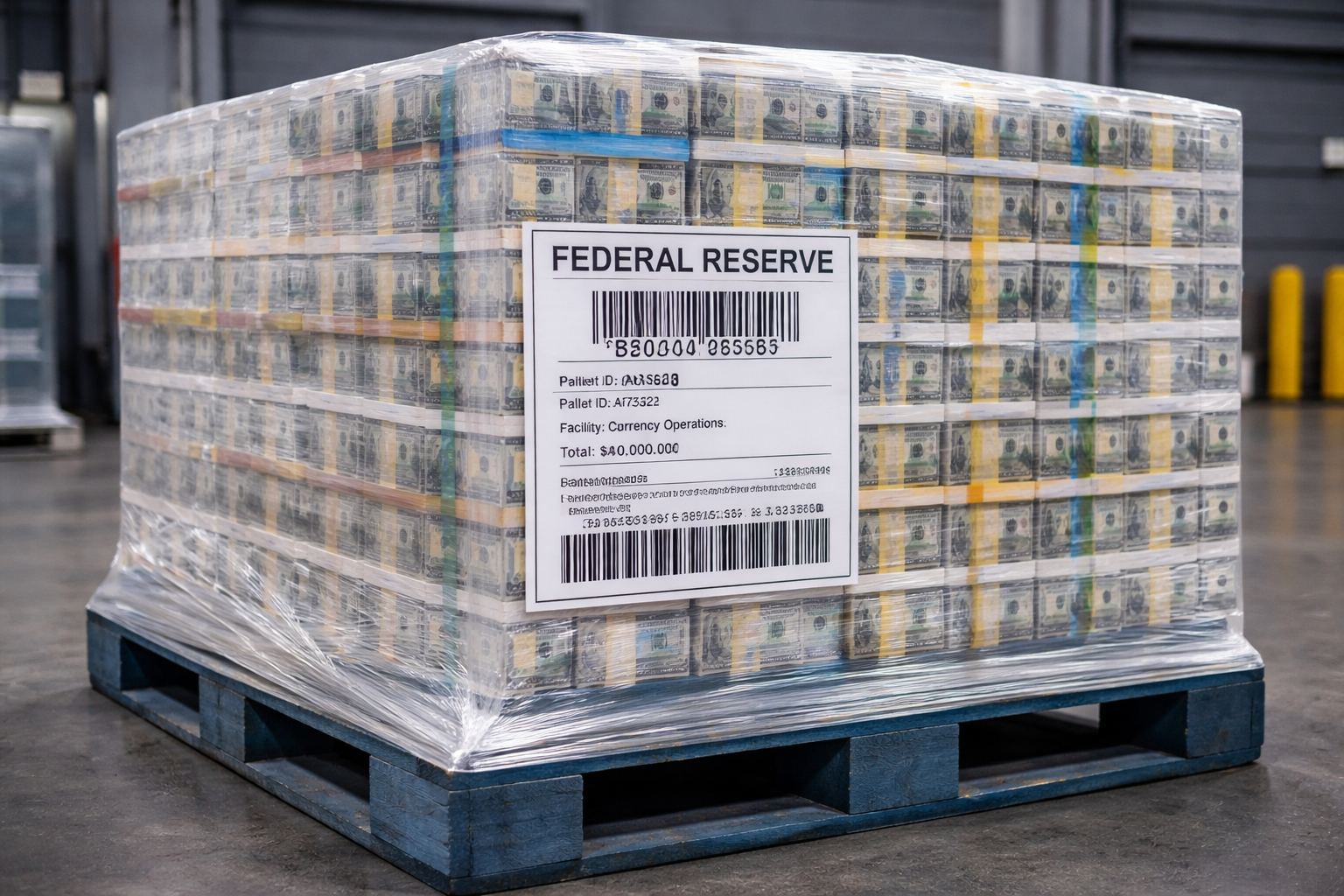
That is exactly what happened when Invest Offshore received a message from a USD Cash Pallet buyer claiming that a Federal Reserve-related process is now converging on Switzerland, that a two-month deadline has been imposed, and that pallet holders worldwide will need to come to Switzerland to make agreements face to face with the proper team.
Whether one accepts every detail of that message or not, the deeper point is impossible to ignore: in serious cash matters, the age of endless middlemen may be coming to an end.
The message itself was blunt. It stressed that pallets are typically barcoded, that only the true owner of a pallet or the primary authorized representative should be involved at the outset, and that barcode verification comes first. It also claimed that almost all of the intermediary layer is compromised by fraudsters, and that nothing meaningful will be discussed over the phone. Everything, according to the message, is to be handled at the table in Switzerland.
That tone matters.
Because in the real world of high-value financial settlement, the first thing that matters is not noise. It is control.
And control means documentation, chain of authority, physical verification, and decision-makers who can sit across from one another and close.
Now, let us separate the atmosphere of the message from the publicly documented mechanics.
Official Federal Reserve cash-service materials describe a system built around depository institutions, Fed accounts, settlement relationships, FedLine access, strict deposit standards, and detailed packaging and manifest procedures. Public Federal Reserve service guidance says FedCash Services are provided to institutions with the required account relationships, and Federal Reserve materials also state that currency is provided to depository institutions rather than directly to the general public.
The Fed’s own deposit guidance further shows that packaged currency is handled through formal operational standards, including straps, bundles, piece counts, authenticity checks, and manifest requirements. (Federal Reserve Financial Services)
In other words, the official system is institutional, procedural, and documentation-heavy.
That part actually fits the spirit of the message more than some people may realize.
The message’s emphasis on barcodes, authority documents, and primary representatives reflects the same underlying principle that governs legitimate large-scale financial operations everywhere: not everyone in the room matters. Only the party with standing matters.
That is where this becomes interesting.
Because the pallet world, assuming one moves within circles where such inventory is discussed, has long suffered from a fatal disease: too many “introducers,” too many “mandates,” too many voices, too many unverifiable stories, and too few actual principals.
One person says they know the owner.
Another says they represent the mandate.
A third says they can reach the clearing party.
A fourth says the buyer is ready.
By the time the chain reaches its tenth link, nobody can prove anything except that time has been wasted.
That is why the most important line in the message may not be the reference to Switzerland or even the mention of the Federal Reserve.
It may be this idea: only the owner or the primary authorized representative should be involved first.
That is not merely a preference. That is the dividing line between a real process and a theatrical one.
The Switzerland angle adds another layer of intrigue. The Swiss National Bank’s official public role is clear: it is Switzerland’s central bank, it issues Swiss banknotes, supplies cash to the Swiss economy, and operates under its own legal and institutional framework. Its public materials describe monetary authority, counterparties, legal guidelines, and central-bank functions in Switzerland. (SNB)
What those public materials do not show is any official announcement that Switzerland is taking custody of “all the pallets in the world,” nor did I find an official White House, Treasury, Federal Reserve, or SNB announcement supporting the specific claim of a Trump-issued two-month deadline tied to such a handover. The official sources I checked describe ordinary institutional cash and central-bank frameworks, not a global private pallet migration to Switzerland. (Federal Reserve Financial Services)
That does not make the message meaningless.
Far from it.
Sometimes a message matters because it is fully documented. Sometimes it matters because it shows what sophisticated players are beginning to demand, even before the public paperwork catches up.
And what this message reveals is a tightening of expectations.
Less talk.
Less telephone mythology.
Less chain-brokering.
Less room for fantasy.
More face-to-face meetings.
More proof of authority.
More verification.
More accountability.
Frankly, that is healthy.
If a holder truly controls a pallet, then a barcode check should not frighten them.
If a representative is truly authorized, then presenting the authorization order should not be a problem.
If a buyer is serious, then sitting at a table in Switzerland with principals should be the easiest part of the process.
The ones who panic are usually the ones who never had control in the first place.
That is why this message, even if one treats its geopolitical framing cautiously, captures a truth that the pallet business badly needs to hear: the intermediary carnival is over.
Or at least, it should be.
Serious money has a way of stripping away theatre. The bigger the transaction, the smaller the room becomes. Eventually it comes down to documents, authority, verification, and whether the people at the table can actually sign.
That is the real story here.
Not romance.
Not rumor.
Not the tenth forward in a WhatsApp chain.
But a return to the old rules of real finance: principal to principal, paper to paper, face to face.
And in a market polluted by noise, that may be the most believable part of the entire message.
If you want, I can also turn this into a more aggressive Gordon Gekko-style version or add a headline deck plus SEO subtitle options.
Leave a Reply