
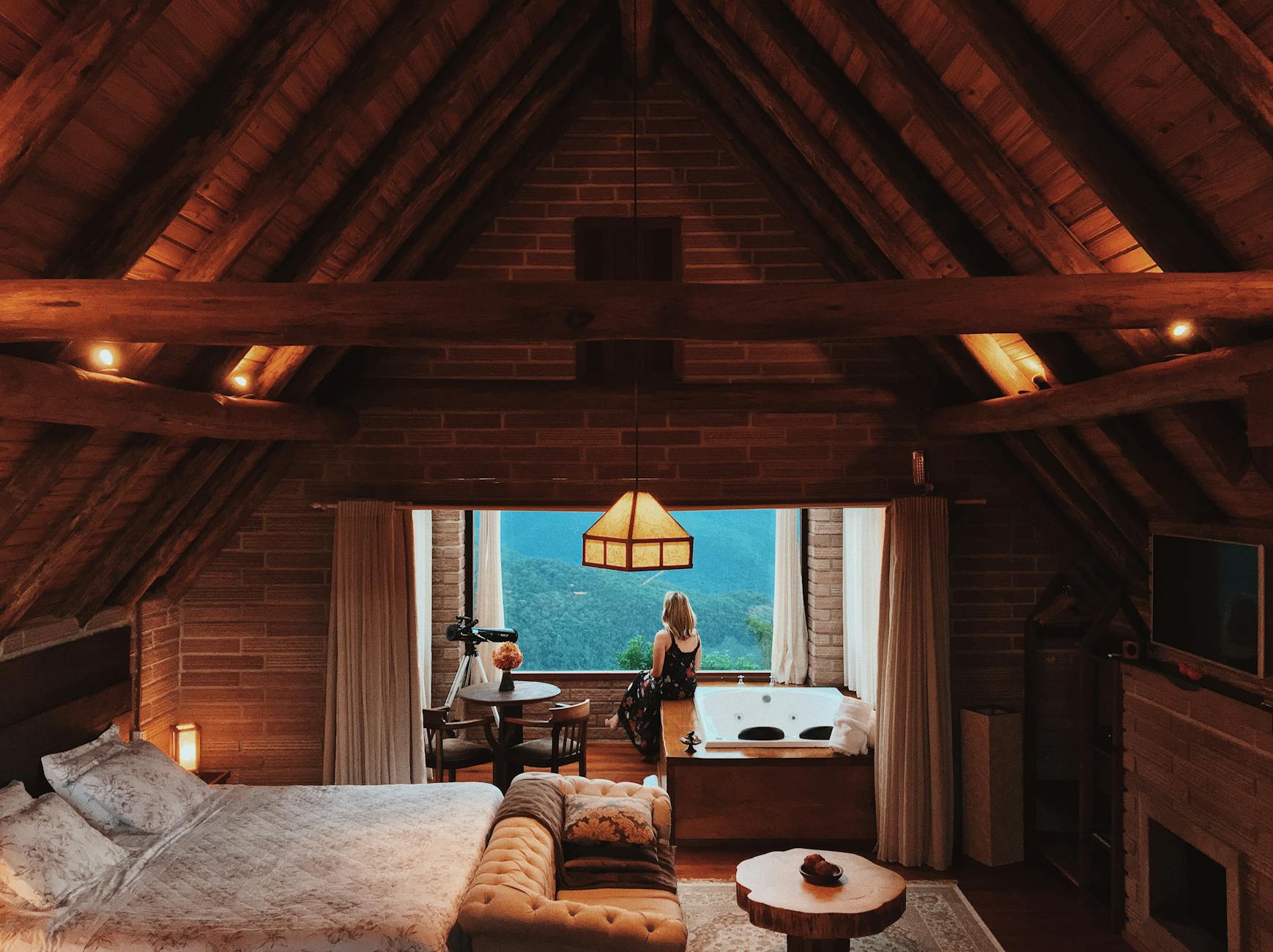
The Airbnb real estate model is not really about owning a house or condo. It is about owning a mini hospitality business wrapped inside a piece of real estate.
That distinction matters.
A traditional rental investor buys a property and collects fixed monthly rent. An Airbnb-style investor buys a property, furnishes it, markets it for short stays, and tries to maximize revenue through nightly pricing, occupancy, reviews, and seasonal demand. In simple terms, the goal is to turn one asset into a higher-yield, actively managed income stream rather than a passive long-term lease.
The math is straightforward: nightly rate x occupancy x bookable nights = gross revenue. From there, the investor subtracts cleaning, utilities, supplies, management, platform fees, maintenance, taxes, and debt service. What is left is the real number that matters: net cash flow.
That is why the Airbnb model attracts so much attention. If executed properly, it can outperform long-term rentals in the right market. But it can also underperform quickly if the city is overregulated, oversupplied, or too seasonal.
What separates a good Airbnb investment from a bad one is usually not the property itself. It is the city.
The best Airbnb cities tend to share a few traits: year-round tourism or business travel, strong event calendars, walkable neighborhoods, reliable air access, and local rules that still allow short-term rentals. In 2026, Airbnb says travel demand is being driven by short, high-energy city getaways, with Gen Z increasingly favoring 1–2 day international trips. Airbnb also says 65% of its top-searched 2026 travel dates and cities line up with major global events such as the Winter Olympics, Coachella, and the FIFA World Cup. (Airbnb Newsroom)
That tells investors something important: demand is clustering around cities that combine culture, events, and convenience.
Some of the cities Airbnb itself says are trending in 2026 include Buenos Aires, Busan, Marrakesh, Mexico City, San Juan, and Nakano (Tokyo) for fast, experience-rich urban escapes. These are exactly the kinds of markets where well-located short-term rentals can thrive because guests are not just booking a bed—they are buying access to food, nightlife, architecture, events, and local identity. (Airbnb Newsroom)
Mexico City stands out in particular because it checks many investor boxes at once: deep cultural demand, constant domestic and international travel, and major event tailwinds. Airbnb’s 2026 trend report lists Mexico City among its top fast-growth city getaways, and Airbnb’s own footnotes show it is also one of the FIFA World Cup host cities being tracked for 2026 demand. (Airbnb Newsroom)
Event-driven demand is becoming one of the most powerful pieces of the Airbnb model. Reuters reported in February 2026 that Airbnb is offering a $750 incentive to attract new hosts in the 16 North American World Cup cities, and that vacation rental prices on match days are up by as much as 50% year over year in some host markets, according to AirDNA. Reuters also said Airbnb expects hosts in the New York–New Jersey area, Boston, and Los Angeles to be among the biggest beneficiaries. (Reuters)
That is the short-term rental playbook in one paragraph: buy where demand spikes are predictable.
Outside the mega-event cycle, investors still gravitate to cities with proven short-term rental economics. AirDNA’s 2025 U.S. market comparison highlighted Nashville, Savannah, and Anaheim as standout Airbnb markets, underscoring that music tourism, historic leisure travel, and theme-park demand can all create strong revenue potential when paired with the right asset and management approach. (AirDNA)
But there is a catch—and it is a big one.
The Airbnb model is only as good as the local legal environment. A city can be profitable today and difficult tomorrow. Reuters reported that Spain has launched a broad crackdown on tourism rentals, that Barcelona’s court-backed plan is to stop renewing short-term rental tourism licences after 2028, and that Lisbon has debated measures that could affect roughly 20,000 holiday rentals. Reuters also noted that Budapest’s sixth district voted to ban short-term rentals starting in 2026. (Reuters)
So the real Airbnb investment model is not “buy a condo and list it online.” It is this:
Buy in a city with durable demand, legal clarity, and a reason for guests to keep coming back.
Then operate the property like a hotel, not like a passive rental.
That means professional photos, great design, fast communication, dynamic pricing, excellent cleaning standards, and a hard look at local rules before closing. The winning investor is not the one with the fanciest unit. It is the one who understands that short-term rental income is a business model first and a real estate play second.
For Invest Offshore readers, the lesson is simple: the Airbnb model can be highly profitable, but only when you treat location, licensing, and operations as seriously as the property itself. In this space, the best cities are not just really popular—they are predictable, compliant, and monetizable.
Leave a Reply