
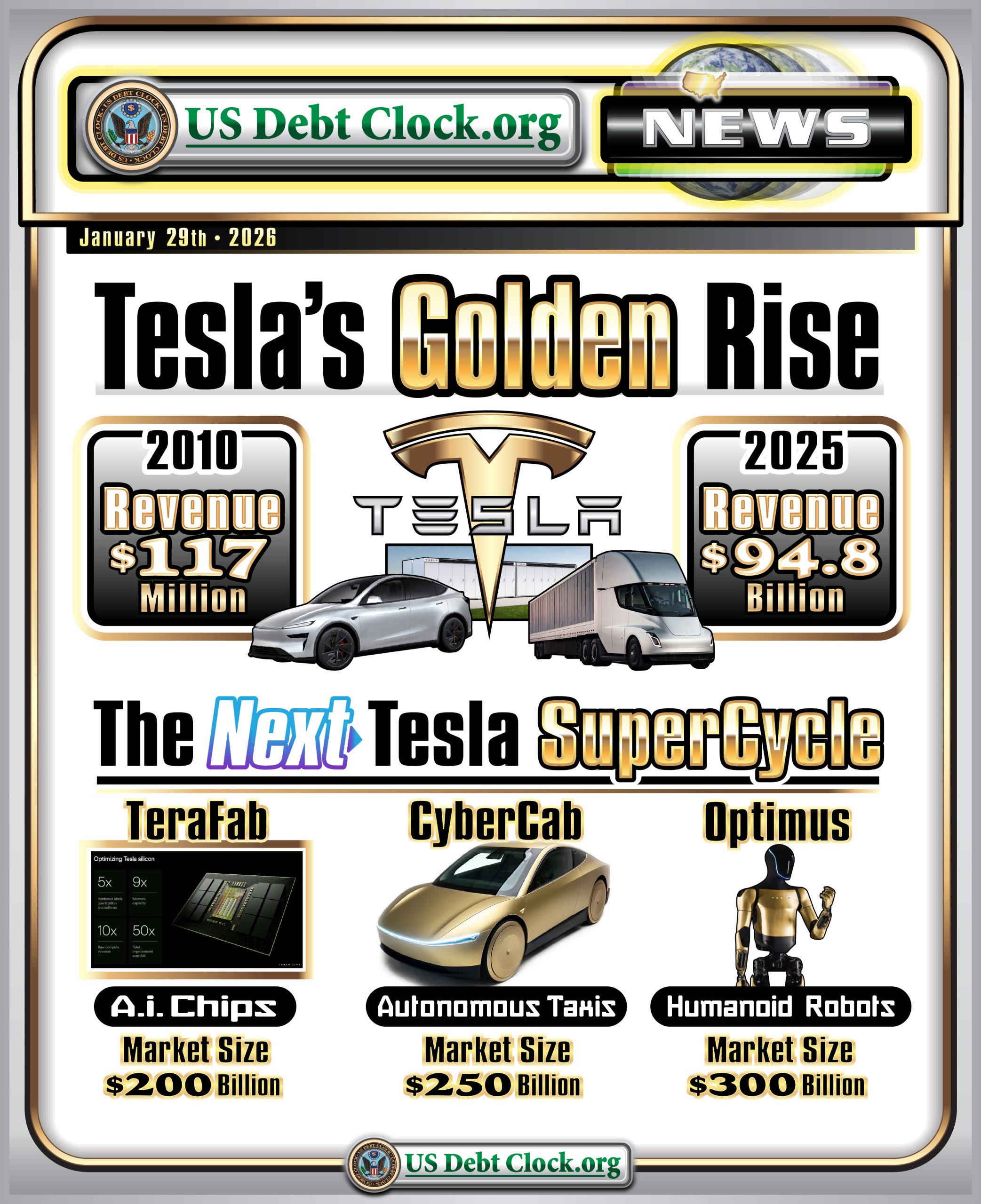
Today’s U.S. Debt Clock graphic is doing what it does best: compressing a decade-plus of disruption into one punchy visual.
At the center is Tesla’s revenue arc — from roughly $116.7M in 2010 to $94.8B in 2025 — a reminder that “impossible” often just means “early.” Tesla’s own 2010 results pegged full-year revenue at $116.7M. And Tesla’s 2025 revenue near $94.8B was widely reported following its latest results.
But the graphic isn’t celebrating the past. It’s selling the next act.
The three pillars: chips, autonomy, robots
The Debt Clock image frames Tesla’s next cycle as three new “companies inside the company,” each tied to a massive addressable market:
- “TeraFab” (AI chips): Tesla leaning deeper into the AI hardware stack, potentially including its own chip manufacturing capabilities to secure long-term supply and performance advantages.
- CyberCab / Robotaxi: Tesla continues to position autonomous transport as a core growth engine, with large-scale deployment of self-driving vehicles aimed at transforming urban mobility.
- Optimus (humanoid robotics): the “robot workforce” thesis — where Tesla evolves from being seen as a car company into a vertically integrated automation and robotics enterprise.
The numbers circulating on the graphic (AI chips $200B, autonomous taxi $250B, humanoid robots $300B) should be viewed as narrative-sized opportunity estimates, not precise forecasts. Still, the strategic direction is unmistakable: AI + autonomy + robotics define Tesla’s next decade.
A practical “Tesla Super Cycle” stock watchlist (by exposure)
Not investment advice. For thematic exposure only.
1) The core bet
- Tesla (TSLA) — the purest expression of the thesis, spanning vehicles, energy storage, autonomy, AI compute, and robotics.
2) AI compute & semiconductor leverage (the “TeraFab” orbit)
Companies that benefit if AI hardware spending accelerates:
- NVIDIA (NVDA) — AI accelerators and software ecosystem
- AMD (AMD) — datacenter GPUs and CPUs
- TSMC (TSM) — leading-edge semiconductor manufacturing
- ASML (ASML) — critical lithography equipment supplier
3) Autonomy stack and robotaxi adjacency
Firms tied to sensing, compute, and autonomous driving infrastructure:
- Mobileye (MBLY) — ADAS and autonomy systems
- Uber (UBER) — potential beneficiary as a global mobility marketplace if autonomous fleets scale
4) Industrial robotics & automation (the “Optimus halo” trade)
If humanoid robotics becomes commercially viable, the entire automation sector re-rates:
- ABB (ABB) — robotics and industrial automation
- Fanuc (FANUY) — factory robotics leader
- Rockwell Automation (ROK) — industrial control systems
5) Materials & electrification “picks and shovels”
Massive buildouts require raw materials:
- Albemarle (ALB) — lithium supply chain exposure
- Freeport-McMoRan (FCX) — copper exposure tied to electrification and datacenter expansion
The Invest Offshore angle: the real super cycle is physical
Behind every futuristic chart are very real requirements: power generation, copper, batteries, factories, logistics, and industrial capacity.
That is why Invest Offshore continues to focus on real-asset opportunities alongside technology trends. We currently have investment opportunities in West Africa seeking investors for the Copperbelt Region.
Leave a Reply