
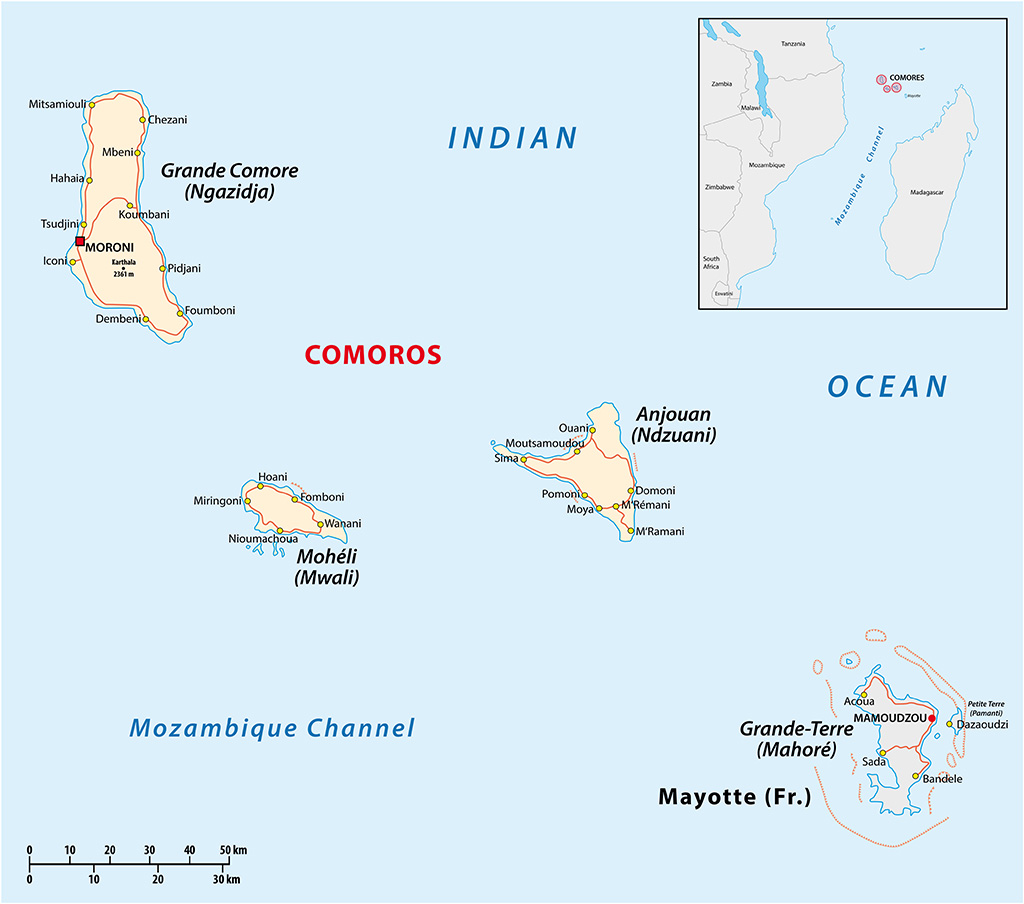
In the world of offshore finance, attention usually gravitates toward familiar jurisdictions such as Cayman, BVI, Panama, or Seychelles. Yet quietly sitting in the Indian Ocean, off the coast of East Africa, the Union of the Comoros (UoC) occasionally appears on radar screens as an “emerging” offshore jurisdiction.
Comoros is a small, three-island archipelago covering just 2,236 km², with a population of roughly 800,000 people. According to multilateral development institutions, the country became a lower middle-income economy in 2019, with estimated GDP per capita of USD 1,478. Its long-term development agenda is anchored in the Emerging Comoros Plan 2030 and the Accelerated Growth and Sustainable Development Strategy, which emphasize structural transformation and private-sector participation.
But does this translate into a viable offshore tax haven?
Let’s examine the good, the bad, and the ugly.
The Good
1. Low International Profile
Comoros remains relatively obscure in global offshore finance. For certain investors, this low profile can be appealing:
- Less saturation compared to legacy offshore hubs
- Fewer headline-grabbing scandals
- A perception (fair or not) of being “under the radar”
For niche structures or regional African trade activities, this anonymity can seem attractive.
2. Low Operating Costs
Compared to traditional offshore centers, Comoros offers:
- Lower company formation costs
- Low labor expenses
- Inexpensive real estate and office space
For entrepreneurs focused on cost minimization rather than prestige, this can be a tangible advantage.
3. Strategic Geographic Location
Comoros sits along important Indian Ocean trade routes between:
- East Africa
- The Middle East
- South Asia
This positioning can support:
- Regional trading companies
- Shipping-adjacent services
- Africa-focused holding structures
For investors with East African exposure, Comoros can appear geographically logical.
4. Development-Oriented Policy Framework
The country’s national strategies prioritize:
- Private-sector development
- Economic diversification
- Infrastructure and institutional strengthening
In theory, this suggests a long-term willingness to accommodate foreign capital.
The Bad
1. Weak Governance
Comoros has a long history of:
- Political instability
- Frequent leadership changes
- Institutional fragility
This directly affects:
- Contract enforcement
- Regulatory predictability
- Investor confidence
Offshore structures depend heavily on legal certainty, and Comoros scores poorly in this area.
2. Limited Financial Infrastructure
Unlike established offshore centers, Comoros lacks:
- Large international banks
- Sophisticated trust companies
- Deep professional services ecosystems
This means:
- Heavy reliance on foreign correspondent banks
- Difficulty opening and maintaining accounts
- Limited access to advanced financial products
In practice, many “Comoros companies” still need banking elsewhere.
3. Thin Regulatory Track Record
Top-tier offshore jurisdictions have decades of jurisprudence and regulatory refinement. Comoros does not.
Consequences include:
- Unclear interpretation of laws
- Inconsistent regulatory enforcement
- Higher compliance uncertainty
For serious asset-protection or institutional structures, this is a major drawback.
4. Perception Risk
Even when technically legal, companies registered in obscure jurisdictions can trigger:
- Enhanced due diligence
- Compliance red flags
- Reluctance from banks and counterparties
Reputation matters in offshore finance.
The Ugly
1. Political Unrest
Comoros has experienced repeated episodes of political turmoil, coups, and constitutional changes.
For offshore users, this introduces existential risks:
- Sudden regulatory shifts
- Asset freezes
- Retroactive policy changes
Stability is the foundation of offshore wealth planning—and Comoros struggles here.
2. High Corruption Risk
Weak institutions often correlate with:
- Bribery exposure
- Informal decision-making
- Unofficial “fees”
This environment undermines rule-of-law protections that offshore investors depend on.
3. Not a Recognized Global Offshore Hub
Comoros is not comparable to:
- Cayman Islands
- British Virgin Islands
- Bermuda
- Jersey
- Singapore
It lacks:
- Global brand recognition
- Legal sophistication
- Treaty networks
As a result, Comoros structures are rarely accepted as “best practice” in serious international planning.
4. False Economy
While initial setup costs may be cheap, downstream problems can be expensive:
- Failed bank account openings
- Re-domiciliation costs
- Rejected counterparties
- Legal restructurings
What looks inexpensive upfront can become costly over time.
Bottom Line
Comoros may appeal to speculative entrepreneurs seeking ultra-low-cost incorporation or niche regional exposure. However, it is not a serious offshore tax haven for high-value asset protection, institutional structuring, or long-term wealth planning.
For most investors, the risks of:
- Political instability
- Weak governance
- Banking limitations
- Reputation challenges
far outweigh the perceived benefits.
Established, well-regulated offshore jurisdictions with strong legal systems and deep financial infrastructure remain the gold standard.
Invest Offshore works with proven offshore banking centers and carefully structured international opportunities, including select investment projects in West Africa and the Copperbelt Region seeking qualified investors.
Leave a Reply